

There’s tired.
And then there’s the kind of exhaustion where you feel like you have absolutely nothing left to give.
That’s the closest I can come to describing what ADHD burnout feels like for me.
It’s not just needing more sleep.
It’s not having a busy week.
It’s feeling defeated.
Like you’ve spent so much time trying to keep up, remember everything, finish what you start, be on time, manage your emotions, stay organized, and generally function like everyone else seems to function that eventually something inside you just says:
I’m done.
Not “I need a break.”
Not “I’ll try again tomorrow.”
Just…
I don’t know what else to do.
What Does ADHD Burnout Feel Like?
For me, exhaustion isn’t even the best word for it.
Defeated is.
Things I know how to do suddenly feel overwhelming.
Small responsibilities start piling up. The more they pile up, the harder it becomes to start.
And then comes the guilt.
Because I know things need to get done.
I can see them.
I’m thinking about them.
I might spend the entire day worrying about everything I’m not doing.
But somehow, I’m still not doing it.
That combination of exhaustion, guilt, frustration, and constantly feeling like I’m falling behind is what eventually gets me.
Sometimes it feels like I’ve been trying for so long that I no longer believe trying harder is going to change anything.
That’s a very different kind of tired.
The ADHD Burnout Cycle I Keep Falling Into
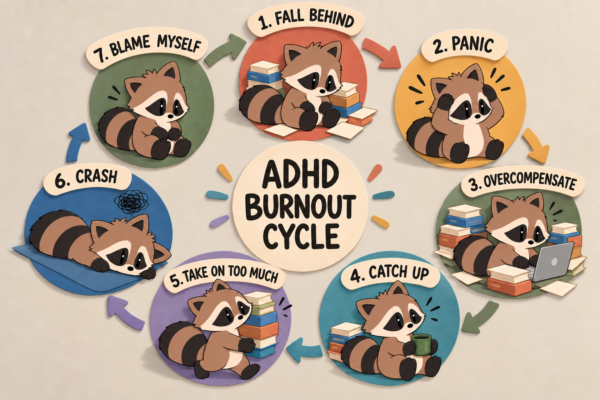
For me, burnout doesn’t usually appear out of nowhere.
There’s a pattern.
1. I fall behind.
Something isn’t getting done.
Maybe it’s one thing. Maybe it’s a bunch of little things that have slowly accumulated until I finally realize how much shit I’ve been avoiding.
2. I panic.
Now everything feels urgent.
I need to fix it.
Not eventually.
Right now.
3. I overcompensate.
I work harder.
Stay up later.
Make plans.
Create systems.
Promise myself that tomorrow is the day I’m finally going to get my shit together.
4. I catch up.
And sometimes?
It works.
Things start getting done again.
I feel productive.
I feel capable.
And instead of thinking:
Maybe I should enjoy having some breathing room.
I think:
Holy shit. Look at me. I can do everything.
5. I take on too much again.
More projects.
More responsibilities.
More expectations.
Because apparently the lesson I learned from barely surviving everything I was already doing was that I should do more.
6. I crash.
Now I’m exhausted.
I’m irritable.
Things I was managing a few weeks ago suddenly feel impossible.
7. I blame myself.
Why can’t I stay consistent?
Why do I always do this?
Why does everybody else seem capable of handling normal life?
Eventually, I start trying to catch up again.
And around we go.
Why Good Days Can Get Me Into Trouble
This is one of the stranger parts of the cycle for me.
Sometimes the beginning of my next crash happens when I’m actually doing well.
I have a good week.
I’m motivated.
Things are getting done.
Maybe my medication is helping.
So naturally, I decide this would be an excellent time to reorganize my entire life, start three projects, create a new workout routine, fix my finances, learn Spanish, and finally become the person I’ve apparently been waiting 42 years to become.
Two weeks later?
I don’t want to open my email.
The version of me making all those plans assumes this level of energy is going to last forever.
The version of me who eventually has to fulfill all those commitments would like a word.
And it isn’t only the stuff I voluntarily take on.
There’s work.
Parenting.
Money.
Appointments.
Relationships.
Cleaning.
Things I forgot.
Things I remembered at the last possible second.
Things I’ve been meaning to do for three weeks.
Messages I still need to answer.
Individually, none of it sounds impossible.
Stack enough of it together, though, and eventually I feel like I’m spending my entire life catching up with my own life.
ADHD Burnout vs. ADHD Paralysis
I’ve experienced both, and I don’t think they feel the same.
ADHD paralysis is more like:
I know what I need to do. Why the hell can’t I start doing it?
Burnout feels bigger.
I’m not stuck on one thing.
I’m tired of having to keep doing all of it.
The problem is that they can feed each other.
I’m exhausted, so starting things gets harder.
Things don’t get done, so they accumulate.
The pile gets bigger, so I become more overwhelmed.
Now I’m even more exhausted.
Beautiful system we’ve got here.
What Actually Helps Me When I’m Burned Out
My first instinct when I realize things have gotten bad is usually to fix my entire life.
Immediately.
New routine.
New calendar.
New diet.
New budget.
New workout plan.
New life.
By Tuesday.
It feels good in the moment because planning makes me feel like I’m doing something about the problem.
But now I’ve taken an exhausted person and given him another project.
I’m slowly learning that recovering from being overwhelmed probably shouldn’t begin by giving myself more things to accomplish.
Take Something Off the List
Sometimes I need to look at everything I’m carrying and ask:
What actually has to happen?
What can wait?
What am I doing because it genuinely matters?
And what am I doing because somewhere along the way I decided I should be doing it?
Sometimes something has to come off the list.
Not moved to tomorrow.
Not reorganized into a prettier productivity app.
Off the list.
Make the Task Smaller
I also have to make things embarrassingly small sometimes.
“Clean the house” isn’t a task.
That’s a project.
Put the dishes in the sink.
That’s a task.
“Catch up at work” isn’t a task.
Answer one email.
That’s a task.
When everything already feels like too much, making the first step smaller gives me somewhere to start.
Take Care of the Boring Basics
Then there are the answers nobody wants.
Sleep.
Food.
Water.
Movement.
Rest.
I would much rather discover some incredible ADHD hack that instantly fixes my life.
Unfortunately, my body continues insisting on being a body.
And sometimes I need to accept that not everything deserves my maximum effort.
Some emails can be three sentences.
Some meals can come from the freezer.
Some things can wait.
Some days don’t need to become success stories.
Don’t Spend the First Good Day All at Once
This one gets me.
I finally start feeling better and immediately think:
YES. I’M BACK.
Suddenly I’m trying to accomplish six weeks of neglected responsibilities before dinner.
Then I wonder why I’m exhausted again three days later.
I’m learning that feeling better doesn’t mean I have to immediately catch up on everything.
Maybe recovery isn’t just getting my energy back.
Maybe it’s learning not to immediately spend all of it.
When Burnout Starts Feeling Like Something Heavier
This is the part I don’t want to soften.
Sometimes exhaustion becomes something heavier.
You stop believing things are going to improve.
You look at everything you’re struggling with and think:
How long am I supposed to keep doing this?
That deserves to be taken seriously.
Adults with ADHD have an elevated risk of suicidal thoughts and behaviors, particularly when other mental health conditions are involved.
If you’re constantly exhausted, withdrawing from people, losing interest in things you normally enjoy, feeling worthless, thinking people would be better off without you, or thinking about death or suicide, don’t assume it’s something you just need to push through.
Tell someone.
A doctor.
A therapist.
Someone you trust.
If you’re in the United States and you’re in immediate danger or worried you might hurt yourself, call or text 988 or go to the nearest emergency department.
There are situations where another productivity system isn’t the answer.
Getting help is.
Frequently Asked Questions
What are the physical symptoms of ADHD burnout?
Burnout can feel physical too.
You might feel completely drained, have trouble sleeping, feel tense, get headaches, or just feel like your body has nothing left in the tank.
Physical symptoms can have a lot of causes, though.
If something is new, persistent, severe, or worrying you, I wouldn’t automatically blame it on ADHD burnout. That’s worth talking to a healthcare professional about.
How long does ADHD burnout last?
I wish there were a useful answer like:
Three business days.
There isn’t.
How long that exhaustion sticks around can depend on what’s happening in your life and whether the things draining you actually change.
That second part matters.
Taking a weekend off doesn’t necessarily fix much if Monday puts you straight back into the exact situation that burned you out.
Sometimes rest helps.
Sometimes something actually has to change.
Is ADHD burnout the same as depression?
I wouldn’t assume they’re the same thing.
But I also wouldn’t assume everything I’m feeling is “just burnout.”
There can be overlap.
Exhaustion.
Not wanting to do anything.
Withdrawing.
Struggling to concentrate.
Feeling like everyday life suddenly takes way more effort.
If that turns into persistent hopelessness, losing interest in things I normally enjoy, or struggling to function for an extended period, that’s where I’d rather talk to somebody than convince myself I already know what’s happening.
I Don’t Think I Need to Try Harder
The hardest part of burnout for me isn’t always being exhausted.
It’s reaching that point where the exhaustion starts feeling like evidence that I’m failing at life.
That’s when my instinct is usually to push harder, make another plan, and promise myself I’m going to fix everything.
I’m starting to realize that’s probably the exact moment I need to do the opposite.
I don’t need another speech about trying harder.
I’ve been trying.
Maybe something needs to come off the list.
Maybe I need rest.
Maybe I need help.
Maybe I need to admit that whatever I’m doing right now isn’t sustainable.
I’m still figuring out what that looks like.
But I’m getting better at recognizing when I’m carrying too much before I reach the point where I don’t want to carry any of it anymore.
If you know exactly what you need to do but somehow still can’t get yourself to begin, read my article about ADHD paralysis next.
Burnout and paralysis can overlap, but that “I know what I need to do, so why can’t I just do it?” feeling is its own frustrating experience.