

A few months ago, we got a new coworker.
Before she even started, another coworker who had worked with her before was already telling people what she was supposedly like.
She was horrible.
She’d throw you under the bus.
Don’t trust her.
So by the time she showed up, people already had an opinion of her.
Then she happened to sit near me.
And I got to know her.
If she isn’t one of the nicest human beings I’ve ever encountered, I don’t know what being a good person is.
Reliable. Hardworking. Trustworthy. Just a genuinely good person.
Meanwhile, the person who had been talking about her was someone I already knew had a habit of stretching the truth.
And by stretching the truth, I mean sometimes just blatantly making shit up.
Still, the damage had been done.
It wasn’t one huge incident. It was little things.
She hadn’t been trained properly. People treated her differently. She was struggling.
Eventually it got to the point where she was crying and her job was in jeopardy.
Another coworker and I basically reached the same conclusion:
Dude, we can’t let this happen.
So I went to our supervisor.
I told him I thought she’d been improperly trained because people had already made up their minds about her.
I helped train her.
I talked to other coworkers about what was happening.
I made it a point to help her get through her first 90 days.
Today?
She’s beloved.
She’s one of the best workers we have.
And this whole situation bothered the absolute shit out of me.
So What Is Justice Sensitivity?
Justice sensitivity is basically what it sounds like: people differ in how strongly they notice and react to things they perceive as unfair.
But there’s more to it than just getting pissed off when somebody cuts in line.
Researchers actually look at justice sensitivity from four different perspectives.
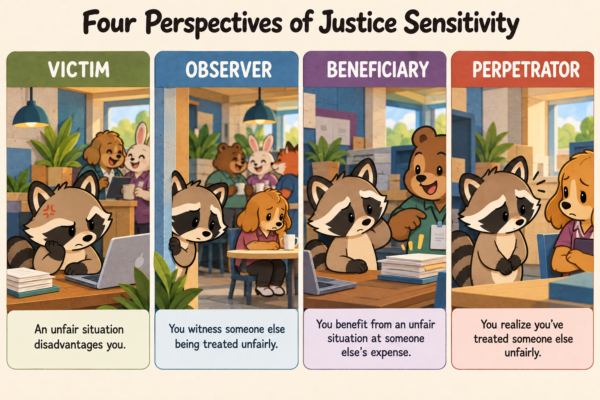
There’s injustice happening to you.
Injustice you’re watching happen to someone else.
Injustice where you benefit while someone else gets screwed.
And injustice where you’re the person who did something unfair.
That last one is interesting to me.
Because when I realize I’ve done something I shouldn’t have done, I feel horrible.
I need to rectify it.
I need to apologize.
I need to explain where I think I went wrong.
And if the person is still upset, I can keep explaining.
And explaining.
And probably overexplaining.
I need them to understand how genuinely ashamed and apologetic I am.
But the bigger question here is:
What does any of this actually have to do with ADHD?
That’s where things get a lot less simple.
Does ADHD Actually Make You More Sensitive to Injustice?
There is some research connecting ADHD and justice sensitivity.
There just isn’t nearly enough for me to comfortably say:
“People with ADHD have a stronger sense of justice.”
One pilot study comparing adults with ADHD to people without ADHD found higher sensitivity in the ADHD group when they observed injustice happening to others and when they benefited from an unfair situation.
There wasn’t a significant difference when participants were the ones who had committed the injustice.
Interestingly, participants with the inattentive subtype scored higher across all four perspectives in that study.
That sounds pretty convincing.
Until you keep researching.
Another study looked at more than 1,200 German adolescents between 10 and 19 years old.
Those with ADHD symptoms reported more sensitivity to being treated unfairly themselves and more perceptions of injustice.
But they actually reported less sensitivity to being the person who treated somebody else unfairly.
Different population.
Different pattern.
And we’re talking about a pretty small ADHD-specific research base to begin with.
So when I see justice sensitivity described as an ADHD trait, I think that’s stronger than what the evidence currently gives us.
There may be a connection.
There is something worth studying here.
But ADHD doesn’t automatically give somebody a finely tuned internal morality detector.
I certainly don’t have one.
My Moral Compass Apparently Has a Sneaker Exception
Our office has a rule:
No sneakers.
And this irritates me because I have an extensive sneaker collection sitting at home while I’m at work wearing uncomfortable black work shoes because…
Business casual.
Fine.
Rules are rules.
But then I’ll see somebody walking around the office blatantly wearing sneakers.
Nobody says anything.
And I’m thinking:
What the hell?
Why am I following this stupid rule if nobody cares when someone else breaks it?
Very principled of me.
Except I’ve worn sneakers to work before too.
And when nobody said anything?
Was I outraged that management had unfairly given me an exception?
Absolutely not.
I was basically:
Heh heh heh. Got away with it this time.
Everyone else can walk around in their lemon pepper steppers.
So no, I don’t think justice sensitivity means I walk around demanding perfect fairness regardless of whether the unfairness benefits me.
I’m still a person.
And apparently my commitment to equal enforcement weakens considerably when I’m wearing a nice pair of sneakers.
Sometimes I Can’t Just Pretend Everything Is Fine
There are situations where this gets much harder for me.
If I think someone has seriously mistreated somebody I care about, I have a hard time separating what I know about that person from how I’m expected to interact with them.
Other people can sometimes do that.
Family gathering.
Shake hands.
Laugh.
Be cordial.
Keep the peace.
I understand the logic.
I have a much harder time actually doing it.
If I know how you’ve been treating someone, smiling and shaking your hand can feel like I’m betraying what I believe.
And what really gets me is when everybody knows what’s happening.
We all know.
But now we’re standing around laughing and acting like everything is normal?
I can’t do it.
At least not very well.
That doesn’t necessarily mean my response is the smartest response.
Keeping the peace can sometimes be the more useful thing to do.
But knowing that intellectually doesn’t automatically make acting friendly feel right to me.
Feeling Like Something Is Wrong Doesn’t Mean I Need to Fix It
This is where my reaction to unfairness has gotten me into trouble.
Years ago, I found out that one friend was trying to get with another friend’s ex-wife.
I thought it was scummy.
I thought he was taking advantage of the situation.
And I called him out.
Problem was, in doing that, I exposed the person who had told me about it.
I couldn’t control myself with the knowledge I had.
Looking back, I should’ve shut my mouth.
It wasn’t my business.
And that’s an important distinction for me.
Believing something is wrong doesn’t automatically mean it’s mine to correct.
I’ve gotten invested in situations before to the point where I felt like I had to prove my judgment was right.
That can create its own damage.
And just because I see something a certain way doesn’t mean I’m right.
If I learn new information and realize I was wrong, I can admit I was wrong.
The problem is that sometimes I get involved before I have all that information.
My reaction to something feeling unfair isn’t evidence that I’ve correctly understood the situation.
I Find It Easier to Stand Up for Other People
This was probably the biggest thing I realized while thinking about all of this.
I’m better at standing up for somebody else than I am at standing up for myself.
Funny how that works.
When I was younger, unfairness bothered me too.
But I rarely spoke up.
I had very little self-esteem.
I spent years comparing myself to other people, getting negative feedback and trying to hide parts of myself.
I didn’t feel like the person who stood up and said:
This isn’t right.
Therapy helped.
Getting diagnosed with ADHD and understanding myself better helped.
There wasn’t some dramatic moment where I suddenly became outspoken.
It happened gradually.
Now, if I see somebody being treated in a way that reminds me of feelings I’ve had myself, it’s difficult for me to ignore.
I don’t want somebody else to feel the way I felt.
Or sometimes still feel.
That may explain part of my reaction to unfairness.
I don’t know that ADHD does.
Justice Sensitivity Isn’t the Same Thing as ADHD
Justice sensitivity is real.
The different perspectives researchers study are real.
And there is some evidence that people with ADHD may differ in certain forms of justice sensitivity.
But the research doesn’t give me a clean explanation for why I react to unfairness the way I do.
Some of my experience resembles what researchers call observer sensitivity.
Some resembles sensitivity to being the person who caused harm.
Some may have absolutely nothing to do with ADHD.
My history matters.
My personality matters.
The experiences I’ve had matter.
And sometimes I’m just annoyed that somebody else gets to wear sneakers.
I actually prefer that answer to pretending science has figured all of this out.
Because there’s a difference between saying:
“This concept helps me understand something about myself.”
and:
“My ADHD makes me do this.”
I’m getting much more careful about that difference.
I can tell you that unfairness has bothered me for as long as I can remember.
I can tell you that watching someone else get treated unfairly can bother me enough that I feel like I need to do something.
I can tell you that pretending everything is fine when I don’t think it is feels almost dishonest.
And I can tell you that I’ve learned the hard way that feeling strongly about what’s right doesn’t necessarily mean I’mright.
What I can’t tell you is that ADHD gave me some unusually powerful sense of justice.
The research isn’t there yet.
And considering the sneaker situation…
I’m probably not the guy who should be making that claim anyway.