
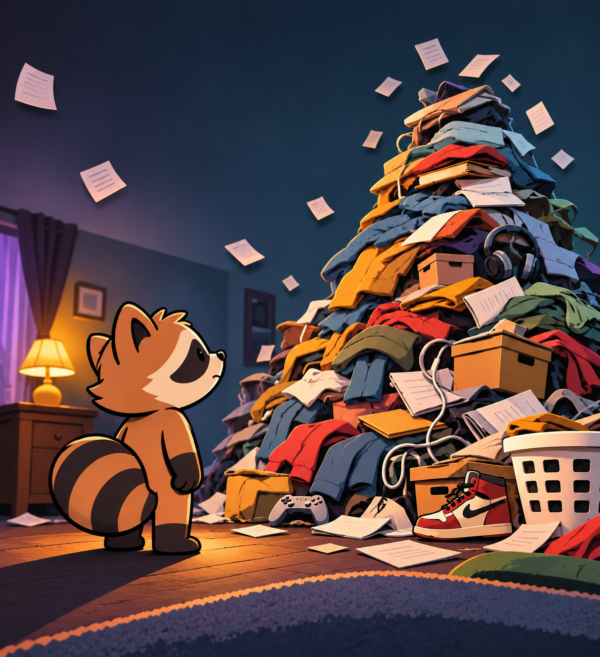
I have piles of random crap everywhere.
My bedroom. My desk. My car. My closet.
Sometimes they’re actual piles. Other times they’re bags or boxes filled with things I’ve been meaning to go through.
And every time I see one, I tell myself the same thing.
I’m gonna get to that soon.
Except I don’t.
The pile gets bigger.
Eventually, I look at everything I’ve accumulated and think:
Damn. That’s a lot.
Now cleaning feels like a huge project.
So I tell myself I’ll deal with it later.
Then one day, I’ve had enough.
THAT’S IT.
I start throwing things away, moving stuff around, and convincing myself that certain things are worth keeping.
The room looks better.
I can finally breathe.
Problem solved, right?
Not exactly.
Because somewhere else, another pile has already started forming.
And apparently, I’m running a franchise.
What Are ADHD Doom Piles?
DOOM stands for “Didn’t Organize, Only Moved.”
At least, that’s the popular explanation you’ll see in ADHD communities.
A doom pile is a collection of belongings that keeps accumulating because you haven’t sorted everything or figured out where it belongs.
Think about the clothes sitting on a chair, random paperwork covering your desk, or a bag of miscellaneous items you shoved into a closet because you didn’t know what else to do with them.
Sometimes you move everything into a box to make the room look cleaner.
Congratulations.
You now have a doom box.
Same problem. Different packaging.
Doom piles aren’t an official ADHD symptom. They’re an informal name for an experience that can be connected to ADHD-related difficulties with organization, planning, attention, and starting tasks.
And here’s the part I find most frustrating.
I know the piles are there. I want them gone. But somehow, I keep putting off dealing with them.
Why Does ADHD Make Cleaning Feel So Overwhelming?
I notice the mess.
Trust me.
I’ll walk into my bedroom, see a pile of stuff, and think:
Okay. I really need to get started on that.
But then I look at how much stuff has accumulated.
And suddenly, cleaning doesn’t look like one task anymore.
It looks like a hundred little tasks.
I have to figure out what everything is.
Decide what to keep.
Decide what to throw away.
Find somewhere to put the things I’m keeping.
And probably discover another pile while I’m doing all of that.
So instead of starting, I tell myself I’ll get to it later.
The ridiculous thing is that I know what’s going to happen.
That pile isn’t going to organize itself.
It’s going to keep growing.
And somehow, knowing that still isn’t enough to make me start.
Cleaning Requires More Than Picking Things Up
One possible explanation involves executive functioning.
That’s the name for the mental skills we use to plan, organize, remember information, manage attention, and get things done.
Think about cleaning a desk.
Sounds simple, right?
Except cleaning the desk might involve sorting paperwork, deciding what matters, finding places for belongings, resisting distractions, and remembering to finish what you started.
That’s a lot of decisions for something that sounds as simple as clean your desk.
Research supports the connection between ADHD and difficulties with executive functions, including planning, organization, working memory, and attention.
A comprehensive review published in World Psychiatry summarizes evidence from multiple studies showing these difficulties in adults with ADHD.
Read the scientific review of adult ADHD
That doesn’t mean everyone with ADHD struggles with clutter.
And it doesn’t mean every messy room is caused by executive dysfunction.
But it helps explain why organizing a space can require more mental effort than people realize.
For me, the hardest part often happens before I’ve picked up a single thing.
I look at the pile.
I think about everything involved in cleaning it.
And I decide I’ll deal with it later.
Why I Suddenly Clean Everything When I’ve Had Enough
Here’s another thing about me.
I can look at the same pile for weeks and keep putting it off.
Then suddenly, something changes.
I reach a point where I’m completely fed up.
THAT’S IT. I’M CLEANING THIS SHIT.
And I go at it head-on.
Things start getting thrown away.
I start moving stuff.
I’m making decisions.
I’m finally doing the thing I’ve been telling myself I needed to do.
Why couldn’t I do this two weeks ago?
Excellent question.
I’d love to know.
ADHD can make it difficult to start and follow through on tasks, especially when they involve several steps and aren’t particularly interesting or rewarding.
Urgency can sometimes change that.
A pile might bother me for weeks without feeling urgent enough to tackle.
Eventually, the frustration becomes intense enough that I stop postponing it.
Now cleaning feels important.
Not someday.
Right now.
And suddenly, I’m doing it.
But there’s a problem with waiting until I’ve completely had enough.
I usually have to let the mess get pretty bad before I finally do something about it.
And even when I clean, I don’t necessarily organize everything.
Sometimes I just relocate the evidence.
Didn’t Organize, Only Moved. Literally.
Let’s say I have a pile of stuff on my desk.
I finally get tired of looking at it.
So I start cleaning.
Some things go in the trash.
Some things get put away.
But then I find something I don’t know what to do with.
Maybe I haven’t used it in months.
I probably won’t use it anytime soon.
But what if I need it later?
So I keep it.
Then I find something else.
Same problem.
Eventually, I move those things somewhere else.
Maybe into a bag.
Maybe into a box.
Maybe into the closet.
And now my desk looks fantastic.
Except I haven’t actually dealt with everything.
I’ve just moved part of the pile.
Didn’t Organize, Only Moved.
Whoever came up with that acronym deserves some credit.
Because that’s exactly what happens.
Why Is Throwing Things Away So Difficult?
This part genuinely frustrates me.
I’ll pick something up and think:
I haven’t used this thing in months.
Then immediately:
Yeah, but what if I need it?
Bro.
JUST THROW IT AWAY.
I know I probably won’t use it.
I know keeping it means finding somewhere to store it.
But I don’t want to regret getting rid of it.
So I keep it.
And I don’t even fully understand why.
Every item comes with another decision.
Keep it?
Throw it away?
Donate it?
Put it somewhere else?
What if I regret getting rid of it?
And when I don’t want to make that decision, postponing it becomes the easiest option.
The item goes back into the pile.
Or into a box.
Or somewhere else where I can deal with it later.
The problem is that later doesn’t come with an actual appointment.
It’s just some imaginary future moment when I’ll apparently become incredibly organized.
I’m still waiting to meet that guy.
Of course, difficulty throwing things away isn’t unique to ADHD.
People keep belongings for all kinds of reasons, including sentimental value, uncertainty, financial concerns, and fear of needing something later.
ADHD-related difficulties with organization and decision-making may make the process harder, but they don’t explain every reason someone keeps something.
And having doom piles doesn’t automatically mean someone has hoarding disorder.
Hoarding disorder involves persistent difficulty discarding possessions and clutter that can significantly interfere with the use of living spaces.
That’s a different issue from having a collection of unsorted belongings sitting on your desk.
My Doom Piles Have Actually Cost Me Money
I’m not just talking about losing a charging cable and buying another one.
I’ve managed to do something considerably more expensive.
I once found a vial of retatrutide buried in one of my doom piles.
It was supposed to be refrigerated.
By the time I found it, I couldn’t use it anymore.
That’s a decent amount of money straight into the trash.
And yes, I’m aware of the legal and ethical conversations surrounding retatrutide. I don’t need a lecture about it. I’m trying to get beach-body ready by 2027. We’re getting there one way or another.
Anyway.
I had something valuable that needed to be stored properly.
And somehow, it ended up in a pile of random crap.
That’s what bothers me.
The clutter isn’t always just an eyesore.
Sometimes there are actual consequences.
Money wasted.
Things lost.
Items damaged.
Time spent searching for something that should’ve been easy to find.
I’ve written about these kinds of consequences in ADHD Tax: What It Is, Real-Life Examples, and How to Reduce It.
The retatrutide incident was definitely an ADHD-tax moment for me.
An expensive reminder that putting something somewhere temporarily can become a permanent problem.
The Worst Part Is How the Clutter Makes Me Feel
I hate how my space looks when it’s cluttered.
It makes me feel like a hobo.
A preschooler hobo, apparently.
Because I’m a grown man looking at a pile of random stuff, wondering why I can’t just throw things away or put them where they belong.
It sounds so simple.
And that’s what makes it frustrating.
I know what a clean room looks like.
I know how to throw something in the trash.
I know how to put something in a drawer.
So why the hell do I keep doing this?
It’s not like I’m enjoying the clutter.
I don’t look at a pile of random crap and think:
Beautiful. Exactly the atmosphere I was going for.
I want my space clean.
But wanting that and consistently maintaining it are apparently two different skills.
Even Playing Video Games Comes With Guilt
This is where the clutter starts interfering with something I actually enjoy.
Gaming.
When my space is clean, I can sit down, play a game, and relax.
It feels good.
I can breathe.
But when there’s clutter everywhere?
The guilt is sitting right there with me.
I’m playing a game, and somewhere in the back of my mind:
You’re sitting here gaming while all that crap is still there.
CLEAN UP YOUR SHIT.
So now I’m doing something I enjoy while feeling guilty about something I’m not doing.
And the annoying part is that cleaning would probably make the gaming experience better.
I know that.
I’ve experienced it.
But knowing how good I’ll feel afterward doesn’t always make it easier to get started.
That’s the contradiction.
The clutter makes it harder to relax.
But I still put off dealing with it.
And I end up feeling guilty either way.
Why Doom Piles Keep Coming Back After You Clean
Here’s what usually happens after I finally clean.
The space stays clean.
For a while, everything looks good.
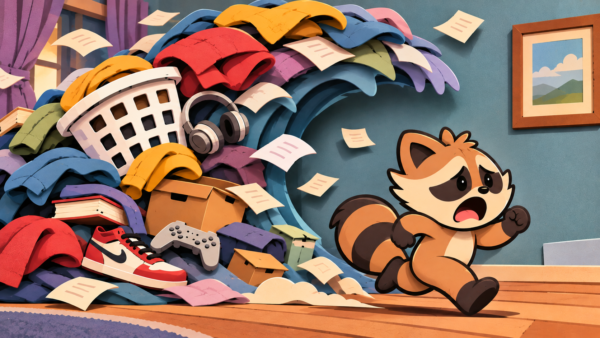
Then another pile starts forming somewhere else.
But this one is small.
So I think:
Eh. No biggie.
It’s just a few things.
I’ll deal with them later.
Then I add something else.
And something else.
Eventually, the pile gets bigger.
And somehow, it ends up moving toward the same place where the original pile used to be.
We’ve come full circle.
And I think this is the most important part of the entire problem.
I can clean a pile without changing what caused it to form.
If I don’t know where something belongs, I might set it down temporarily.
If I don’t want to decide whether to keep something, I might leave it for later.
If the pile is small enough, it doesn’t feel urgent.
And every one of those little decisions makes the next pile possible.
The cleaning spree gets rid of the mess.
But it doesn’t necessarily prevent the next one.
So instead of asking only:
How do I clean this pile?
I probably need to start asking:
Why does this stuff keep ending up here?
How to Get Rid of ADHD Doom Piles Without Creating Another One
I haven’t completely solved this problem.
Clearly.
But the research and organizing guidance point toward something useful.
Make organizing easier to start, easier to finish, and easier to maintain.
That means addressing the decisions that create the pile, not just finding somewhere else to put everything.
These are strategies worth trying, not things I’m claiming to have mastered.
1. Start With One Small Area
When I look at a huge pile, I get discouraged before I even start.
So instead of trying to clean an entire room, choose something smaller.
One corner of the desk.
One bag.
Ten items.
Even five.
The goal is to make the job small enough that starting doesn’t feel like committing your entire afternoon.
CHADD, an organization that provides education and support for people with ADHD, recommends breaking organizing projects into manageable sections and using short work sessions.
Read CHADD’s guide to organizing your home and office.
And here’s an important distinction.
You don’t have to finish the entire room.
But try to finish dealing with the items you chose.
Otherwise, you’ve just created a smaller pile.
2. Give Things an Actual Place to Go
This might be the biggest difference between cleaning and organizing.
Cleaning gets things off the desk.
Organizing determines where those things belong.
If I pick something up and don’t know where to put it, I’m much more likely to set it somewhere temporarily.
And temporary has a funny way of becoming permanent.
So before moving an item, ask:
Where is this actually going to live?
Not where can I hide it.
Not which box has room.
Where does it belong?
If you use something regularly, make its storage spot convenient.
For example, if you always drop your keys on the dresser, maybe that’s where the key tray belongs.
Not in some imaginary perfect location that you’ll never actually use.
The system should fit what you already do.
3. Make the Keep-or-Toss Decision Easier
This is the one I need to work on.
Because I can talk myself into keeping something I know I probably won’t use.
One way to reduce that back-and-forth is to ask a few questions before deciding.
- Have I used this recently?
- Is there a realistic reason I’ll need it?
- Would replacing it be expensive or difficult?
- Am I keeping it because it’s useful, or because I don’t want to regret throwing it away?
- If I keep it, where will I store it?
These questions won’t make every decision easy.
Some things are worth keeping even if you rarely use them.
Important documents.
Emergency supplies.
Seasonal belongings.
Sentimental items.
But that random object you’ve kept for three years because you might need it someday?
Maybe it’s time to reconsider.
And if you genuinely can’t decide, CHADD suggests using a clearly labeled box for uncertain items and setting a future date to review them.
That last part matters.
Because without a review date, congratulations.
You’ve invented another doom box.
4. Deal With Small Piles Before They Become Big Ones
This is probably the part that would make the biggest difference for me.
Because I know how the cycle starts.
A few things accumulate.
I look at them.
No biggie.
Then they keep accumulating.
So instead of waiting for another “THAT’S IT!” moment, try checking the places where piles usually form.
Your desk.
The dresser.
That one chair that apparently exists solely to hold clothes.
Your car.
You don’t necessarily need an hour.
Try five or ten minutes.
Pick up the things that have accumulated and make a decision about each one.
Put it away.
Throw it away.
Or identify what needs to happen next.
CHADD recommends regular, brief pickup sessions to help maintain organized spaces.
The point isn’t to spend your entire life cleaning.
It’s to stop every little pile from becoming a weekend project.
5. Make Your Organizing System Easy to Restart
You might clean everything.
Create a great organizing system.
Keep your room looking fantastic for two weeks.
Then get busy.
Or tired.
Or distracted.
And another pile appears.
That doesn’t necessarily mean the system was useless.
But it does mean you need a way to restart before the mess gets out of hand.
Maybe that’s a ten-minute cleanup.
Maybe it’s clearing one surface.
Maybe it’s dealing with the five things you left on your desk.
The system shouldn’t require another massive cleaning spree every time you fall behind.
Because if the only way I can maintain a clean room is by getting furious enough to attack everything, I’m probably going to keep repeating the same cycle.
A Simple ADHD Doom Pile Check
If you have a pile that’s been sitting there for weeks, try asking:
What’s actually in this pile?
Is it paperwork, clothing, electronics, random objects, or a mixture of everything?
Why haven’t I dealt with it?
Is the pile overwhelming? Do I not know where things belong? Am I avoiding decisions about what to keep?
What can I finish in ten minutes?
Not move.
Finish.
Which items already have a place?
Put those away first.
What am I keeping only because I might need it someday?
Be realistic about whether that day is ever coming.
What keeps causing this pile to form?
Is it inconvenient storage? A lack of space? A habit of setting things down temporarily?
The goal isn’t just to clear the pile.
It’s to understand why it keeps coming back.
Frequently Asked Questions
Are doom piles a sign of ADHD?
They can be associated with ADHD, but having doom piles doesn’t mean someone has ADHD.
Anyone can accumulate clutter.
ADHD becomes relevant when the clutter is part of a broader pattern involving attention, organization, forgetfulness, difficulty starting tasks, or trouble following through.
Doom piles alone aren’t enough to diagnose ADHD.
If you want to understand the broader difficulty of knowing what needs to be done but struggling to start, read my article on Executive Dysfunction and ADHD.
What does DOOM stand for in ADHD doom piles?
DOOM is commonly explained as Didn’t Organize, Only Moved.
It’s an informal term for belongings that get shifted into piles, bags, or boxes instead of being fully sorted and put away.
What’s the difference between a doom pile and a doom box?
A doom pile is a collection of unsorted belongings, often sitting on a desk, chair, or other surface.
A doom box is essentially the same collection moved into a container.
A box can be useful for temporary sorting, but it doesn’t automatically solve the underlying problem.
Why do people with ADHD create doom piles?
ADHD can affect planning, organization, attention, task initiation, and follow-through.
Those difficulties may make it easier to postpone sorting belongings or move them somewhere temporary instead of finishing the organizing process.
However, doom piles aren’t unique to ADHD.
Are doom piles the same as hoarding?
No.
Doom piles are an informal description of clutter.
Hoarding disorder involves persistent difficulty discarding possessions, significant distress, and clutter that can interfere with the normal use of living spaces.
Having doom piles doesn’t automatically mean someone has hoarding disorder.
Why do my doom piles keep coming back after I clean?
Because clearing a pile doesn’t necessarily change what caused it.
If items still don’t have convenient storage places, decisions keep getting postponed, or small piles are ignored, clutter can accumulate again.
How do I get rid of ADHD doom piles?
Start with a small section rather than the entire mess.
Sort items, make decisions about what to keep, give belongings specific storage places, and avoid moving undecided items into another permanent pile.
Brief, regular cleanup sessions may also help prevent new piles from becoming overwhelming.
Final Thoughts: I Just Want to Enjoy My Games Without Feeling Guilty
I know how much better I feel when my space is clean.
I can breathe.
I can sit down, turn on a game, and enjoy myself without staring at a pile of stuff I should’ve dealt with weeks ago.
That’s what I want.
Not some perfectly organized house where every drawer looks like a Pinterest photo.
I just want to stop feeling like I’m surrounded by unfinished chores.
And I want to stop looking at random things I’ve kept for months, wondering why I can’t bring myself to throw them away.
The part I’m starting to understand is that cleaning the pile and preventing the pile are two different problems.
I can get angry enough to clean everything.
I’ve proven that.
But if I keep postponing the same little decisions, another pile is going to appear.
And eventually I’ll be right back where I started.
Looking at a mountain of random crap.
Telling myself I’ll get to it soon.
So maybe the next time I see a small pile forming, that’s the moment to deal with it.
Not when it’s taken over the room.
Not when I’m furious.
And definitely not after I’ve lost something expensive in it.
Because I’d really like to sit down, play my games, and not have that little voice in my head yelling:
CLEAN UP YOUR SHIT.