
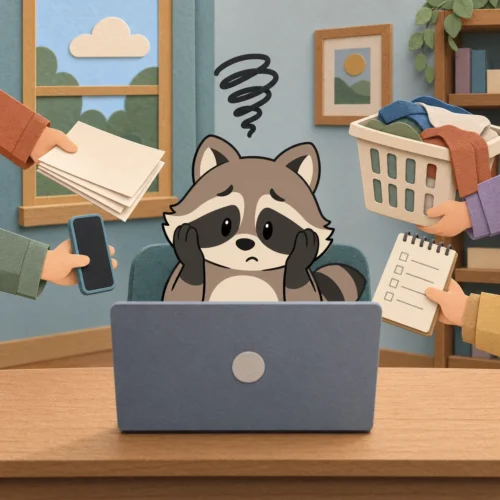
If I’m working on something and my fiancée asks me to do something, I usually want to help.
The problem is that I’m already doing something.
And I can’t always just stop.
If I’m writing, working on the website, or doing something else that has my full attention, I usually need to get to what I’ve started calling a checkpoint.
Not necessarily finish the whole thing.
Just get somewhere I can safely stop.
Maybe I finish the paragraph.
Maybe I get the idea out of my head.
Maybe I finish whatever little piece I’m working on so that when I come back, I know where I was.
And if I’m close enough to actually finishing?
I’ll probably just finish.
Because if I stop at the wrong time, I can lose the momentum completely.
Sometimes I can come back, figure out where I was and eventually get going again.
Sometimes I already know before I even get up.
Yeah. This is probably done.
I’ll close the laptop.
The problem is that while I’m trying to reach that checkpoint…
my fiancée is waiting.
Eventually I hear:
“Never mind. I’ll just do it myself.”
I wasn’t trying to ignore her.
I was trying to find somewhere to stop.
What Is ADHD Task Switching?
Task switching is basically what it sounds like.
You’re doing one thing, and now you need to stop doing that and start doing something else.
I’m writing an article.
Now I need to help my fiancée.
I’m working.
Now it’s time to go home.
I’m on the computer.
Now I need to shower.
I’m doing something around the house.
Now it’s time to go to the gym.
What I’ve realized is that I tend to think about task switching from the wrong end.
I think about the thing I need to do next.
But before I can start the next thing, I have to stop the thing I’m doing now.
And sometimes that’s the harder part.
I Need a Checkpoint

“Checkpoint” isn’t a clinical ADHD term.
It’s just the best word I’ve found for what I’m looking for.
If somebody interrupts me in the middle of something, I don’t necessarily need to completely finish before I can leave.
I need to get to a place where stopping feels possible.
Somewhere I can come back to.
It’s almost like saving a game before turning it off.
I don’t want to stop while something important is still happening.
Except what I’m trying to save isn’t a game.
It’s whatever is happening in my head.
The idea.
The next step.
The sentence I was about to write.
The thing I was about to fix.
Whatever little mental map I’ve built while I’m working.
And apparently I don’t only do this when somebody interrupts me.
I do it when I know a transition is coming.
I noticed myself doing it at work.
I had about an hour left before I was supposed to leave, and I was already looking for my checkpoint.
Not because I wanted to leave early.
Because I wanted to leave on time.
I know what happens if quitting time gets here and I’m still in the middle of something.
There’s a good chance I’m not leaving.
I’ll keep going until I reach a checkpoint.
And if I’m close enough to finishing?
I’ll finish.
Checkpoint or finish. Whichever comes first.
Apparently I can start preparing to stop an hour before I actually need to stop.
Why Can Switching Tasks Be Hard With ADHD?
This is where I wanted to know whether what I experience actually has anything to do with ADHD.
And the research is more nuanced than:
People with ADHD are bad at switching tasks.
Researchers study things like set shifting and cognitive flexibility—our ability to adjust what we’re doing when circumstances, goals or rules change.
Studies of adults with ADHD have found differences in some measures of shifting.
But those differences don’t show up exactly the same way in every study.
In some research, adults with ADHD had more difficulty when switching also required shifting what they were paying attention to.
Other research suggests that how much time someone has to prepare for a switch can matter.
So I don’t think the evidence gives me permission to say:
My ADHD makes it impossible for me to switch tasks.
It obviously doesn’t.
But ADHD is associated with differences in executive functioning, and executive functions are involved in things like shifting attention, holding information in mind, planning and keeping ourselves moving toward a goal.
Working memory may matter here too.
We’ve already talked about how working memory helps keep information temporarily available while we’re using it—and research has repeatedly found working-memory differences between groups of adults with and without ADHD.
Pasted markdown.md
That still doesn’t prove that my need for a checkpoint is some specific ADHD mechanism.
Checkpoint is my word.
It’s how I describe what the transition feels like to me.
I Don’t Want to Lose the Momentum
This is probably the biggest part of it for me.
When I’m really working on something, there’s a whole train of thought happening that nobody else can see.
I know what I’m doing.
I know what comes next.
I’ve got ideas.
I’m moving.
Then:
“Hey, can you come help me with this?”
I can.
But I need a minute.
Because I know what can happen when I come back.
I reread what I wrote.
I stare at the screen.
I try to remember what I was about to do.
I try to get myself back into whatever headspace I was in before I left.
Sometimes I find it again.
Sometimes I don’t.
And that’s why “just stop and come back to it” doesn’t always feel as simple as it sounds.
The laptop will still be there.
The article will still be there.
Everything I was working on will still be exactly where I left it.
The momentum might not be.
“Give Me a Minute” Can Turn Into Twenty
Of course, there’s another person involved in this.
And she doesn’t live inside my head.
My fiancée asks me to do something.
I say I’ll do it.
In my head, I’ve agreed.
I’m just trying to reach my checkpoint first.
But from her perspective…
I’m still sitting there.
Five minutes pass.
Then ten.
Maybe more.
Eventually:
“Never mind. I’ll do it myself.”
Now she’s irritated.
I’m irritated because I really was going to do it.
But we’re responding to two different experiences.
Mine is:
I’m trying to get somewhere I can stop.
Hers is:
I asked you to do something and you’re still doing the same thing.
And understanding why switching can be difficult doesn’t automatically make that fair to her.
If I say “give me a minute” and twenty minutes pass, my intention doesn’t change the fact that she was waiting.
Understanding the problem still leaves me responsible for figuring out how to handle it better.
Sometimes the Checkpoint Is Just Finishing
The checkpoint isn’t always somewhere in the middle.
Sometimes I’m close enough to finishing what I’m doing that stopping at a checkpoint doesn’t make much sense.
So I finish.
That applies whether somebody needs me or whether the next thing is something I need to do for myself.
Eat.
Shower.
Go to the gym.
Leave work.
Whatever comes next still has to wait until I can leave what I’m doing.
So the decision is usually something like:
Can I get to a good stopping point?
Or:
Am I close enough that I should just finish?
The problem is that my estimate isn’t always great.
A checkpoint I thought was five minutes away might take fifteen.
“Almost finished” might turn out to have another twenty minutes hiding inside it.
And now whatever I was supposed to do next gets pushed back.
Not because I decided it wasn’t important.
I still haven’t left the first thing.
My Daughter Has to Wait Too
Even when my daughter needs me, that need for a checkpoint doesn’t disappear.
If I’m in the middle of something and she wants my attention, I still have to hold her off long enough to get somewhere I can stop.
Give Daddy a second.
Hold on.
Let me finish this.
I’m still trying to reach that checkpoint.
Or, if I’m close enough, finish.
Then I can leave what I’m doing and give her my attention.
And I think that tells me something important about how this feels.
The importance of the next thing doesn’t necessarily remove the difficulty of leaving the current thing.
Obviously my daughter is more important than whatever I’m doing on my laptop.
That doesn’t mean my brain instantly drops everything it was holding.
I still have to disengage.
What Actually Helps Me Switch?
I’m still figuring this out.
But I think I’ve been asking the wrong question.
I’ve been thinking:
How do I make myself stop?
Maybe a better question is:
How do I make it easier to come back?
If I’m writing and have to leave, I can put down the thought I was about to work on next.
If I’m halfway through something, I can leave myself a note about where I stopped.
If there’s something important floating around in my head, I can get it somewhere outside my head before I leave.
That’s something I’ve already found useful with working memory: when I’m interrupted, leaving myself a clue about where I was means I don’t have to rely entirely on keeping that information active until I return.
Pasted markdown.md
And I probably need to get better at defining what a checkpoint actually is.
Because there’s a big difference between:
Give me two minutes to finish this paragraph.
and:
Let me finish.
“Finish this paragraph” has an ending.
“Let me finish” could apparently mean sometime before bed.
Maybe I Don’t Need to Finish. I Need Somewhere to Stop.
I think that’s the biggest thing I’ve realized from paying attention to this.
I tend to treat stopping and finishing like they’re the same thing.
They’re not.
Sometimes I’m close enough that finishing makes sense.
But a lot of the time, I don’t actually need to finish.
I need somewhere I can leave it.
A checkpoint.
Something that tells me:
You were here.
This is what you were doing.
This is what comes next.
Because for me, task switching isn’t always about getting myself to start the next thing.
Sometimes the hard part is leaving the first one without feeling like I’m going to lose my place.