
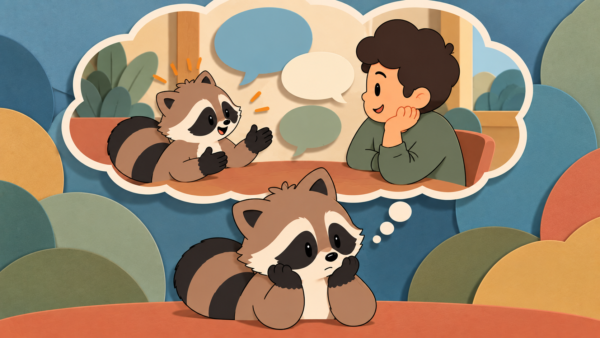
I can have an entire conversation with someone before I’ve actually had the conversation with them.
Job interview coming up?
I’m already thinking about what they’re going to ask me, what I’m going to say, how they’re going to respond, and how the whole thing might go.
Argument I know is coming?
Oh, I’ve already had it.
Both sides.
I know what I’m going to say. I’ve predicted what they’re probably going to say. I’ve responded to that. They’ve responded to my response.
Meanwhile, the actual person is somewhere living their life completely unaware that we’ve already argued twice in my head.
And I don’t really decide to do this.
It just happens.
Something comes up during the day and suddenly I’m rehearsing a conversation that hasn’t happened yet.
For me, I think a lot of it comes down to one thing:
I want to be understood.
I’m Trying to Find the Right Words Before I Need Them
When I rehearse a conversation, I’m not necessarily trying to memorize some perfect speech.
I’m trying to figure out how to explain what I mean.
If I say it this way, maybe they’ll understand.
But what if they respond with this?
Okay, then I’ll say this.
But maybe they’ll take that the wrong way, so maybe I should explain this part first.
Before I know it, I’ve built an entire conversation.
And I think rehearsing it gives me a sense of control.
Not control over the other person.
Control over my part of the conversation.
If I’ve already thought through what I want to say, maybe I won’t forget something important. Maybe I won’t explain it badly. Maybe I won’t walk away wishing I’d said something differently.
Maybe they’ll actually understand what I’m trying to tell them.
That was especially important to me because once the real conversation started, I couldn’t always depend on my brain to give me the exact words I wanted when I wanted them.
Then They Say Something That Wasn’t in the Script
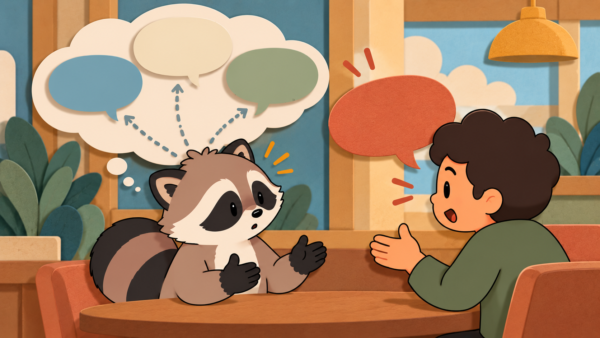
There was one small problem with my system.
The other person had the audacity to not follow the script I wrote for them.
I could predict ten different ways a conversation might go, and somehow they’d find number eleven.
And I used to get frustrated when that happened.
Internally, it felt like:
I wasn’t prepared for this.
Now I have to respond in real time instead of using the conversation I’ve already practiced in my head.
That’s the funny part about rehearsing conversations.
It can make me feel more prepared.
But sometimes I’m not preparing for the conversation.
I’m preparing for my version of the conversation.
Those aren’t always the same thing.
“If Only I Would’ve Said This…”
And apparently one imaginary conversation beforehand wasn’t enough.
Because I used to replay conversations afterward too.
I’d think about what I said.
What they said.
What I should’ve said.
What I could’ve explained differently.
Then, of course, my brain would finally produce the perfect response.
Twenty minutes later.
Alone.
With absolutely no pressure.
Perfect timing, brain.
A lot of those replays came back to the same thing as the rehearsing beforehand:
I wanted the other person to understand me.
So if a conversation didn’t go the way I wanted, I’d think:
If only I would’ve said this instead.
Maybe then they would’ve understood what I meant.
Which meant I could have the conversation before it happened, actually have the conversation, and then have the director’s-cut version afterward.
Apparently one conversation wasn’t enough.
So… Is Rehearsing Conversations an ADHD Thing?
I wanted to know this too, because I’ve done it for years.
Rehearsing conversations isn’t an official ADHD symptom by itself. But some of the things that can come with ADHD can make it pretty easy to understand why someone with ADHD might do it.
Sometimes it’s hard for me to organize exactly what I want to say while I’m saying it.
Sometimes my thoughts are moving faster than my mouth.
Sometimes I know exactly what I mean but can’t find the right way to explain it until later.
And sometimes my brain just keeps going over something long after the actual moment has ended.
So for me, rehearsing gives my brain another chance to organize the conversation before I’m standing in the middle of it.
That’s really all I need the explanation to be.
My brain is trying to prepare.
Sometimes it just prepares a little too much.
Sometimes the Conversation Isn’t Even Going to Happen
Then there’s another version of this that has absolutely nothing to do with preparing for a difficult conversation.
Sometimes I’m basically making a movie.
I can imagine myself getting my dream car and already know who I’m talking to about it.
Where we are.
What they’re saying.
What I’m saying.
How they see me.
I can imagine ADHDefined becoming successful.
People seeing what I built and thinking highly of me.
And these aren’t always quick little thoughts.
There can be scenes.
Specific people.
Specific conversations.
Specific reactions.
Sometimes my brain apparently just has a very generous production budget.
I used to wonder whether imagining those things was somehow tricking my brain into feeling like I’d already accomplished them.
There is some research suggesting that spending too much time fantasizing about the finished result can sometimes make people less likely to put effort toward it.
But the internet version I’ve seen, “your brain gets the dopamine from imagining success, so now it doesn’t need to actually do it” is way too simple.
For me, the more useful question is:
Am I imagining something I want, or am I only imagining it instead of doing something toward it?
Because I don’t think there’s anything wrong with imagining ADHDefined becoming successful.
I just also need to write the damn article.
ADHD Medication Didn’t Stop Me From Rehearsing Conversations
I still rehearse conversations.
Medication didn’t suddenly make my brain stop doing that.
What changed for me was what happened when the real conversation didn’t follow the imaginary one.
I became calmer when something unexpected happened.
I got more comfortable expressing how I actually felt instead of needing everything to come out exactly the way I’d planned it.
And one of the biggest changes happened afterward.
I started getting better at accepting:
The conversation already happened.
I can’t go back and change it.
I can think of seventeen better responses tonight, but none of them are going to travel backward in time and enter the conversation.
I did the best I could to explain what I meant.
The other person still might not understand me.
And I can’t completely control that.
I think for a long time I believed there was always some perfect combination of words that could make another person understand exactly what I meant. And if they didn’t understand? Maybe I just hadn’t found those words yet.
I’m starting to realize that’s not always true.
Sometimes I can explain myself clearly and someone still won’t see it the way I do.
That doesn’t necessarily mean I explained it wrong.
The Conversation in My Head Isn’t the Conversation
I don’t think rehearsing conversations is automatically a bad thing.
Sometimes it helps me figure out what I actually want to say.
If I’m going into an interview, an uncomfortable conversation, or something important, thinking through it beforehand can genuinely help.
The problem is when I start believing I can prepare for every possible version of what might happen.
I can’t.
Because there’s another person involved.
And unfortunately, they haven’t read the script.
So now I try to use the conversation in my head for what it’s actually good for:
Figuring out what I want to say.
Not predicting everything they’re going to say.
Not finding the one magical sentence guaranteed to make them understand me.
Not replaying the conversation for three hours afterward trying to rewrite something that’s already over.
I still rehearse conversations in my head.
I probably always will.
But I’m getting better at recognizing the difference between preparing myself for a conversation and trying to control a conversation that hasn’t even happened yet.
And when it’s over?
Sometimes the conversation is just over.
I’m getting better at letting it stay that way.