
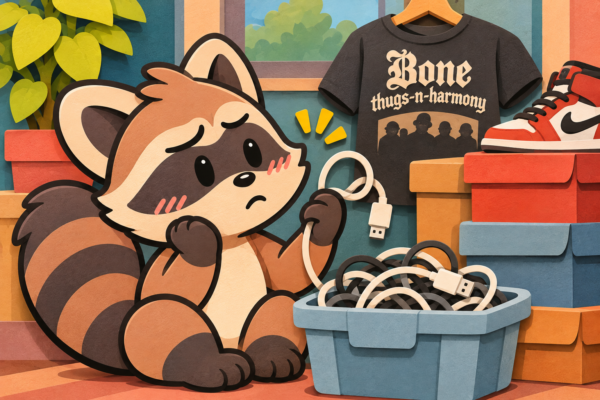
I probably have enough charging cables to open my own electronics store.
Phone chargers. Tablet chargers. Laptop chargers. You name it.
And every time I come across one while cleaning, I think the same thing.
Well, it still works.
What if I need it someday?
So I keep it.
Then I keep another one.
And another.
Eventually, I’m surrounded by things I don’t use, wondering why I have so much crap.
That’s what got me thinking about ADHD and hoarding.
Why do I keep things I don’t need, even when I’m tired of having so much stuff?
Research has found a connection between ADHD and hoarding behaviors, particularly difficulties involving attention and organization.
But there’s more to it than simply having a messy room.
Sometimes it’s about keeping things just in case. Sometimes it’s about not wanting to part with something. And sometimes the clutter builds up faster than you can manage it.
Why Do I Keep Things Just in Case?
For me, one of the biggest reasons is that throwing away something that still works feels wasteful.
Take those charging cables.
I might not need every single one of them, but they’re perfectly good cables.
Why would I throw them away?
What if I need one later?
So I hang on to them.
The funny thing is that when I finally get frustrated enough to throw things away, I don’t even think about them afterward.
I don’t sit around regretting the cables I got rid of.
They’re gone.
And that’s that.
Apparently, making the decision to throw something away is harder than actually living without it.
That’s something I’ve noticed about myself.
And it raises an interesting question.
Why can getting rid of something feel like such a big decision when keeping it requires almost no thought?
Why Can ADHD Make Throwing Things Away Difficult?
Think about what happens when you’re cleaning.
You pick something up.
Do I need this?
Does it still work?
What if I need it later?
Should I donate it?
Where am I supposed to put it?
Now multiply those questions by everything sitting in your closet, drawers, or storage bins.
Suddenly, cleaning isn’t just cleaning.
It’s making dozens of decisions about things you may not have thought about in years.
And ADHD can make those decisions harder to manage.
ADHD affects more than attention. It can also interfere with planning, organizing, prioritizing, and following through.
These abilities are sometimes called executive functions.
They’re the mental skills that help you turn an intention into action.
If you’ve ever known exactly what you needed to do but struggled to actually do it, you might recognize that problem.
I talk more about that in my article on ADHD and executive dysfunction.
What does the research say?
A 2022 study published in the Journal of Psychiatric Research examined hoarding symptoms in adults attending an ADHD clinic.
Researchers found clinically significant hoarding symptoms in approximately 20% of the ADHD group, compared with 2% of the comparison group.
They also found that inattention was particularly associated with hoarding severity.
That’s a meaningful connection.
Researchers found that adults with ADHD reported more hoarding symptoms, particularly when they also struggled with inattention.
That helps explain why managing possessions can be difficult for some people with ADHD.
The Bone Thugs-N-Harmony Shirt That Refuses to Leave
Here’s another example.
I have a Bone Thugs-N-Harmony T-shirt.
That thing shrunk.
It doesn’t fit me anymore.
And every time I come across it while cleaning, I think:
That thing needs to go.
But guess what?
It never goes.
It doesn’t even make it into the donation pile.
I couldn’t tell you exactly why I keep it.
I just don’t want to get rid of it.
And it’s not the only piece of clothing I’ve done that with.
Sometimes I’ll keep clothes because I think I might fit into them again someday.
Other times, I simply don’t want to get rid of them.
Even when I know they’re taking up space.
That’s what makes this frustrating.
I can recognize that something needs to go and still end up keeping it.
Sometimes It’s Not About Needing Something
I also collect sneakers.
I have at least 90 pairs.
Some I wear regularly. Some I barely wear.
And certain pairs remind me of particular periods of my life.
It’s not that I’m trying to preserve those memories or that I’m afraid of forgetting them.
The shoes just remind me of that time.
That’s all.
And I think there’s an important distinction here.
Not everything we keep is something we need.
Sometimes we keep things because we enjoy them.
Sometimes they remind us of something.
Sometimes we think they might be useful later.
And sometimes, like my Bone Thugs shirt, we don’t have a particularly good explanation.
Research into hoarding behaviors has identified several reasons people may struggle to discard possessions, including perceived usefulness and emotional attachment.
The International OCD Foundation explains how a perceived need to save possessions and distress about discarding them are central features of hoarding disorder.
But enjoying a collection isn’t automatically a problem.
I collect sneakers because I like sneakers.
The issue becomes more complicated when keeping possessions starts interfering with your everyday life.
And for me, that’s where the clutter gets frustrating.
Why Does the Clutter Keep Coming Back?
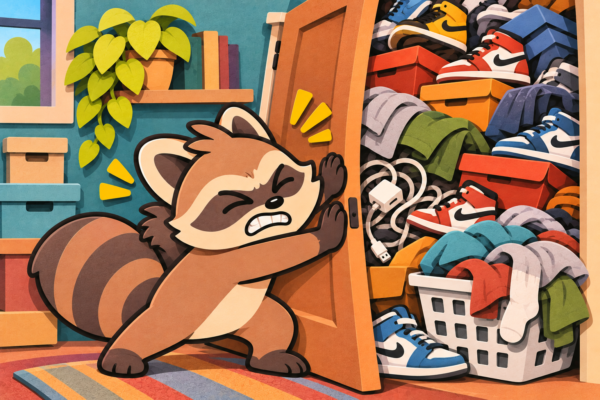
Here’s what really gets on my nerves.
I’ll clean.
I’ll organize things.
I’ll get rid of stuff.
And eventually?
The clutter comes right back.
It’s like I’m cleaning the same things over and over again.
And after a while, I get irritated.
Damn, how many times have I cleaned this already?
Sometimes that frustration pushes me into an intense cleaning session.
I’m fed up.
I want everything cleaned.
And suddenly, I’m ready to throw away things I previously convinced myself I needed.
Other times, I start cleaning, realize how much needs to be done, and get overwhelmed.
Both happen.
And regardless of how thoroughly I clean, the clutter eventually builds back up.
That’s probably the most exhausting part.
It’s not that I never clean.
It’s that cleaning doesn’t seem to solve the problem for very long.
Cleaning and staying organized aren’t the same thing
Cleaning gets rid of the immediate mess.
Staying organized means repeatedly putting things away, deciding what to keep, and preventing unnecessary items from accumulating.
That’s a different challenge.
You can spend hours cleaning a room and still struggle to maintain it afterward.
Especially when the habits that created the clutter haven’t changed.
That’s why telling someone with ADHD to clean more often might completely miss the point.
They might already be cleaning.
The problem is what happens between cleaning sessions.
And sometimes, even getting started can feel overwhelming.
If that sounds familiar, I’ve also written about ADHD paralysis and why knowing something needs to get done doesn’t always make it easier to start.
Is ADHD Hoarding the Same as Hoarding Disorder?
Not exactly.
Hoarding disorder involves persistent difficulty discarding possessions, often accompanied by a strong perceived need to save them or distress about getting rid of them.
Over time, possessions can accumulate to the point that living spaces become difficult to use.
ADHD-related clutter can involve overlapping difficulties, including disorganization, postponed decisions, and trouble maintaining routines.
And some people experience both ADHD and hoarding disorder.
But having ADHD and keeping too many things doesn’t automatically mean someone has hoarding disorder.
The distinction matters because the reasons behind the clutter can be different.
Someone might have a closet full of old clothes because they keep postponing the task of sorting through them.
Someone else might find the thought of discarding those clothes extremely distressing.
Those situations may require different approaches.
The important thing is understanding what’s making it difficult to manage your possessions.
How Can You Stop Accumulating So Much Stuff?
Understanding why clutter accumulates is useful.
But it doesn’t make the charging cables disappear.
So what can you actually do?
Here are four strategies worth trying.
1. Set limits before you start sorting
Imagine going through 40 charging cables and debating whether you might eventually need each one.
That’s exhausting.
Instead, decide how many extras you reasonably need before you start.
For example:
I’m keeping three extra charging cables that work with devices I actually own.
Now you’re not asking whether every cable might someday be useful.
You’re choosing which ones are worth keeping.
The number isn’t important. It should reflect what you actually use.
The point is to make fewer decisions.
2. Give your belongings a designated space
If you have a drawer for charging cables, let that drawer be the limit.
Once it’s full, something has to go before something else comes in.
You can apply the same idea to clothing, paperwork, and miscellaneous household items.
This doesn’t mean forcing yourself to get rid of things you genuinely value.
It means deciding how much space you’re willing to dedicate to them.
And making sure the things you keep have somewhere to go.
3. Don’t treat every possession the same way
An old charging cable and a shirt you don’t want to part with aren’t necessarily the same problem.
One might be something you’re keeping because it could be useful.
The other might have personal meaning.
So it makes sense to approach them differently.
For sentimental belongings, consider keeping a designated memory box or storage area.
For everyday items, focus on whether you use them and how many you realistically need.
You don’t have to get rid of every meaningful possession to reduce clutter.
4. Make maintaining the space easier
A massive cleaning session might make everything look great.
But what happens afterward?
If the same items keep piling up, pay attention to where they’re accumulating.
Do they have a designated place?
Is that place inconvenient?
Are you keeping duplicates?
Are you bringing in more things than you have room for?
Sometimes a small environmental change can make a difference.
A container near the place where you normally leave something might be more useful than an elaborate organizational system you never maintain.
And instead of waiting until the entire room needs attention, try tackling one small area at a time.
The goal isn’t to create a perfect room.
It’s to make the space easier to maintain.
These are strategies to experiment with, not things I’ve personally mastered.
I’m still dealing with clutter that seems determined to come back.
Does ADHD Cause Hoarding?
ADHD is associated with increased hoarding symptoms, but research hasn’t established that ADHD directly causes hoarding disorder.
Difficulties with attention, organization, and decision-making may contribute to accumulating possessions.
For some people, emotional attachment or beliefs about needing items in the future also play a role.
And for others, the problem may be less about wanting to keep everything and more about struggling to sort through what they already own.
If difficulty discarding possessions is causing serious distress or making living spaces difficult to use, professional help may be appropriate.
Cognitive behavioral therapy for hoarding disorder can help people work on decision-making, organizing, and gradually discarding possessions.
I Just Want to Stop Cleaning the Same Crap
I don’t necessarily want to get rid of everything I own.
I like my sneakers.
I have things I want to keep.
And apparently, that Bone Thugs shirt isn’t going anywhere anytime soon.
But I’m tired of cleaning the same mess repeatedly.
That’s the frustrating part.
I don’t want to keep throwing everything away out of frustration, only to end up dealing with the same clutter again.
I’d rather figure out how to stop it from building up in the first place.
Because at some point, I’d like to clean something and have it actually stay clean.