
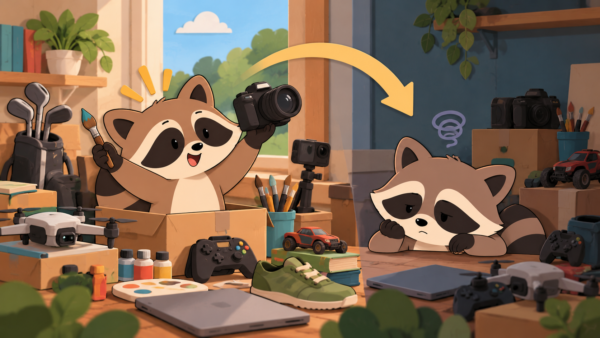
Some people with ADHD get really excited about new hobbies because everything feels fresh and interesting. There’s so much to learn, and that excitement can make it easier to stay focused. But once the hobby becomes familiar and starts requiring more practice, keeping that same interest can become harder.
At least, that’s how it often works for me.
I can go from knowing absolutely nothing about a hobby to spending hours researching it, watching videos, comparing equipment, buying what I need, and genuinely imagining myself doing it for years.
Then sometimes, almost overnight, the pull disappears.
I don’t necessarily hate the hobby.
I don’t even consciously decide to quit.
I just stop wanting to do it.
People sometimes call this hyperfixation.
Clinically speaking, there’s no official diagnosis called Buys 4 Pairs of Golf Shoes and Quits by Tuesday.
But if you’ve ever looked around your house and wondered why you own cameras, golf clubs, podcast microphones, painting supplies, computer parts, and enough charging cables to open your own electronics store…
Yeah.
I know the feeling.
Why Do People With ADHD Have So Many Hobbies?
Not everyone with ADHD constantly changes hobbies.
And plenty of people without ADHD do it, too.
But there are a few reasons some people with ADHD might recognize this pattern.
ADHD can affect how we manage attention, motivation, and impulses.
That doesn’t mean we can’t focus.
Sometimes we can focus intensely on something we find interesting while struggling to stay engaged with something less exciting.
A new hobby can provide several things at once:
- Something interesting to discover.
- New skills to learn.
- Quick progress in the beginning.
- Challenges that keep us engaged.
- The excitement of imagining what we could accomplish.
And when something feels exciting, getting started can seem almost effortless.
The problem?
Eventually, the hobby changes.
The beginner discoveries slow down.
Practicing replaces researching.
Progress takes longer.
And suddenly, something that felt incredibly exciting starts requiring patience and repetition.
For some people with ADHD, that’s where maintaining interest becomes difficult.
But there’s an important distinction.
Losing interest in hobbies isn’t an official ADHD symptom, and it doesn’t automatically mean someone has ADHD.
Sometimes people simply discover that they don’t enjoy something as much as they expected.
Sometimes their priorities change.
And sometimes ADHD-related difficulties with attention, motivation, or follow-through may contribute.
For me, understanding that difference helped explain a pattern I’d been repeating for years.
My Desk Told a Story Before I Ever Knew I Had ADHD
Do you need an iPhone charging cable?
I have about 82 of them.
Android cable?
Got that too.
Need some obscure cable that connects a drone from 2008 to a MacBook?
Give me a few minutes.
I probably have one somewhere.
For years, my desk looked like the electronics aisle at Best Buy.
Charging cables.
Adapters.
Old phones.
Charging blocks.
Memory cards.
Random computer parts.
Most of them hadn’t been touched in years.
But the electronics were only part of it.
There was paint from when I decided I was going to customize sneakers.
They actually came out pretty fire, by the way.
I’ve bought cameras because I was going to make videos.
Podcast microphones from the podcast I started…
Stopped…
Then started again.
I bought an old desktop computer specifically so I could gut it and rebuild it with newer parts.
I bought a Nintendo Switch modding kit because apparently regular Nintendo Switch ownership wasn’t enough for me.
I’ve gone through phases of making rap beats, recording songs, writing poetry, and building websites.
And then there was golf.
Of course I didn’t just try golf.
I bought the clubs.
Shoes.
Gloves.
Everything.
And every time, I had some version of the same thought:
This is it.
This is the thing that’s finally going to stick.
When I Get Interested, I Get INTERESTED
That’s the part I think people can misunderstand about ADHD and hobbies.
I’m not casually interested.
I don’t think:
Golf looks fun. Maybe I’ll try it sometime.
My brain wants to know everything.
So now I’m on YouTube.
Then Reddit.
Then I’m reading beginner guides.
Then equipment comparisons.
Then reviews.
Then I’m learning terminology that meant absolutely nothing to me 48 hours ago.
My YouTube recommendations completely change.
My Instagram feed figures it out.
I’m noticing equipment in other people’s videos that I wouldn’t have even recognized a week earlier.
And the entire time, it feels great.
There’s excitement.
Possibility.
That feeling of discovering something new and wanting to know absolutely everything about it.
Is This Because of Dopamine?
You’ve probably heard people talk about dopamine and ADHD.
Dopamine is a chemical in your brain that helps with motivation, learning, and rewards.
But it’s not as simple as saying every new hobby gives someone with ADHD a huge dopamine rush.
What I know is that discovering something new feels exciting.
And sometimes that excitement makes it incredibly easy to spend hours learning about it.
Every new thing I learn gives me another thing to look up.
Every answer creates another question.
And I love that part.
I’ve spent hours researching a hobby before I even really started doing the hobby.
Sometimes I’ve probably enjoyed researching the thing more than actually doing the thing.
And that leads to a pattern I’ve gotten pretty familiar with.
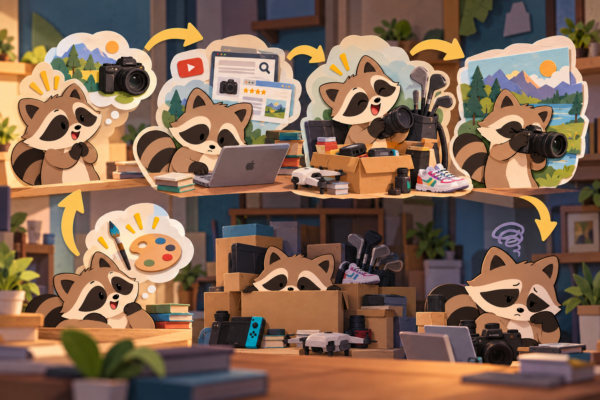
My ADHD Hobby Cycle
After doing this enough times, I eventually realized that my hobbies weren’t nearly as random as they seemed.
The subject changed.
The pattern didn’t.
1. Discovery
Whoa… this looks awesome.
Something catches my attention.
2. Research
Videos. Reddit. Reviews. Comparisons.
I want to know everything.
3. Buying
Getting the equipment feels like I’m getting closer to actually doing it.
4. Immersion
I’m learning, practicing, and imagining where this could go.
5. Friction
The easy progress slows down.
Repetition and actual practice show up.
6. Interest Drop
The thing that was constantly on my mind suddenly isn’t.
7. Storage
I’ll definitely come back to this.
8. Repeat
Something else catches my attention.
The funny part is that while I’m in it, it doesn’t feel like a cycle.
That’s important.
I don’t buy something while thinking:
Here’s another hobby I’ll abandon in six weeks.
That would make this considerably easier.
I believe myself.
This one really does feel different.
Sometimes I Wasn’t Buying a Hobby. I Was Buying a Future.
This is probably the biggest thing I’ve realized about all of this.
Sometimes I wasn’t buying equipment.
I was buying a future version of myself.
When I bought cameras, I wasn’t thinking only about owning a camera.
I could see myself documenting family vacations.
Making videos.
Capturing moments with my daughter that we’d have forever.
Maybe I’d get really good at it.
Maybe this becomes something I do.
Maybe this is just… me now.
Same thing with podcast equipment.
I’m not buying a microphone.
I’m imagining the podcast.
What we’ll talk about.
What it could become.
Golf clubs aren’t just golf clubs.
They’re Saturday mornings playing golf.
They’re the version of me who plays golf.
That’s why buying everything can feel completely reasonable in the moment.
I’m not thinking I’m wasting money.
I’m investing in the person I’m convinced I’m about to become.
And that person needs equipment.
Apparently a lot of it.
Buying the Hobby Can Become Part of the Hobby
This one cost me some money before I figured it out.
Research feels productive.
Shopping feels productive.
Comparing three cameras for two hours feels productive.
Finding the perfect microphone feels productive.
I’m technically doing something related to my new interest, so my brain gets to feel like we’re making progress.
But buying camera gear isn’t photography.
Buying golf clubs isn’t playing golf.
Buying a microphone isn’t making a podcast.
And watching seventeen videos called some variation of 10 Things Every Beginner NEEDS definitely doesn’t make me a beginner anything.
I’ve had to learn to ask myself:
Have I spent more time researching this than actually doing it?
Because sometimes the answer is embarrassingly obvious.
Three hours researching.
Zero minutes doing.
And when those purchases start adding up, they can become part of what people sometimes call the ADHD tax.
That’s the extra money we may end up spending because of things like impulsive purchases, forgotten subscriptions, or difficulty following through.
Understanding why something happens doesn’t make the financial consequences disappear.
That’s why recognizing the pattern matters.
Why Do I Suddenly Lose Interest in My Hobbies?
This was the part that confused me for years.
Because usually nothing happens.
There’s no dramatic moment where I decide:
Screw photography.
I don’t suddenly hate golf.
Podcasting doesn’t become stupid.
The volume just gets turned down.
Something that was occupying my brain all day suddenly… isn’t.
Photography still seems cool.
Golf still looks fun.
Podcasting is still interesting.
But that feeling that kept pulling me toward it?
Gone.
Sometimes the Newness Wears Off
When I first discover something, there’s always something new to learn.
New equipment.
New techniques.
New possibilities.
But eventually, I reach a point where improving requires doing the same things repeatedly.
And that’s not always as exciting.
Take golf.
Learning about clubs?
Interesting.
Watching videos about improving my swing?
Interesting.
Buying equipment?
Apparently very interesting.
Practicing the same swing hundreds of times?
Well.
Now we’re asking a lot.
For someone who struggles with maintaining attention during repetitive activities, that transition can be difficult.
But it’s not the only explanation.
Sometimes I realize I liked the idea of the hobby more than the hobby itself.
Sometimes something else becomes more interesting.
And sometimes I genuinely just don’t want to do it anymore.
Not every abandoned hobby needs an ADHD explanation.
Before I understood this pattern, I’d look at all the equipment sitting around and think the obvious thing:
Why can’t I ever stick with anything?
The ADHD Hobby Graveyard
Eventually all those future versions of me need somewhere to live.
A closet.
A shelf.
The garage.
Storage.
Mine used to be my desk.
Cameras.
Cables.
Paint.
Microphones.
Computer parts.
Golf equipment.
Stuff I was unbelievably excited about at one point just sitting there.
And yeah, there’s a real downside to this.
This stuff can get expensive.
Understanding why I do it doesn’t magically put the money back in my bank account.
It also doesn’t mean every purchase was secretly a brilliant investment.
Some of it was unnecessary.
Some of it I bought too quickly.
Some of it I absolutely could’ve waited on.
That’s why understanding the pattern has actually been useful.
Not so I can tell myself every abandoned hobby was wonderful.
So I can catch myself before I buy everything next time.
But Were All Those Hobbies Actually Wasted?
This is where things get complicated.
Because I didn’t become a travel vlogger.
But I learned photography.
Composition.
Lighting.
Video editing.
I didn’t build the next Joe Rogan Experience.
Not even close.
But podcasting taught me audio editing and made me more comfortable talking into a microphone.
I don’t spend every weekend rebuilding computers.
But I learned enough that I’m now the person people call when something goes wrong with theirs.
And then there are websites.
That one obviously didn’t disappear.
You’re reading one.
So I don’t think the lesson is that every hobby I abandon was secretly meant to happen.
Some were probably dumb purchases.
But losing interest doesn’t erase whatever I learned while I was interested.
That’s something I didn’t appreciate before.
Sometimes Old Hobbies Come Back
Another weird part of this is that some interests don’t completely die.
They go dormant.
Months or even years later, I can see a video or somebody mentions something and suddenly my brain goes:
Ohhhhhhh. Remember THIS?
And there it is again.
That’s another reason I’ve stopped treating every interest like it has to fit into one of two categories:
Lifelong passion or complete waste of time.
Apparently my interests don’t work like that.
Some stick.
Some disappear.
Some come back.
Some leave me with skills I keep using even though I never touch the hobby again.
And some leave me with a box of things I should probably sell.
All of those things can be true.
How to Stick With Hobbies When You Have ADHD
I haven’t magically stopped getting excited about things.
I don’t really want to.
I like that part of myself.
What I’m trying to change is what happens between excitement and my credit card.
And when I genuinely want to stick with something, I’m learning that I need to make it easier to continue after the initial excitement wears off.
Here are a few things I’ve been trying.
1. I Wait Before Buying Everything
My brain still wants the good equipment immediately.
Because obviously I’m serious about this thing I’ve known about for four days.
Now, especially with bigger purchases, I try to wait.
If I still want it later, it’ll still exist.
Amazon will survive without me for a week.
2. I Try the Hobby Before Buying the Equipment
I don’t need professional equipment to find out whether I like something.
Beginner equipment exists for a reason.
Sometimes I can borrow something.
Rent it.
Use something I already own.
One approach worth trying is what I call the Three-Session Rule.
Before making a big purchase, try the actual activity three times.
Not three hours of research.
Three sessions of doing it.
Want to get into photography?
Take pictures with your phone.
Want to start a podcast?
Record something using equipment you already own.
Want to try golf?
Borrow clubs or visit a driving range.
Three sessions won’t tell you whether something will become a lifelong passion.
But they might help you figure out whether you enjoy doing the activity before spending hundreds of dollars.
3. I Make Myself Actually Do Something
This one matters.
If I’ve watched hours of videos about photography but haven’t taken pictures…
Go take pictures.
If I’m researching podcast equipment but haven’t recorded anything…
Record something.
I want some evidence that I enjoy the actual activity before I keep investing in the imaginary future around it.
4. I Make the Goal Smaller
Instead of:
I’m becoming a photographer.
Photograph one family outing.
Instead of:
I’m starting a podcast.
Record one episode.
Instead of:
I’m going to become amazing at golf.
Go practice for 20 minutes.
That gives me a much faster answer to an important question:
Do I like doing this, or do I like imagining myself doing this?
Those aren’t always the same thing.
5. I Make the Boring Parts Easier to Start
Sometimes I still like the hobby.
I just don’t feel like doing the repetitive part.
That’s where I try to make the next step smaller.
Instead of planning a two-hour practice session, maybe I only need ten minutes.
Instead of finishing an entire project, maybe I only need to set everything up.
Getting started can be its own challenge with ADHD.
That’s related to something called executive dysfunction—difficulty managing tasks such as planning, starting, organizing, and following through.
I explore that in more detail in my article on ADHD and Executive Dysfunction.
Sometimes the problem isn’t that I don’t care about the hobby.
It’s that getting myself to do the next part feels harder than it should.
6. I Give Curiosity Some Room
I also don’t think the answer is banning myself from trying new things.
I’d probably fail at that anyway.
A curiosity budget makes more sense to me.
Whatever amount fits your finances.
$25.
$50.
$100.
Whatever works without interfering with your bills, savings, or other responsibilities.
Money you’re allowed to spend exploring something without pretending you’ve committed to doing it for the next twenty years.
Because curiosity isn’t the problem.
Going $700 deep into curiosity before you’ve actually done anything might be.
Should I Force Myself to Stick With a Hobby?
I don’t think there’s one answer.
I’ve started asking myself something more useful:
Am I stopping because this isn’t actually for me, or because I’ve reached the part that isn’t new anymore?
Because those are different.
Sometimes I genuinely don’t care anymore.
Fine.
But sometimes I still want the end result.
I just don’t want to do the repetitive, frustrating middle required to get there.
That’s where I might need to push myself a little.
Not by forcing myself to spend hours doing something I hate.
Maybe by making the next step easier.
Practicing with a friend.
Trying something new within the hobby.
Setting a smaller goal.
Or reminding myself why I wanted to do it in the first place.
I don’t want to use ADHD as a reason to quit everything the second something gets difficult.
But I also don’t want to turn a hobby I no longer enjoy into another obligation just so I can prove something to myself.
I’m still figuring out the difference.
Hyperfocus vs. Hyperfixation: What’s the Difference?
You’ve probably seen both words used in ADHD discussions.
They’re related, but people don’t always use them in exactly the same way.
Here’s how I use them.
Hyperfixation
When I say hyperfixation, I’m talking about an interest that keeps occupying my thoughts.
Photography, for example.
I’m thinking about cameras at work.
Watching photography videos at night.
Researching lenses.
Talking about it.
Planning what I’m going to shoot.
The interest keeps pulling my attention back to it.
Hyperfocus
When I say hyperfocus, I’m talking about becoming deeply absorbed in an activity.
I start editing photos.
Suddenly four hours disappear.
I lose track of time.
Maybe I forget to eat.
Maybe I ignore everything else because I’m so involved in what I’m doing.
That’s how I distinguish the two experiences.
But these aren’t universally standardized clinical definitions.
Neither hyperfixation nor hyperfocus is an official ADHD diagnostic criterion.
They’re descriptive terms people use to talk about experiences involving intense interest and attention.
And they can overlap.
If you want to explore this experience beyond hobbies, I explain it further in my article on ADHD hyperfixation.
The useful part isn’t memorizing perfect definitions.
It’s recognizing what your attention is doing.
When Does ADHD Hobby Hopping Become a Problem?
Having a bunch of hobbies isn’t automatically a problem.
Neither is trying something new and deciding you don’t enjoy it.
The part I’d pay attention to is what those hobbies are doing to the rest of your life.
Are you going into debt?
Are purchases causing fights with your partner?
Are you neglecting responsibilities because the new interest is taking over everything?
Are you consistently losing sleep?
Does the cycle actually distress you?
That’s different from simply being somebody who likes trying a lot of things.
According to the National Institute of Mental Health, ADHD involves ongoing patterns of inattention and/or hyperactivity-impulsivity that interfere with daily functioning.
Changing hobbies alone isn’t enough to identify ADHD.
If impulsive spending, difficulty controlling your attention, or repeatedly abandoning important responsibilities is causing serious problems, it’s worth discussing with a healthcare professional.
Understanding the pattern can help.
But sometimes additional support is useful, too.
What I Wish I’d Understood Earlier
I spent years looking at all this stuff and thinking it proved something about me.
That I couldn’t commit.
That I wasted money.
That I never finished anything.
Now I think the truth is messier than that.
Yes, I’ve wasted money.
Yes, I’ve gotten ridiculously excited about things that I barely touched six months later.
Yes, I should probably be legally prohibited from watching Best Beginner Gear videos after 11 p.m.
But I’ve also learned a ridiculous amount of stuff because of those interests.
Some disappeared.
Some came back.
Some gave me skills I still use.
And a few actually stuck.
The goal for me isn’t to find the magical hobby that finally proves I can commit to something forever.
It’s to understand what happens when that initial excitement hits.
Because I know myself better now.
When my brain says:
This is it. This is finally the thing.
Maybe it is.
But I probably don’t need to buy everything tonight.
Frequently Asked Questions
Is Changing Hobbies a Symptom of ADHD?
Not by itself.
Frequently changing hobbies isn’t part of the official diagnostic criteria for ADHD.
However, some people with ADHD describe becoming intensely interested in something while it’s new and engaging, then having difficulty maintaining that same level of interest later.
Why Do People With ADHD Suddenly Lose Interest in Hobbies?
Sometimes the experience changes once the beginner stage is over.
There are fewer discoveries and more repetition, practice, and maintenance.
For me, it can feel less like deciding to quit and more like the interest suddenly stopped pulling me toward it.
How Can I Stick With Hobbies When I Have ADHD?
Try making the activity easier to start, setting smaller goals, and finding ways to keep practice engaging.
It can also help to try a hobby several times before spending money on expensive equipment.
And remember that you don’t have to turn every hobby into a lifelong commitment.
Is Hyperfixation an Official ADHD Symptom?
No.
Hyperfixation isn’t listed as an official diagnostic symptom of ADHD.
It’s a commonly used term for becoming intensely interested in a topic, activity, or hobby.
Can an ADHD Hobby Become a Lifelong Passion?
Absolutely.
Not every intense interest disappears.
Some hobbies stick around.
Some disappear and return later.
Others grow into useful skills, careers, or long-term interests.
You might not know which one you’re dealing with while you’re standing in the store buying the equipment.