

ADHD is something I wouldn’t wish on my worst enemy.
It’s not cute. It’s not chic. And it’s not just some quirky explanation for why you lose your dang keys all the time.
ADHD stands for attention-deficit/hyperactivity disorder. It’s a neurodevelopmental condition that affects attention, impulse control, and executive functioning, the mental processes that help us plan, organize, remember things, manage time, and actually get things done.
That’s the clinical explanation.
But knowing the definition of ADHD and understanding what it actually feels like to live with it are two very different things.
I wish I could tell you exactly what ADHD has taken from me.
I can’t.
I can only speculate.
Would I have done better in school? Handled relationships differently? Friendships? Social situations? Would I have been better with money or finished more of the things I started?
I don’t know.
There’s no alternate version of my life sitting somewhere that I can compare mine to.
For most of my life, my brain was just…my brain.
It wasn’t until I started understanding ADHD—and eventually experienced medication—that I finally had something to compare it to.
That’s when a lot of things I’d spent years criticizing myself for started making a lot more sense.
ADHD Isn’t Just a Lack of Attention
The name attention-deficit/hyperactivity disorder can be misleading.
Because I don’t always have a deficit of attention.
Sometimes I have more attention than I know what to do with.
Think of attention like a flashlight.
Most people imagine ADHD as a flashlight that keeps flickering all over the room.
And sometimes that’s accurate.
But other times, my flashlight locks onto one thing and apparently forgets the rest of the room exists.
I can become completely absorbed in something.
Food?
Doesn’t matter.
Water?
Nope.
Going to the restroom?
Apparently that can wait too.
Whatever else I was supposed to be doing?
Good luck.
People often describe that kind of intense focus as hyperfocus. Hyperfocus isn’t part of the official diagnostic criteria for ADHD, but it’s an experience many people with ADHD describe.
And as much as ADHD has made parts of my life difficult, that feeling when I’m completely in the zone?
I don’t want to lose it.
The problem isn’t always that I can’t pay attention.
Sometimes I can’t control where my attention goes.
Executive Function: When Knowing Isn’t Enough
Before I understood ADHD, I thought attention was basically the whole thing.
You get distracted. You can’t focus. Maybe you’re hyperactive.
That’s ADHD, right?
Not exactly.
ADHD can also affect executive functioning.
Executive functions are the mental skills that help us plan, remember information, organize ourselves, manage time, control impulses, switch between tasks, and turn intentions into actions.
That last part used to confuse the hell out of me.
How can I want to do something and still not do it?
Take laundry.
To somebody else, doing laundry might sound like one task.
Do the laundry.
But my brain can turn it into:
Find the dirty clothes. Sort them. Bring them to the washer. Put them in. Add detergent. Start the washer. Remember that I started the washer. Move everything to the dryer. Start the dryer. Remember the dryer exists. Take everything out. Fold it. Put it away.
And somewhere along that chain, the entire operation can fall apart.
That’s one of the frustrating things about executive dysfunction.
Knowing what you’re supposed to do isn’t necessarily the same thing as being able to make yourself do it.
I’ve written much more about that in my article on executive dysfunction, because it deserves its own explanation.
What Are the Symptoms of ADHD?
Looking back is weird.
Now that I understand ADHD better, there are things from my past that make me think:
Bro. You HAD to have known.
Except I didn’t.
The hobbies should’ve been a clue.
I could become completely obsessed with something, buy everything I needed for it, learn everything about it…and eventually move on without finishing what I started.
Then there was the procrastination.
And I don’t just mean putting off things I hated doing.
I’ve procrastinated on things I genuinely wanted to do.
None of those things individually proves someone has ADHD.
They were simply things I experienced without knowing there might be a bigger pattern behind them.
Clinically, ADHD symptoms are divided into two main groups: inattention and hyperactivity/impulsivity.
But the clinical words don’t always capture what those experiences actually feel like.
Inattention
If I had to choose the inattentive difficulty that’s affected me most, it would probably be not finishing things.
Starting something?
Oh, I can start some shit.
A new hobby. A project. Something around the house. Some new idea I’m suddenly convinced I need to pursue.
Finishing it is a completely different conversation.
A very close second is what ADHD symptom lists describe as not listening when spoken to directly.
I hate how that sounds.
Because someone can literally be RIGHT THERE IN FRONT OF MY FACE talking to me and I’ll still go:
“Huh?”
“Can you repeat that again?”
It’s not necessarily that I don’t care.
Sometimes I genuinely want to hear what the person is saying.
But somewhere between them saying the words and my brain actually holding onto those words, something gets lost.
Other signs of inattention can include being easily distracted, forgetfulness, losing things, difficulty staying organized, trouble sustaining attention, and difficulty following through on tasks.
Hyperactivity and Impulsivity
Hyperactivity was another part of ADHD I misunderstood.
I’m not bouncing off the walls.
But restless?
Absolutely.
I don’t feel like I have an off switch.
I wake up feeling like I need to do something.
If I’m working, fine.
If I’m not working, I feel like I need to go to the gym.
If I don’t do either?
I can spend the rest of the day telling myself I’m a lazy slob because I didn’t accomplish anything.
I recently came back from Cancun, and you have no idea how hard it was for me to just relax.
I’m on vacation.
There’s literally nothing I’m supposed to be doing.
My brain apparently didn’t receive that memo.
Then there’s impulsivity.
I have basically no filter.
Medication has helped with that a little, but without it?
Absolutely no filter.
Something enters my brain and apparently decides there’s no reason to stop by security before exiting my mouth.
Interrupting has been a big one for me too.
That’s why ADHD hyperactivity doesn’t always look like the stereotype of someone physically running around.
It can also feel like internal restlessness—like your brain is constantly telling you that you should be doing something.
The Three Presentations of ADHD
ADHD doesn’t look the same in everyone.
Clinically, there are three presentations:
- Predominantly inattentive presentation: Symptoms mainly involve difficulties with attention, organization, forgetfulness, and following through.
- Predominantly hyperactive-impulsive presentation: Symptoms mainly involve restlessness, excessive talking, interrupting, difficulty waiting, and acting impulsively.
- Combined presentation: Enough symptoms from both the inattentive and hyperactive-impulsive groups are present.
You may have heard people use ADD to describe someone who struggles with attention but isn’t obviously hyperactive.
ADD isn’t a separate diagnosis anymore. It’s all classified as ADHD.
And that’s important.
You don’t have to look hyperactive to have ADHD.
A lot of what someone is experiencing may not be obvious from the outside.
How ADHD Can Affect Everyday Life
This is where ADHD becomes more than a symptom list.
Eventually, these difficulties start affecting your actual life.
For me, one of the biggest examples has been money.
Impulse spending. Not saving enough. Credit cards. Not paying enough attention to my credit.
All of it.
And the frustrating part?
I knew.
I had a feeling I wasn’t doing the best thing financially.
But knowing that and actually changing what I was doing were two completely different things.
Then came the shame.
You make another decision you know probably wasn’t the smartest one.
You look at your finances and don’t like what you see.
You tell yourself:
I need to get my shit together.
And somehow…you keep doing it.
ADHD can affect planning, impulse control, organization, remembering deadlines, and following through on intentions.
That doesn’t mean ADHD caused every bad financial decision I’ve ever made.
It means I can now see how some of the difficulties I was experiencing may have contributed.
And money is only one area.
ADHD can affect school, work, relationships, friendships, household responsibilities, sleep, and taking care of yourself.
That’s also where something people sometimes call the ADHD tax comes in—the extra money, time, or consequences that can pile up from things like forgotten bills, missed deadlines, impulse purchases, or replacing things you’ve lost.
Getting distracted is annoying.
Watching the consequences of your own decisions pile up while wondering why the hell you keep doing this is something else entirely.
What Causes ADHD?
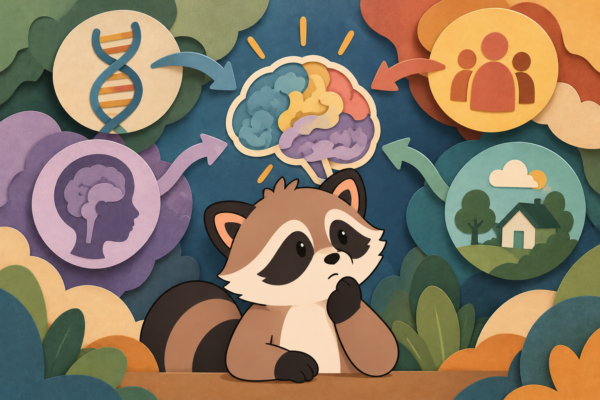
There isn’t one single known cause of ADHD.
What we do know is that ADHD is a neurodevelopmental condition and genetics plays a major role in who develops it. Researchers are continuing to study how genes and other factors contribute.
ADHD isn’t simply caused by laziness, bad parenting, too much sugar, or spending too much time on your phone.
Learning about the genetic side of ADHD also made me look at my own family differently.
I started recognizing certain behaviors in my mom.
The forgetfulness. The impulsivity. The interrupting.
To this day, she finishes people’s sentences.
And yes, it can still be annoying.
That doesn’t mean my mom has ADHD. I can’t make that determination.
But learning about my own ADHD made me more forgiving of my parents.
It made me realize that some behaviors I’d spent years reacting to might have explanations I had never considered.
I didn’t expect understanding my own brain to change how I looked at theirs.
How Is ADHD Diagnosed?
Maybe you’ve been reading this article and recognizing yourself.
The unfinished projects.
The procrastination.
The restlessness.
The impulsivity.
And now you’re wondering:
Do I actually have ADHD?
Recognizing yourself in ADHD experiences can be a reason to explore the possibility, but it isn’t enough to diagnose yourself.
There isn’t a single blood test, brain scan, or online quiz that can tell you whether you have ADHD.
An ADHD evaluation generally involves a qualified healthcare professional looking at your symptoms, when they began, whether they occur in more than one part of your life, and whether they’re interfering with your everyday functioning.
Because ADHD is a developmental condition, they’ll also look for evidence that symptoms were present before age 12—even if nobody recognized them as ADHD at the time.
They may also consider other explanations for your symptoms. Anxiety, depression, sleep problems, and other conditions can sometimes cause similar difficulties.
And yes, you can be diagnosed with ADHD as an adult.
Sometimes you spend years assuming certain behaviors are simply part of your personality.
Then you start learning about ADHD, look backward, and suddenly find yourself questioning things you never thought twice about.
If these difficulties are persistent and are affecting your life, talking with a healthcare professional experienced in evaluating ADHD is a reasonable next step.
How Is ADHD Treated?
ADHD treatment isn’t one-size-fits-all.
Depending on the person, treatment can involve medication, behavioral therapy or cognitive behavioral therapy, skills and organizational strategies, environmental changes, or a combination of approaches.
Practical changes can help too.
For example, someone who regularly forgets appointments might benefit from automatic reminders. Someone who struggles to start large projects might find it easier to break them into smaller steps or work alongside another person.
Those strategies aren’t guaranteed solutions, and they don’t replace treatment when treatment is needed. But they can make some everyday difficulties easier to manage.
I can only tell you what medication has been like for me.
It didn’t get rid of my ADHD.
I still procrastinate.
I still lose focus.
I’m still impulsive.
I still have moments where I know exactly what I’m doing and somehow keep doing it anyway.
Medication has minimized some of those difficulties.
But one of the biggest things it gave me wasn’t something I expected.
Awareness.
Before medication, my brain was just my brain.
I’d lived inside it my entire life.
I didn’t have a control group.
Medication finally gave me something to compare.
And once I had that comparison, I started understanding myself differently.
Instead of immediately going:
Why the hell am I doing this again?
Sometimes I can recognize:
Okay. This is what this is.
That understanding has helped me be kinder to myself.
But there’s another side of this that’s important.
Understanding what’s happening doesn’t mean you suddenly know how to fix it.
Sometimes I’ll be right in the middle of procrastinating and know I’m procrastinating.
I can realize I’m not paying attention while I’m not paying attention.
I can understand why I’m doing something and still do the damn thing.
Medication didn’t hand me the right answer every time.
It didn’t erase ADHD.
For me, it turned the volume down on some of the difficulties and helped me understand what I was experiencing.
And sometimes understanding what’s happening helps me respond differently.
Sometimes it doesn’t.
Common Questions About ADHD
What Does ADHD Stand For?
ADHD stands for attention-deficit/hyperactivity disorder.
Is ADHD a Mental Illness?
ADHD is classified as a neurodevelopmental disorder. It’s also commonly treated within mental healthcare. ADHD isn’t the same condition as anxiety or depression, although they can occur together.
Can You Have ADHD Without Being Hyperactive?
Yes. Someone with predominantly inattentive ADHD may have significant difficulties with attention, organization, forgetfulness, and following through without obvious outward hyperactivity.
Can Adults Have ADHD?
Yes. ADHD begins during childhood, but symptoms can continue into adulthood. Some people aren’t diagnosed until adulthood because their symptoms weren’t recognized when they were younger.
Is ADHD Genetic?
ADHD has a strong genetic component. Having ADHD in your family doesn’t guarantee that you’ll have it, but genetics plays an important role in the condition.
Is ADHD Just Laziness?
No.
And this is one I wish I’d understood sooner.
I’ve wanted to do things and still couldn’t get myself to start them.
I’ve known what I needed to change and still struggled to change it.
That doesn’t mean every unfinished task or procrastinated responsibility is ADHD.
But struggling to execute something isn’t the same thing as not caring about it.
So, What Is ADHD Really Like?
I can give you the clinical definition of ADHD.
And that definition matters.
But knowing the definition and understanding what it feels like to live with ADHD are two different things.
For most of my life, my brain was just my brain. I didn’t have anything to compare it to.
Medication didn’t make my ADHD disappear.
It showed me how things could be.
And suddenly, things I’d spent years criticizing myself for started making more sense.
I can still know I’m procrastinating and continue procrastinating.
I can recognize that I’m not paying attention and still struggle to bring my attention back.
I can understand why I’m doing something and still do the damn thing.
Understanding ADHD hasn’t magically given me the right answer every time.
But it has changed the way I understand myself.
And I wish I’d had that understanding a hell of a lot sooner.
Research & Editorial Standards
This article combines my lived experience with established clinical information about ADHD. My experiences are my own and won’t necessarily reflect everyone else’s experience with the condition.
The medical information is supported by the following resources.
Sources and Further Reading
- National Institute of Mental Health (NIMH) — ADHD in Adults: 4 Things to Know
- Centers for Disease Control and Prevention (CDC) — About ADHD
- Centers for Disease Control and Prevention (CDC) — ADHD in Adults
- Centers for Disease Control and Prevention (CDC) — Diagnosing ADHD
- CHADD — ADHD Quick Facts: ADHD Presentations
These resources provide additional information about ADHD symptoms, presentations, diagnosis, causes, and treatment.