
Have you ever looked at the clock and thought…
“There’s no way it’s already 4:00.”
You were just going to answer one email.
Or throw a load of laundry in.
Or watch one YouTube video.
Or organize one drawer.
Now somehow half the day is gone.
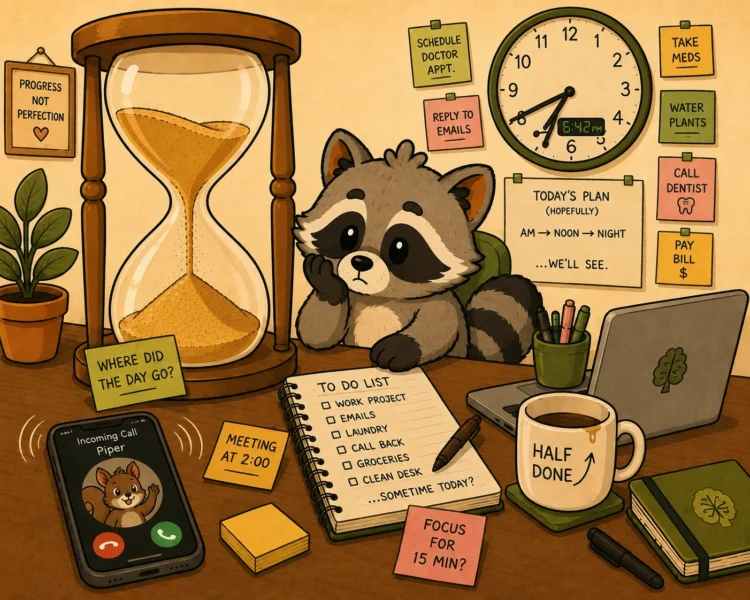
The weird part is, it doesn’t even feel like that much time passed.
If you have ADHD, chances are you’ve had moments like this more times than you can count.
Before I knew anything about ADHD, I honestly thought I was just terrible at managing my time.
People would tell me to “leave earlier.”
“Plan better.”
“Set more alarms.”
I wanted to.
Seriously.
I wasn’t trying to be late.
I wasn’t trying to miss deadlines.
I wasn’t trying to make life harder for myself.
It just kept happening.
For years I blamed myself.
Then I learned about something called time blindness, and suddenly a lot of my life started making sense.
Quick Answer
Time blindness is a common challenge experienced by many people with ADHD that makes it difficult to accurately sense the passage of time, estimate how long tasks will take, and plan for future events. While it isn’t an official medical diagnosis, researchers believe it’s closely connected to the executive function differences associated with ADHD.
Key Takeaways
Time blindness is common in people with ADHD.
It’s not about being lazy or careless.
Many people with ADHD struggle to accurately estimate how much time has passed or how long something will take.
Time blindness can contribute to lateness, missed deadlines, ADHD tax, and chronic stress.
External systems, like timers, calendars, and reminders, often work better than relying on memory alone.
What Is Time Blindness?
Time blindness is exactly what it sounds like.
It’s having difficulty seeing, feeling, or accurately judging time.
That doesn’t mean someone literally can’t read a clock.
It means the brain doesn’t always process time in a way that’s useful for everyday life.
For many people, time naturally creates a sense of urgency.
If dinner is in an hour, they instinctively know they shouldn’t start a project that takes three hours.
If an appointment is tomorrow morning, it gradually becomes more important as it gets closer.
Many people with ADHD don’t experience time that way.
Tomorrow often feels just as far away as next month.
An hour can disappear without warning.
Five minutes somehow turns into thirty.
Deadlines don’t always feel real until they’re suddenly right in front of us.
Time blindness isn’t an official symptom listed in the Diagnostic and Statistical Manual of Mental Disorders (DSM-5-TR), but ADHD researchers and clinicians frequently describe difficulties with time estimation, planning, and time management as part of the broader executive function challenges associated with ADHD.
Why Does ADHD Affect Time?
This is where things start getting interesting.
Most people think managing time is one skill.
It isn’t.
Managing time actually depends on several different mental processes working together.
Things like:
Estimating how long something will take
Planning ahead
Switching attention
Holding information in working memory
Monitoring your own progress
Remembering future intentions (called prospective memory)
When those executive functions don’t work together as smoothly, time itself becomes harder to manage.
That’s one reason ADHD isn’t simply an attention disorder.
It’s also a disorder of self-management over time, a concept ADHD researcher Dr. Russell Barkley has discussed extensively.
In other words, ADHD doesn’t just affect what you pay attention to.
It can affect when you pay attention to it.
Time Horizon: Why Tomorrow Doesn’t Feel Urgent
One idea that really helped me understand ADHD comes from something researchers sometimes call your time horizon.
Think of your time horizon like the distance your brain naturally looks into the future.
For someone without ADHD, next week’s deadline might already feel important.
For many people with ADHD…
Next week barely exists.
Not because we don’t care.
Because our brains naturally place much more weight on what’s happening right now.
That’s why you might fully intend to pay a bill next Tuesday…
…and then suddenly realize it’s Thursday and there’s now a late fee.
Or maybe you’ve known about a dentist appointment for months.
Then the day before it feels like someone dropped it into your lap out of nowhere.
That doesn’t mean you forgot because you didn’t care.
It often means your brain struggles to make future events feel important until they become immediate.
I joke that my brain has two calendars.
Now.
And…
Not now.
Unfortunately, “Not now” has a habit of becoming “Oh no.”
What Time Blindness Actually Feels Like
One of the hardest parts about explaining time blindness is that it isn’t really about clocks.
It’s about your experience of time.
For me, time almost feels invisible.
If I’m focused on something interesting, hours can disappear without me noticing.
If I’m avoiding something stressful, those same hours can disappear in a completely different way.
Either way…
Time keeps moving.
I just don’t always feel it moving.
That’s why people with ADHD often say things like:
“I swear I just sat down.”
“I thought it had only been twenty minutes.”
“Where did the day go?”
Those aren’t excuses.
They’re usually genuine expressions of surprise.
Because from the inside, that’s honestly what it felt like.
Waiting Mode: When an Appointment Takes Over Your Entire Day
This is one of those ADHD experiences I thought only I had.
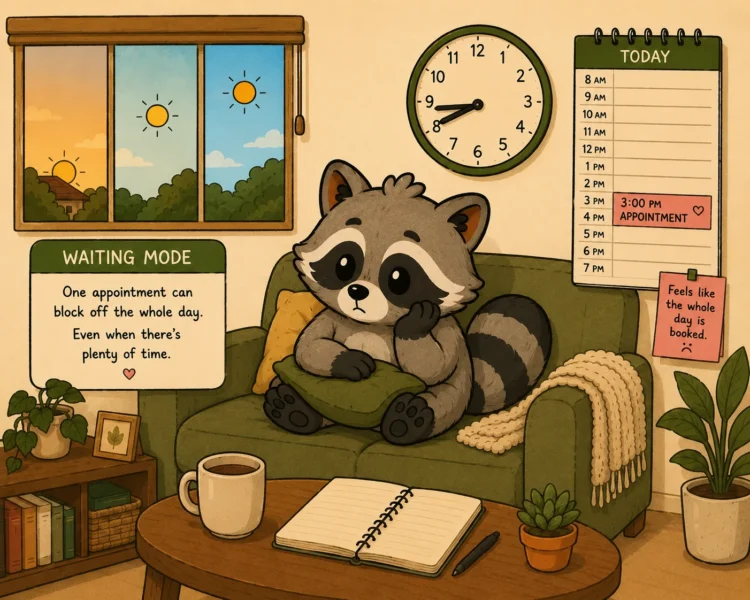
Let’s say you have an appointment at 3:00 PM.
You wake up at 8:00.
Technically, you have seven hours.
Plenty of time to get things done.
Except…
Your brain doesn’t treat those seven hours like free time.
Instead, it keeps reminding you there’s something important later.
So you don’t start cleaning the garage.
You don’t begin that work project.
You don’t run errands.
You don’t relax enough to watch a movie.
You kind of…wait.
Hours go by, and it feels like your entire day revolved around a thirty-minute appointment.
I’ve lost more Saturdays to waiting mode than I’d like to admit.
It sounds irrational when you say it out loud.
But if you’ve experienced it, you probably know exactly what I’m talking about.
Why This Isn’t Just “Being Bad at Time”
One thing I wish more people understood is that people with ADHD usually aren’t ignoring time on purpose.
Most of us are frustrated by it too.
I’ve never been late and thought,
“Good. I hope everyone’s waiting on me.”
Usually it’s the opposite.
I’m replaying every decision that got me there.
Wondering how I misjudged the timing again.
Promising myself it won’t happen next time.
Time blindness isn’t about intelligence.
It isn’t about motivation.
It isn’t about respect.
It’s about relying on an internal clock that doesn’t always keep accurate time.
And once I stopped seeing it as a character flaw…
I could finally start looking for solutions instead of just blaming myself.
Everyday Examples of ADHD Time Blindness
One of the biggest reasons time blindness is so frustrating is that it doesn’t stay in one part of your life.
It follows you everywhere.
Work.
Home.
School.
Relationships.
Money.
Sometimes it’s obvious.
Other times, you don’t even realize time blindness was involved until you’re apologizing to someone…again.
If any of these sound familiar, you’re definitely not alone.
“I’ll Leave in Five Minutes”
You check the clock.
You have twenty minutes before you need to leave.
Perfect.
You decide to do one quick thing first.
Maybe it’s putting the dishes away.
Then you notice the trash is full.
While taking it outside, you remember you left your sunglasses in the car.
When you get back inside, you see a package that needs to be opened.
You answer one text.
Grab a drink.
Look at the clock.
You’re late.
Again.
The frustrating part?
It honestly doesn’t feel like twenty minutes passed.
You weren’t trying to ignore the time.
Your attention simply kept moving from one thing to the next while your internal clock quietly fell behind.
The “This Won’t Take Long” Trap
If I had a dollar for every time I thought something would take fifteen minutes…
I’d probably have enough to pay all the ADHD tax I’ve accumulated over the years.
You decide to organize one drawer.
Clean one shelf.
Respond to a few emails.
Before you know it, two hours have disappeared.
The project isn’t finished.
Now you’re behind on everything else you planned to do.
People with ADHD often struggle to accurately estimate how long tasks will take. Researchers sometimes refer to this as a difficulty with time estimation, and it’s one of several executive function skills that can be affected by ADHD.
It’s not that we’re bad at math.
Our brains are simply making predictions with incomplete information.
Hyperfocus: When Time Completely Disappears

Then there’s the opposite problem.
Sometimes time doesn’t feel slow.
It disappears completely.
You’re building something.
Researching a topic you’re excited about.
Playing a game.
Reading.
Working on a hobby.
Maybe you’re finally organizing your photos.
Or…
If you’re anything like me…
You’re making “one small change” to your website.
The next time you look at the clock…
It’s midnight.
You skipped dinner.
Your phone has eight unread messages.
The laundry is still sitting in the washer.
You forgot you even had plans.
People often assume hyperfocus means someone has incredible concentration.
Sometimes it does.
But it also comes with a cost.
When your attention becomes completely absorbed, your awareness of time often fades into the background.
That’s one reason ADHD can feel so confusing.
On one day, five minutes feels like an hour.
On another, five hours feels like five minutes.
Waiting Mode: The Productivity Killer
Earlier, I mentioned waiting mode, but it deserves its own section because it’s something so many people with ADHD experience.
Let’s say you have an appointment at 3:00 PM.
It’s only 10:00 in the morning.
Most people would probably think,
“I’ve got plenty of time.”
My brain thinks,
“Don’t start anything important. You have somewhere to be later.”
So I wait.
Not because I want to.
Because my brain has a hard time fitting another activity into the hours before the appointment.
I’ve wasted entire mornings because of a thirty-minute dentist appointment.
Not scrolling.
Not relaxing.
Not being productive.
Just…waiting.
The strange part is that once the appointment is over, I suddenly feel free again.
If you’ve ever wondered why a single event can seem to take over your whole day, time blindness may be part of the answer.
Forgetting Future You Exists
One concept that’s closely connected to time blindness is something called prospective memory.
That’s just a fancy way of saying remembering to remember.
For example:
Remember to pay your credit card on Friday.
Remember to switch the laundry before it smells.
Remember to pick up your prescription after work.
Remember to RSVP before the deadline.
Remember to bring your lunch tomorrow.
These aren’t difficult because you don’t know how.
They’re difficult because the reminder has to survive hours—or sometimes days—before it becomes relevant.
For many people with ADHD, those future intentions don’t stay active in the background.
Once they’re out of sight…
They’re often out of mind.
That’s one reason calendars, reminders, and alarms are so powerful.
They don’t replace your memory.
They become your memory.
How Time Blindness Affects Everyday Life
Time blindness isn’t usually one giant problem.
It’s hundreds of tiny ones.
Each one seems manageable on its own.
Together, they become exhausting.
At Work
Time blindness can make work feel like you’re constantly trying to catch up.
You underestimate how long a project will take.
You spend more time than expected on one task.
A meeting sneaks up on you.
You miss a deadline that genuinely didn’t feel as close as it was.
People sometimes assume this means someone with ADHD doesn’t care about deadlines.
Most of the time, that’s the exact opposite of what’s happening.
Many people with ADHD care so much about doing a good job that every missed deadline feels deeply personal.
In Relationships
Time blindness can create misunderstandings with the people we care about.
A partner might see chronic lateness as a lack of respect.
A friend might assume you’re flaky.
Family members may think you’re disorganized because you don’t care enough to plan ahead.
The truth is usually much different.
Most people with ADHD feel embarrassed when they’re late.
They’re apologizing before they even walk through the door.
They’re replaying everything they could have done differently.
Understanding time blindness doesn’t erase the impact it has on other people.
But it can help explain why it keeps happening.
That understanding often leads to better conversations than simply assuming someone is inconsiderate.
With Money
Time blindness and ADHD tax often go hand in hand.
Think about how many financial mistakes depend on timing.
A payment due Friday.
A free trial that expires next week.
Returning a shirt before the return window closes.
Renewing your driver’s license.
Scheduling your oil change.
None of those tasks are particularly difficult.
The challenge is remembering them at the right time.
That’s where time blindness can quietly become expensive.
Late fees.
Overdraft charges.
Expired coupons.
Forgotten subscriptions.
Buying something again because you forgot you already owned it.
It’s death by a thousand paper cuts.
The Emotional Side Nobody Talks About
The hardest part about time blindness isn’t usually the clock.
It’s what happens afterward.
You apologize.
Again.
You promise yourself you’ll do better next time.
Again.
You buy another planner.
Download another productivity app.
Set another reminder.
Then it happens again.
Over time, it’s easy to start believing there’s something wrong with you.
I know I did.
For years, every late arrival felt like evidence that I just wasn’t responsible enough.
Learning about time blindness didn’t magically make me punctual.
But it gave me something I didn’t have before.
An explanation.
Not an excuse.
An explanation.
And those are two very different things.
When you understand why something keeps happening, you’re finally in a position to build systems that actually help instead of just blaming yourself.
Time Blindness vs. Procrastination
People use these two terms almost interchangeably.
I used to.
But they’re not actually the same thing.
They can absolutely overlap, and they often do, but they’re describing two different challenges.
Here’s the simplest way I can explain it.
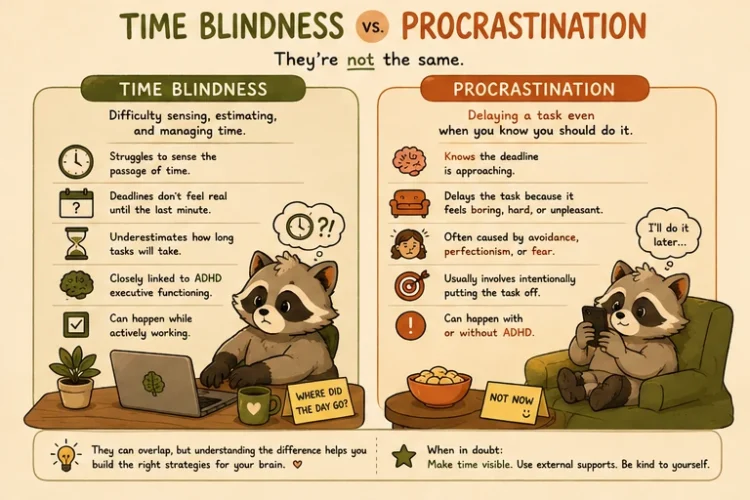
Procrastination is about delaying a task.
Time blindness is about misjudging time.
Sometimes time blindness causes procrastination.
Other times, procrastination has nothing to do with ADHD at all.
Let’s say you have a report due next Friday.
If you have time blindness, next Friday might not feel very important on Monday. Your brain treats it like a distant event, even though it’s only a few days away.
Then Thursday night arrives…
…and suddenly it’s an emergency.
From the outside, it looks like procrastination.
From the inside, it often feels like the deadline appeared out of nowhere.
That’s why simply telling someone with ADHD to “stop procrastinating” usually misses the real problem.
If your brain struggles to accurately feel time, planning around time becomes much harder.
Time Blindness vs. Procrastination
| Time Blindness | Procrastination |
|---|---|
| Difficulty sensing the passage of time | Delaying a task despite intending to do it |
| Underestimates how long tasks will take | Often postpones a task because it’s unpleasant, boring, or stressful |
| Deadlines may not feel urgent until the last minute | Usually knows the deadline is approaching but delays anyway |
| Can happen while actively working | Often involves avoiding the task altogether |
| Closely linked to ADHD executive functioning | Can happen with or without ADHD |
They’re different problems.
But when they happen together, they can create the perfect storm.
Time Blindness vs. Executive Dysfunction
If you’ve read my article on executive dysfunction, you probably noticed there’s a lot of overlap.
That’s because time blindness isn’t separate from executive dysfunction.
It’s one way executive dysfunction can show up.
Think of executive dysfunction as the engine.
Time blindness is one of the warning lights on the dashboard.
Executive functions include skills like:
Planning
Organization
Working memory
Emotional regulation
Task initiation
Self-monitoring
Flexible thinking
Time management
When several of those systems are working differently, it becomes much harder to estimate time, prioritize future events, and switch between tasks.
That’s why you rarely hear someone say,
“I only have time blindness.”
Usually, it comes packaged with several other executive function challenges.
Why “Just Manage Your Time Better” Doesn’t Work
I know people usually mean well when they say things like:
“Just leave earlier.”
“Use a planner.”
“Start sooner.”
“Be more organized.”
The problem is that this advice assumes the issue is a lack of knowledge.
Most people with ADHD already know those strategies.
We’ve probably bought the planner.
Downloaded the app.
Watched the YouTube videos.
Made the color-coded schedule.
The problem isn’t knowing what to do.
It’s consistently doing it at the right time.
Imagine telling someone who constantly loses their glasses,
“You should just remember where you put them.”
Technically…
They’re right.
But it doesn’t solve the reason the problem keeps happening.
Time blindness works the same way.
Advice that depends entirely on your internal sense of time often falls apart if that’s the very thing your brain struggles with.
How to Manage ADHD Time Blindness
I wish I could tell you there’s one trick that fixes everything.
There isn’t.
But there are strategies that make life a whole lot easier.
One thing I’ve learned is this:
I can’t rely on my brain to keep track of time by itself.
So I’ve stopped asking it to.
Instead, I try to build systems that make time impossible to ignore.
Make Time Visible
Time is invisible.
That’s part of the problem.
The more visible you can make it, the better.
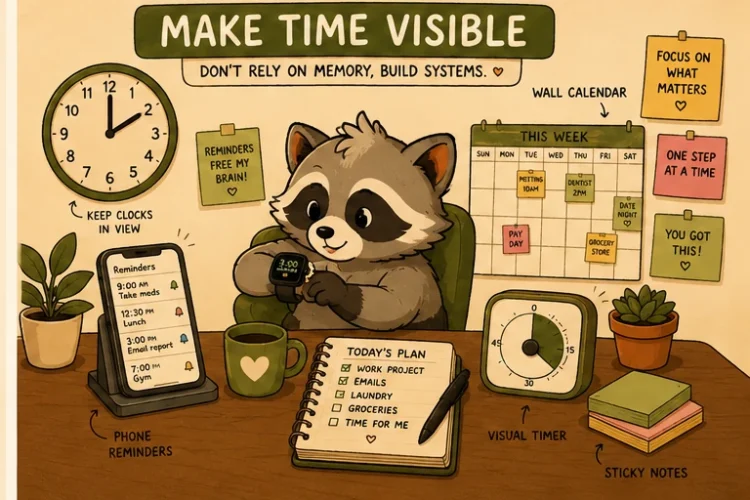
Things that have helped me include:
Countdown timers
Calendar notifications
Smartwatch reminders
Multiple alarms instead of one
Visual timers that show time disappearing
Keeping clocks where I can actually see them
A timer isn’t admitting defeat.
It’s giving your brain information it struggles to generate on its own.
Stop Trusting Future You
This one took me a while to accept.
If something depends entirely on me remembering it later…
There’s a decent chance it won’t happen.
Not because I don’t care.
Because later eventually becomes now, and my brain is already focused on something else.
Now I try to get important things out of my head as quickly as possible.
Calendar.
Reminder.
Sticky note.
Voice assistant.
Whatever works.
My goal isn’t to have a better memory.
It’s to need my memory less.
Add More Time Than You Think You Need
If I think a project will take thirty minutes…
I automatically assume it’ll probably take forty-five.
Not because I’m pessimistic.
Because I’ve seen this movie before.
My estimates usually forget to include real life.
Traffic.
Looking for my keys.
Walking back inside because I forgot my wallet.
Answering one “quick” text.
Getting distracted by something shiny.
Giving yourself extra time isn’t cheating.
It’s planning for reality instead of perfection.
Create Routines Instead of Relying on Motivation
One thing that has helped me more than I expected is doing certain things in the same order every single time.
Leaving the house.
Getting ready for work.
Packing for a trip.
Taking my medication.
When something becomes part of a routine, I don’t have to make as many decisions.
The routine remembers for me.
That’s a lot easier than trying to remember everything from scratch every morning.
Give Yourself Permission to Start Small
Sometimes the hardest part isn’t finishing a task.
It’s starting.
If a project feels overwhelming, make the first step almost ridiculously easy.
Instead of:
“Clean the garage.”
Try:
“Spend ten minutes in the garage.”
Instead of:
“Write the report.”
Try:
“Open the document.”
Small starts create momentum.
Waiting for motivation usually doesn’t.
My Biggest Mindset Shift
Learning about time blindness didn’t suddenly make me punctual.
I still underestimate how long things take.
I still have moments where I look at the clock and think,
“There’s no way it’s already that late.”
The difference is how I respond.
Years ago, I’d immediately assume I was lazy.
Or irresponsible.
Or just bad at being an adult.
Now I ask myself a different question.
“What system would have helped Future Me?”
That question changes everything.
Instead of blaming myself, I’m looking for a better tool.
A better reminder.
A better routine.
Sometimes the problem isn’t that you’re failing.
Sometimes you’re trying to solve an invisible problem without making it visible first.
When Should You Talk to a Professional?
Everyone loses track of time once in a while.
Everyone has shown up late to something.
Everyone has underestimated how long a project would take.
By themselves, those things don’t mean someone has ADHD.
The difference is how often it happens and how much it affects your life.
If difficulties with time are consistently causing problems at work, school, in your relationships, or with your finances, it’s worth talking with a qualified healthcare professional.
Time blindness isn’t an official diagnosis, but it often appears alongside other ADHD-related challenges like executive dysfunction, working memory difficulties, emotional dysregulation, and trouble with planning and organization.
If you’ve spent years wondering why managing time feels harder for you than it seems to be for everyone else, getting evaluated can provide answers—and more importantly, strategies that actually fit how your brain works.
You don’t have to figure it out by yourself.
Frequently Asked Questions
Is time blindness an official ADHD symptom?
No.
Time blindness isn’t listed as an official symptom in the Diagnostic and Statistical Manual of Mental Disorders (DSM-5-TR). Instead, it’s a term commonly used by ADHD clinicians, researchers, and the ADHD community to describe difficulties estimating, sensing, and managing time. These challenges are thought to be closely related to the executive function differences associated with ADHD.
Does everyone with ADHD have time blindness?
No.
ADHD affects everyone differently.
Some people struggle mostly with inattention.
Others experience impulsivity, hyperactivity, emotional regulation challenges, or executive dysfunction.
Many people with ADHD experience some degree of time blindness, but not everyone experiences it in the same way or to the same extent.
Why do people with ADHD lose track of time?
Researchers believe it has to do with several executive functions working together, including attention, working memory, planning, self-monitoring, prospective memory, and time estimation.
When those systems aren’t working together efficiently, accurately judging the passage of time becomes much more difficult.
Is time blindness the same as procrastination?
No.
Procrastination is delaying a task.
Time blindness is difficulty accurately sensing or estimating time.
The two often overlap, but they’re different challenges.
Someone can procrastinate without having time blindness, and someone with time blindness can lose track of time even while actively working.
Can ADHD medication help with time blindness?
For some people, treating ADHD may improve attention and executive functioning, which can make managing time easier.
Medication isn’t a cure for time blindness, and it doesn’t work the same way for everyone.
If you’re considering medication, talk with a qualified healthcare professional about the options that are right for you.
Can you have time blindness without ADHD?
Yes.
Although time blindness is most commonly discussed in relation to ADHD, difficulties with time perception can also occur with other conditions or circumstances, including certain neurological conditions, sleep deprivation, high stress, anxiety, or depression.
That’s one reason it’s important not to self-diagnose based on a single symptom.
Why do I always think I have more time than I actually do?
Many people with ADHD naturally underestimate how long tasks will take or don’t notice time passing while they’re focused on something else.
That combination can make deadlines feel farther away than they really are until they suddenly become urgent.
Final Thoughts
If there’s one thing I hope you take away from this article, it’s this:
Struggling with time doesn’t mean you don’t care.
For years, I thought every late arrival, every missed deadline, and every rushed apology meant there was something wrong with me.
I thought I wasn’t disciplined enough.
I thought everyone else had figured out something I never would.
Learning about time blindness didn’t magically make me better at managing my schedule.
I still underestimate how long things take.
I still occasionally get caught in hyperfocus.
I still have moments where I look at the clock and think,
“Where did the day go?”
But now I understand what’s happening.
And that understanding has made a huge difference.
Instead of asking,
“Why can’t I just be better at this?”
I ask,
“What can I put in place so Future Me doesn’t have to rely on memory?”
That shift has probably helped me more than any productivity app ever has.
Because here’s the truth.
You can’t solve a problem you don’t understand.
If you’ve spent years feeling guilty because time seems to work differently for you, I hope this article gave you something I wish I’d had much sooner:
An explanation.
Not an excuse.
An explanation.
And sometimes, that’s the first step toward finding solutions that actually work.
Research & Editorial Standards
Every article on ADHDefined combines lived experience with evidence-based research. Our goal is to explain ADHD in plain language while accurately reflecting current scientific understanding.
While our content is not a substitute for professional medical advice, every article is reviewed against guidance from trusted organizations such as the National Institute of Mental Health (NIMH), CHADD (Children and Adults with Attention-Deficit/Hyperactivity Disorder), the Centers for Disease Control and Prevention (CDC), and peer-reviewed scientific literature whenever appropriate.
The following sources were referenced during the research and writing of this article:
CHADD (Children and Adults with Attention-Deficit/Hyperactivity Disorder) – Information on ADHD symptoms, executive functioning, and everyday management strategies.
Russell Barkley, Ph.D. – Research and educational materials on ADHD, executive functioning, time blindness, and self-regulation.
National Institutes of Health (NIH) – Peer-reviewed research and evidence on ADHD, cognition, and neurodevelopment.
Psychology Today – Expert-written articles providing additional context on ADHD experiences, emotional regulation, and clinical perspectives.