
Have you ever noticed something before everyone else?
A tiny change in someone’s tone.
A problem with a system that keeps happening.
The ending of a movie twenty minutes before the big reveal.
Or a connection between two completely unrelated things that somehow makes perfect sense in your head.
I’ve had moments like that.
And if you search for ADHD and pattern recognition online, you’ll find plenty of people describing the same thing.
Some even call it an ADHD superpower.
We’re supposedly great at reading people. Predicting outcomes. Spotting inconsistencies. Connecting ideas other people miss.
I’ll admit, I like the idea.
Who doesn’t want to discover that the same brain responsible for losing your phone while holding your phone also came with some hidden neurological upgrade?
Unfortunately, the science isn’t that simple.
Pattern recognition is not an established symptom of ADHD, and research has not shown that people with ADHD are universally better at recognizing patterns. The official diagnostic criteria focus on patterns of inattention and/or hyperactivity and impulsivity—not enhanced pattern recognition.
That doesn’t mean the experiences people describe aren’t real.
The more interesting question is:
Why do some people with ADHD feel unusually good at connecting dots—and when should we trust the picture those dots create?
Because sometimes we genuinely notice something important.
Sometimes experience helps us predict what happens next.
Sometimes we make connections that are incredibly useful.
And sometimes…
Our brain sees three dots and starts drawing an entire picture that isn’t actually there.
Quick Answer: Are People With ADHD Better at Pattern Recognition?
Some people with ADHD describe themselves as particularly good at noticing connections, inconsistencies, recurring behaviors, or patterns that other people don’t immediately see.
But enhanced pattern recognition is not an established ADHD trait or diagnostic symptom, and there isn’t good evidence showing that people with ADHD are universally better at general pattern-recognition tasks.
That doesn’t mean you aren’t genuinely good at it.
Experience matters. Repeated exposure matters. Spending a ridiculous amount of time learning about something matters.
And if you have ADHD, you may know what it’s like to become completely absorbed in something that actually interests you.
Spend enough time with anything and eventually you start recognizing what usually happens next.
So yes, you might genuinely be excellent at recognizing certain patterns.
Just don’t assume ADHD automatically gave you that ability.
And recognizing a possible pattern doesn’t mean your interpretation of it is automatically correct.
Key Takeaways
- Pattern recognition is not an official symptom or diagnostic criterion for ADHD.
- Research has not established superior general pattern recognition as a universal ADHD ability.
- Experience and expertise can make someone exceptionally good at recognizing patterns in a specific area.
- Spending a lot of time absorbed in a subject can give you a huge amount of exposure to recurring patterns.
- Anxiety and previous experiences can affect how we interpret changes in other people’s behavior.
- Recognizing a pattern and consistently changing your behavior based on that pattern are completely different skills.
- A pattern is something worth investigating—not automatic proof that your interpretation is correct.
Is Pattern Recognition Actually an ADHD Trait?
This is where things get complicated.
Spend enough time on ADHD social media and you’ll eventually hear some version of:
“People with ADHD have amazing pattern-recognition abilities.”
We notice things other people miss.
We can read people instantly.
We know something is wrong before anyone else does.
We can predict the ending of every movie.
Except Christopher Nolan movies.
Nobody knows what the hell is happening in those.
The problem is that those claims go much further than the evidence does.
Pattern recognition isn’t part of the diagnostic criteria for ADHD, and research hasn’t established some general ADHD advantage in pattern recognition. Research into possible ADHD-related strengths does exist, especially around things like creativity and hyperfocus, but the findings are mixed and don’t establish pattern recognition as an ADHD ability.
There’s a difference between saying:
“Some people with ADHD experience themselves as unusually good at recognizing patterns.”
and:
“ADHD makes people better at pattern recognition.”
The first describes an experience.
The second makes a scientific claim we can’t confidently support.
That doesn’t mean we dismiss the experience.
It means we get more curious about what’s actually happening.
Why Might Some People With ADHD Feel Good at Recognizing Patterns?
There probably isn’t one explanation.
And not everyone with ADHD will relate to this at all.
But I think there are some pretty normal ways someone could become very good at connecting information without needing to invent an ADHD pattern-recognition superpower.
Your Brain May Make Connections Quickly
My brain rarely travels in a straight line.
One thought reminds me of something else.
That reminds me of a conversation I had three years ago.
Which reminds me of an article I read.
Which somehow connects to something I’m currently trying to figure out.
Sometimes the result is useful.
I make a connection I hadn’t considered before.
I solve a problem.
I come up with an idea.
Other times, I’m halfway through explaining something and realize I have absolutely no idea how I got there.
The person listening doesn’t know either.
We’re both victims at this point.
There’s research looking at ADHD and things like creativity and different ways of thinking, but the evidence isn’t strong enough to turn my personal experience into neuroscience.
I just know what it feels like from inside my own head.
Sometimes the answer appears before I can explain exactly how I reached it.
Basically:
“I don’t know. My brain took the scenic route.”
Intense Interests Can Build Real Expertise
Maybe you’re good at recognizing certain patterns because you’ve spent an unreasonable amount of time learning about them.
Think about someone who loves cars.
They hear an engine make a strange sound and immediately know something isn’t right.
A nurse notices a subtle change in a patient.
A gamer predicts what another player is about to do.
A wrestling fan knows the exact moment someone is about to turn heel.
That can look like intuition.
But underneath it may be hundreds or thousands of previous examples.
You’ve seen this before.
Then again.
Then again.
Eventually your brain doesn’t need to consciously walk through every step.
It recognizes something familiar.
And this is where my ADHD experience comes into it.
When something genuinely interests me, getting me to stop can be harder than getting me to start.
I can spend hours researching.
Reading.
Comparing.
Trying to understand every part of something.
Then there are the things I actually need to do.
Those somehow require seventeen alarms and a personal intervention.
ADHD is fun.
Hyperfocus is commonly used to describe this kind of intense absorption. Research does suggest that deep concentration or hyperfocus occurs in people with ADHD, but researchers are still figuring out exactly how to define and measure it, and it isn’t part of the formal ADHD diagnostic criteria.
But for pattern recognition, the point is much simpler:
Spending a lot of time with something gives you a lot of examples.
More examples can make recurring relationships easier to recognize.
Someone who has spent 2,000 hours obsessively learning about something may recognize patterns that someone with 20 hours of experience doesn’t.
That isn’t magic.
It’s exposure.
ADHD didn’t magically install the knowledge.
You still built it.
ADHD Attention Isn’t Simply “Not Paying Attention”
One misconception about ADHD is that it means you’re incapable of paying attention.
It’s more complicated than that. In adults, ADHD can involve difficulty managing attention, staying organized, completing lengthy tasks that aren’t interesting, and controlling behavior.
In everyday life, for me, that can look like trying to listen to someone while also noticing:
The air conditioner.
Someone clicking a pen.
A person walking past the window.
A notification.
Something slightly different about the room.
Most of the time?
That’s distracting as hell.
But occasionally, something I notice turns out to matter.
An inconsistency.
A change.
Something that doesn’t fit what I’ve seen before.
That doesn’t prove ADHD gives me superior perception.
It just means attention is more complicated than “ADHD people don’t notice things.”
What ADHD Pattern Recognition Can Look Like in Everyday Life
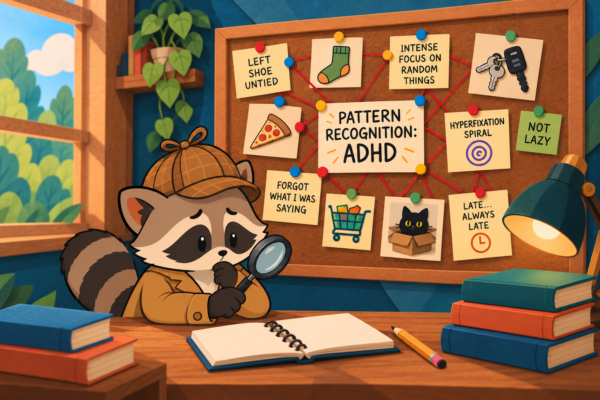
Pattern recognition usually isn’t Sherlock Holmes standing in front of a wall covered in red string.
Sometimes it’s much less impressive.
Sometimes it’s just knowing exactly how something is going to go wrong.
Predicting Movies and Stories
Five minutes into a movie:
“He’s the killer.”
Nobody believes you.
An hour and a half later?
He’s the killer.
Maybe you’re incredible at pattern recognition.
Maybe Hollywood needs better writers.
Probably a little of both.
Stories use familiar structures. Characters follow recognizable archetypes. Writers leave clues.
The more stories you’ve watched, the more examples your brain has available.
Eventually you start recognizing what usually comes next.
That’s pattern recognition.
It doesn’t necessarily have anything to do with ADHD.
Troubleshooting Problems
This is where recognizing patterns can become genuinely useful.
You’ve encountered similar problems repeatedly.
You recognize what usually causes them.
Instead of testing every possible explanation, you jump toward the one that has been correct most often.
To someone else, that can look like intuition.
But your brain may simply be comparing what’s happening now with what happened before.
You’ve seen something like this.
Connecting Ideas That Don’t Obviously Belong Together
Some of my favorite ideas come from connecting things that originally had nothing to do with each other.
Something I learned at work helps me solve a completely different problem.
An article reminds me of a conversation.
A random experience gives me an idea for a project.
I don’t need to claim ADHD makes me a creative pattern-recognition machine to appreciate that.
And connecting ideas definitely has a downside.
Sometimes it means having twelve business ideas before breakfast and finishing none of them.
There are trade-offs.
Recognizing Changes in People
This is probably the most complicated version for me.
Someone communicates differently.
Their responses get shorter.
Their tone changes.
They stop initiating conversations.
Something feels off.
And I notice.
Sometimes I’m right.
Something actually changed.
But sometimes?
I have two pieces of information, seventeen previous experiences, and enough anxiety to write the rest of the story myself.
That’s where pattern recognition can quietly become something else.
When Pattern Recognition Becomes Pattern Seeking
Human brains look for patterns.
That’s useful.
It can also get us into trouble.
One event happens.
Then another.
Our brain connects them.
Now we have a theory.
And once we have the theory, it becomes really easy to notice everything that supports it.
Someone responds differently.
See?
They’re quieter.
I knew it.
They take longer to respond.
There it is again.
Before long, we’re no longer asking:
“Is my interpretation correct?”
We’re collecting evidence for something we’ve already decided is true.
That’s why noticing a pattern should be the beginning of an investigation, not the end of one.
Pattern Recognition vs. Hypervigilance
This distinction matters, especially when the “patterns” involve other people.

Pattern recognition is basically identifying recurring relationships in information or events.
Hypervigilance is different.
It involves heightened monitoring for possible danger or threat.
Someone who has experienced repeated criticism, rejection, bullying, betrayal, trauma, or other difficult experiences may become particularly sensitive to signals that something similar could happen again.
That can sometimes feel like being incredibly good at reading people.
And sometimes you are noticing something important.
But being highly alert to a possible threat can also change how ambiguous information gets interpreted.
| Pattern Recognition | Hypervigilance |
|---|---|
| Based on recurring observations | Centered on detecting possible threats |
| Doesn’t necessarily involve fear | Often accompanied by anxiety or tension |
| Interpretation can remain flexible | Ambiguous information may feel threatening |
| New evidence can change the conclusion | Feeling unsafe can make alternative explanations harder to trust |
| “I’ve noticed this tends to happen.” | “I need to notice this before something bad happens.” |
They can overlap.
And unless I’m being completely honest with myself, I don’t always know which one I’m experiencing.
The ADHD Pattern Recognition Paradox
Here’s the part I find most interesting.
You can recognize a pattern perfectly.
Understand exactly why it’s happening.
Know what you should do differently.
And then…
do the exact same thing again.
I noticed this after starting a new job.
I was late more often than I wanted to be.
Eventually, the pattern became painfully obvious.
Stay awake too late → morning is harder.
Don’t prepare my clothes → waste time.
Don’t pack beforehand → rush around looking for things.
Don’t put important things somewhere visible → forget them.
I saw the pattern.
So I changed things.
I prepared my clothes.
Packed my backpack.
Put important things where I could see them.
And it worked.
Then eventually…
I stopped consistently doing those things.
This is the part that can drive me insane.
I know what works.
I’ve seen it work.
I can explain exactly why it works.
I could probably write an entire article telling someone else how to do it.
And then I don’t do it.
Because recognizing a pattern and consistently changing your behavior based on that information are different abilities.
ADHD is associated with difficulties in executive functions including working memory, response inhibition, and planning and organization.
Which leads to one of the most important things I’ve learned about myself:
Insight is not execution.
Knowing yourself doesn’t automatically make consistently managing yourself easy.
How Do You Know Whether You’ve Found a Real Pattern?
I’ve learned that noticing something isn’t enough.
Especially when other people are involved.
Before I completely trust the story my brain is telling me, I try to run it through a few questions.
Has This Actually Happened Repeatedly?
One event isn’t a pattern.
Neither is one weird text message.
Look for repetition.
What actually keeps happening?
What Evidence Doesn’t Fit My Theory?
This one sucks.
Once I believe something, it’s very easy to notice everything that supports it.
So I deliberately look for information that doesn’t.
If my theory is:
“They’re avoiding me.”
What evidence would suggest they aren’t?
You aren’t trying to prove yourself wrong.
You’re trying to see the whole picture.
Could Something Else Explain It?
Maybe they’re upset with me.
Maybe they’re exhausted.
Maybe they’re stressed.
Maybe they’re busy.
Maybe something happened that has absolutely nothing to do with me.
I don’t have to ignore my instincts.
I just don’t have to immediately promote them to facts.
Am I Calm Enough to Evaluate This?
I don’t make my finest interpretations of human behavior when I’m angry, anxious, embarrassed, or feeling rejected.
Shocking, I know.
If the pattern still makes sense after the emotional intensity comes down, it’s probably worth examining.
Is This Something I Actually Know a Lot About?
Expertise matters.
Recognizing patterns in something you’ve studied for ten years is different from confidently predicting something you barely understand.
Sometimes I know what I’m talking about.
Sometimes I’ve watched three YouTube videos.
Those are not the same level of expertise.
Can I Test the Pattern?
This is my favorite one.
If you think you’ve identified a recurring relationship, see whether it helps predict what happens next.
Make a small change.
Observe what happens.
Collect more information.
You don’t have to rebuild your entire life around a theory you came up with Tuesday afternoon.
How to Use Pattern Recognition as an ADHD Strength
I don’t think we need to call pattern recognition an ADHD superpower to make it valuable.
If you’re good at recognizing certain patterns, use that ability where it actually helps you.
Look at What Happens Before Recurring Problems
Don’t only study the problem.
Study what happens immediately before it.
Before you’re late.
Before you’re overwhelmed.
Before you start avoiding something.
Before you abandon a routine.
Before you stay awake until 2 a.m.
Patterns are more useful when they help you intervene before the outcome.
Write Down Connections Before Your Brain Deletes Them
If your brain makes connections quickly, capture them.
Notes app.
Voice memo.
Notebook.
Whatever you’ll actually use.
Because there’s nothing quite like having an amazing idea, promising yourself you’ll remember it, and realizing twenty minutes later that your brain apparently deleted the file.
Build Systems Around Patterns You’ve Confirmed
If something repeatedly works, make doing it easier.
Put important objects where you’ll see them.
Automate recurring responsibilities.
Reduce unnecessary steps.
Use reminders.
Prepare things before you need them.
Build systems around how you actually behave, not the imaginary version of yourself who wakes up at 5 a.m., meditates, journals, meal-preps and watches the sunrise.
I have never met that man.
Make Your Systems Easy to Restart
This might matter more than creating the perfect system.
Because you’re probably going to stop using some of them.
I do.
Instead of designing a routine that collapses after one bad week, design one that’s easy to restart.
Falling out of a system doesn’t mean the system failed.
Sometimes restarting is part of the system.
Be Extra Careful With Patterns Involving Rejection
This is where I think the most caution is warranted.
Notice the change.
Respect the fact that something caught your attention.
Then check the evidence before reacting to your interpretation of it.
Something can feel significant without you knowing exactly what it means yet.
I’ve written more about that feeling in my article about rejection sensitive dysphoria (RSD).
A Simple ADHD Pattern Check
When your brain says “I’ve figured this out,” try asking:
- What keeps happening?
- How many times has it actually happened?
- What usually happens immediately before it?
- What evidence supports my interpretation?
- What evidence contradicts it?
- Could something else explain what I’m noticing?
- Am I calm enough to evaluate this clearly?
- Do I actually have experience in this area?
- What’s one small way I could test my theory?
You don’t need to immediately decide what the pattern means.
Sometimes the smartest thing you can do is keep collecting information.
Frequently Asked Questions
Is pattern recognition a symptom of ADHD?
No. Enhanced pattern recognition is not an official ADHD symptom or diagnostic criterion. ADHD’s diagnostic criteria focus on persistent patterns of inattention and/or hyperactivity and impulsivity.
Some people with ADHD describe being good at noticing recurring behaviors, inconsistencies, connections, or outcomes, but that shouldn’t be generalized to everyone with ADHD.
Are people with ADHD better at recognizing patterns?
There isn’t sufficient evidence showing that people with ADHD are universally better at general pattern recognition.
Individual strengths can develop through expertise, repeated exposure, experience, and other differences.
Being good at recognizing patterns is real.
We just shouldn’t automatically assume ADHD caused it.
Why do people with ADHD connect ideas so quickly?
Some people with ADHD—including me—describe their thoughts as moving quickly between ideas, memories, and experiences.
There is research into possible ADHD-related strengths such as creativity and hyperfocus, but the evidence is mixed. We don’t have enough evidence to say that quickly connecting ideas is a universal ADHD characteristic or that it necessarily makes someone better at pattern recognition.
Sometimes my brain just arrives somewhere before I can explain the route it took.
Is hyperfocus related to ADHD?
Hyperfocus is commonly reported by people with ADHD, and research has found an association between ADHD and experiences of deep concentration.
However, hyperfocus isn’t part of the formal diagnostic criteria, and the research is still relatively limited. Researchers are still working out exactly how it should be defined and measured.
Is predicting movie endings an ADHD thing?
There isn’t good evidence showing that people with ADHD are inherently better at predicting movie endings.
Experience with storytelling conventions, genres, characters, and similar plots can make anyone better at recognizing what will probably happen next.
Also, sometimes the movie is just obvious.
Can ADHD make you good at reading people?
ADHD itself doesn’t automatically make someone better at reading people.
Experience, familiarity with someone’s behavior, attention to social cues, anxiety, previous relationships, and heightened monitoring for changes can all influence what someone notices and how they interpret it.
Noticing that something changed and knowing why it changed are two different things.
What’s the difference between pattern recognition and hypervigilance?
Pattern recognition involves identifying recurring relationships between observations or events.
Hypervigilance involves heightened alertness to potential danger or threat.
Both can involve noticing small changes and anticipating what might happen next, which is one reason they can sometimes feel similar from the inside.
Why can I recognize my bad habits but still repeat them?
Recognizing a behavior and consistently changing that behavior require different abilities.
ADHD can involve difficulties with executive functions such as working memory, inhibition, planning, and organization.
Knowing what you should do doesn’t necessarily eliminate the difficulty of consistently doing it.
Insight isn’t execution.
Final Thoughts: Notice the Pattern, Then Check the Evidence
I don’t think pattern recognition needs to be an official ADHD superpower to be valuable.
Maybe you’re genuinely good at connecting ideas.
Maybe you notice inconsistencies.
Maybe you understand certain systems quickly.
Maybe years of obsessing over a subject gave you a ridiculous amount of knowledge about it.
Those can be real strengths.
We just don’t need to turn them into neurological mythology to appreciate them.
Because sometimes we recognize patterns.
Sometimes we search for them.
Sometimes anxiety fills in information we don’t actually have.
Sometimes experience lets us recognize something before everyone else.
And sometimes we know exactly what’s happening and still struggle to change it.
I know that last one well.
For me, recognizing the pattern is only the beginning.
I still have to figure out whether I’m right, whether there’s another explanation, and—probably the hardest part—whether I’m actually going to do anything differently now that I see it.
Insight is useful.
Doing something with it is harder.