
Quick Answer
Rejection Sensitive Dysphoria (RSD) describes an intense emotional reaction to real or perceived rejection, criticism, or failure. Although RSD is not an official diagnosis or a symptom listed in the DSM-5-TR, many people with ADHD report experiencing it, and many ADHD specialists consider it a common part of the emotional challenges associated with ADHD.
Key Takeaways
- Rejection Sensitive Dysphoria (RSD) is commonly discussed within the ADHD community but is not an official medical diagnosis.
- People with RSD often experience rejection or criticism much more intensely than others.
- The emotional pain is real, even when the rejection is only perceived.
- RSD is different from emotional dysregulation, anxiety, and low self-esteem, although they often overlap.
- Understanding RSD can help replace self-blame with healthier coping strategies and better communication.
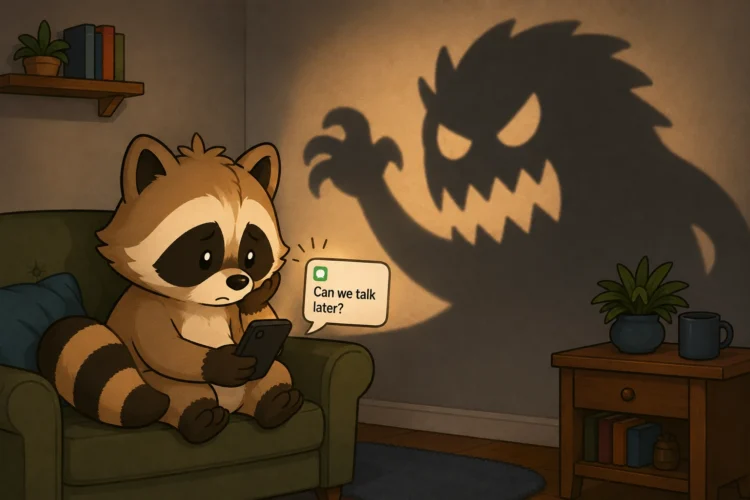
A friend sends you a text.
“Can we talk later?”
That’s it.
Five words.
No explanation.
Most people might glance at it, assume it’s nothing urgent, and go on with their day.
Your brain?
It already knows.
They’re upset.
You did something wrong.
They’re tired of you.
Maybe they’re ending the friendship.
By the time they actually call…
You’ve already had the entire conversation in your head.
You’ve apologized.
You’ve defended yourself.
You’ve replayed every interaction from the past week trying to figure out where you messed up.
Then they call.
They wanted to know if you were free for dinner.
(Side note… why couldn’t you just text me the invitation in the first place? I’ve spent the last three hours mentally attending my own funeral because my brain convinced me you secretly hated me.) 🪦
If you’ve ever had something like that happen…
You’re not alone.
For a long time, I thought I was simply too sensitive.
I assumed everyone else was just better at handling criticism, awkward conversations, or even small changes in someone’s tone.
I didn’t realize that my brain often treated uncertainty like evidence.
Not…
“Maybe they’re upset with me.”
But…
“They’re definitely upset with me.”
That certainty could feel overwhelming, even when I had very little proof that anything was actually wrong.
Eventually I learned there was a name people often used to describe experiences like this:
Rejection Sensitive Dysphoria.
Whether you call it RSD or simply intense rejection sensitivity, learning about it helped me stop asking,
“Why am I like this?”
and start asking,
“What’s actually happening in my brain right now?”
That one question changed everything.
What Is Rejection Sensitive Dysphoria (RSD)?
Rejection Sensitive Dysphoria, usually shortened to RSD, describes an intense emotional reaction to real or perceived rejection, criticism, failure, or disappointment.
For some people, those emotions arrive almost instantly.
A harmless joke suddenly feels deeply personal.
Constructive feedback feels like a personal attack.
Someone cancelling plans feels like they’re pulling away from the relationship entirely.
The emotional response can become so intense that it feels physically painful.
One thing that’s important to understand is this:
The pain isn’t fake.
The rejection simply isn’t always real.
Sometimes someone actually is criticizing you.
Sometimes they’re not.
RSD isn’t about whether rejection exists.
It’s about how intensely your brain experiences it.
One of the biggest misconceptions is that people with RSD are “too dramatic.”
That isn’t how it feels from the inside.
Most people experiencing it would give anything to react differently.
In fact, many recognize their reaction feels much bigger than the situation almost immediately afterward.
Knowing that doesn’t automatically make the feeling disappear.
Is Rejection Sensitive Dysphoria an Official ADHD Symptom?
This is where the conversation gets a little more complicated.
Unlike inattention, impulsivity, or hyperactivity, Rejection Sensitive Dysphoria is not listed in the DSM-5-TR as a diagnostic symptom of ADHD.
It also isn’t a separate medical diagnosis.
That surprises a lot of people because RSD is discussed so often in ADHD communities.
The reason is that many clinicians, researchers, and ADHD specialists have observed that intense rejection sensitivity appears to be common among many people with ADHD.
Dr. William Dodson helped popularize the term Rejection Sensitive Dysphoria within the ADHD community, while other experts, including Dr. Russell Barkley, have discussed emotional regulation and sensitivity to criticism as important parts of ADHD.
At the same time, researchers are still studying exactly how rejection sensitivity fits into ADHD.
Some experts view it as part of emotional dysregulation.
Others believe it deserves its own discussion because the emotional trigger is so specific.
Right now, there isn’t universal agreement.
And honestly…
I think that’s okay to admit.
One thing you’ll notice on ADHDefined is that I’m not interested in pretending the science is settled when it isn’t.
If researchers are still debating something, I’d rather tell you that than make it sound more certain than it really is.
What is clear is that many adults with ADHD describe experiences that sound remarkably similar, regardless of what label we use.
RSD vs. Emotional Dysregulation
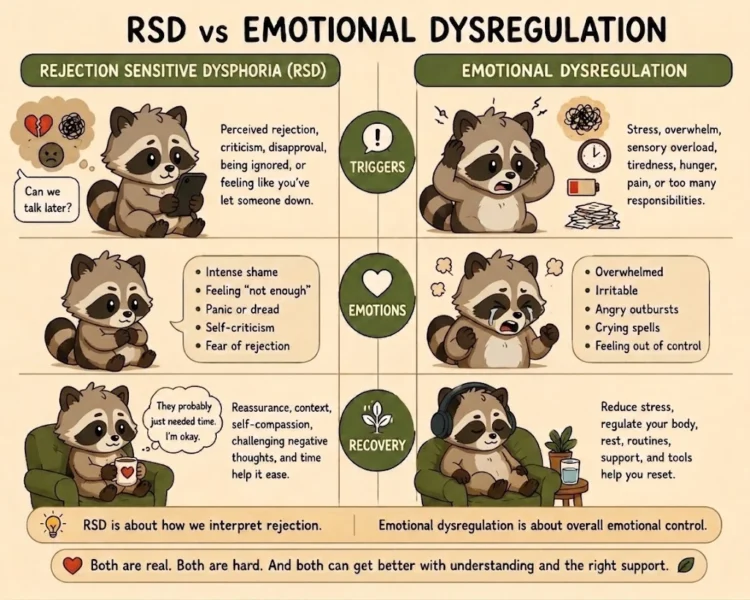
One of the easiest ways I’ve found to understand the difference is this:
Emotional dysregulation is difficulty regulating many different emotions.
RSD is one specific emotional trigger: rejection or criticism.
Think of emotional dysregulation as the umbrella.
RSD is one storm that can happen underneath it.
Someone with emotional dysregulation might become overwhelmed because they’re frustrated, overstimulated, disappointed, stressed, or excited.
Someone experiencing RSD is usually reacting to something their brain interprets as rejection.
That rejection might be:
- Real.
- Imagined.
- Misunderstood.
- Completely accidental.
Either way…
The emotional pain feels completely real.
RSD vs Emotional Dysregulation at a Glance
| Experience | Rejection Sensitive Dysphoria | Emotional Dysregulation |
|---|---|---|
| Primary trigger | Real or perceived rejection, criticism, or failure | Many different emotional situations |
| Emotional response | Intense emotional pain related to rejection | Difficulty regulating emotions in general |
| Official ADHD symptom? | No | No |
| Often discussed with ADHD? | Yes | Yes |
| Can both occur together? | Absolutely | Yes |
One doesn’t replace the other.
In fact, many people experience both.
Understanding the difference isn’t about putting yourself into a box.
It’s about finding the explanation that best matches what you’ve been experiencing.
Why Does Rejection Sensitive Dysphoria Happen?
If you’re looking for a simple answer…
Researchers don’t have one yet.
Unlike ADHD itself, RSD hasn’t been studied enough for scientists to say with certainty exactly why it happens or whether it should be considered its own condition.
What we do know is that many adults with ADHD describe remarkably similar experiences.
They aren’t just afraid of rejection.
They experience rejection differently.
Many ADHD researchers believe this may be connected to the same executive functioning and emotional regulation differences that already exist in ADHD.
If your brain already has a harder time regulating emotions, it makes sense that criticism or rejection might hit much harder.
That doesn’t mean everyone with ADHD experiences RSD.
And it doesn’t mean everyone with RSD has ADHD.
The relationship is still being studied.
I know that’s probably not the satisfying answer people want.
But I’d rather tell you what researchers actually know than pretend everything has already been figured out.
What Rejection Sensitive Dysphoria Actually Feels Like
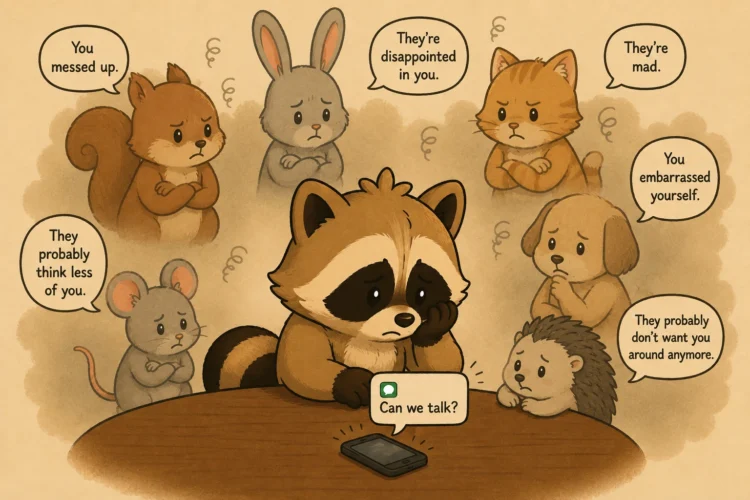
One thing I don’t think gets explained well enough is that RSD isn’t just about being hurt.
It’s about how quickly your brain fills in the blanks.
Someone replies with a short text.
They must be mad.
Your boss asks if you have a minute.
You’re probably getting fired.
Your friend cancels dinner.
They don’t enjoy spending time with you anymore.
Someone doesn’t laugh at your joke.
Now you’re wondering if everyone secretly finds you annoying.
Notice what happened there?
Very little evidence.
Very big conclusion.
That’s one reason I don’t think RSD is simply “being sensitive.”
It’s your brain taking a tiny amount of information and confidently building an entire story around it.
The difficult part is that the story often feels completely believable.
Not because it’s true.
Because your brain has already decided it is.
The Emotional Pain Feels Real
This might be one of the most important things in this entire article.
The rejection doesn’t have to be real.
The pain does.
People sometimes hear “perceived rejection” and assume it means someone imagined the whole thing.
That’s not really what we’re talking about.
Imagine watching a scary movie.
You know the monster isn’t actually in your house.
Your heart still races.
Your palms still sweat.
Your body still reacts.
Your emotions don’t always wait for proof.
RSD can feel similar.
Your logical brain might eventually realize,
“Maybe they weren’t upset with me after all.”
But that realization often comes after the emotional response.
Not before.
Why Small Moments Can Feel So Personal
One thing I’ve noticed about my own brain is that it rarely stays in the present moment.
Someone gives me constructive feedback.
Instead of hearing,
“Here’s something you can improve.”
My brain wants to hear,
“You’re not good enough.”
Those aren’t the same message.
Not even close.
But when RSD shows up, criticism can stop feeling like information and start feeling like a verdict on who you are.
That’s exhausting.
Because eventually you start trying to avoid situations where criticism might happen at all.
You stop asking questions because you don’t want to sound stupid.
You hesitate to apply for jobs because you don’t want to be rejected.
You avoid difficult conversations because you’re afraid of what you might hear.
Over time, your world can quietly become smaller.
Not because you don’t want new experiences.
Because you’re trying to protect yourself from emotional pain.
What RSD Can Look Like in Everyday Life
It isn’t always obvious.
In fact, many people around you may never realize it’s happening.
Some common experiences include:
- Reading too much into someone’s facial expression.
- Apologizing even when you haven’t done anything wrong.
- Assuming silence means someone is upset with you.
- Replaying conversations for hours afterward.
- Avoiding situations where you might be criticized.
- Feeling embarrassed long after everyone else has moved on.
- Becoming defensive before the other person even finishes speaking.
- Working yourself to exhaustion because you’re terrified of disappointing people.
Not everyone with RSD experiences all of these.
And plenty of people experience some of them without having ADHD.
The goal isn’t to use this list to diagnose yourself.
It’s simply to help you recognize patterns that may be worth exploring with a qualified healthcare professional.
RSD vs. Anxiety
This is one of the easiest places to get confused.
At first glance, they can look almost identical.
Both can involve overthinking.
Both can involve worrying about relationships.
Both can involve expecting the worst.
The difference often comes down to the trigger.
Anxiety usually asks,
“What if something bad happens?”
RSD often says,
“Something bad already happened.”
Even if it didn’t.
One looks forward.
The other reacts.
That doesn’t mean they’re completely separate.
Many people with ADHD experience anxiety too.
Sometimes years of rejection, criticism, or misunderstanding naturally create anxiety over time.
That’s one reason it’s so important not to assume every emotional experience comes from a single cause.
RSD vs. Social Anxiety
People also confuse these two all the time.
Social anxiety is usually about fearing embarrassment, judgment, or humiliation before or during social situations.
RSD often shows up after the interaction.
You get home.
Now your brain starts reviewing everything you said.
“Did they think I talked too much?”
“Why did they make that face?”
“I probably sounded ridiculous.”
Or maybe you receive one piece of criticism.
Now you’re convinced the entire relationship has changed.
Both experiences can overlap.
They’re just not the same thing.
RSD vs. Low Self-Esteem
Someone with low self-esteem may generally believe they aren’t good enough.
RSD is different.
You might feel perfectly confident…
Until one moment of rejection.
Then suddenly everything crashes.
It’s less like constantly carrying around a heavy backpack.
It’s more like walking through your day normally and unexpectedly stepping on a landmine.
One event.
One comment.
One misunderstood text.
And suddenly your entire emotional landscape changes.
RSD vs Anxiety, Social Anxiety, and Low Self-Esteem
| Experience | Rejection Sensitive Dysphoria | Anxiety | Social Anxiety | Low Self-Esteem |
|---|---|---|---|---|
| Main trigger | Rejection or criticism | Future uncertainty | Social situations | Negative self-beliefs |
| Typical thought | “They don’t like me anymore.” | “What if something goes wrong?” | “I’ll embarrass myself.” | “I’m not good enough.” |
| When it happens | Usually after a perceived rejection | Often before a feared event | Before or during social situations | Can be persistent |
| Can overlap with ADHD? | Yes | Yes | Yes | Yes |
One thing I hope you notice is that none of these experiences exist in isolation.
Human emotions are messy.
It’s completely possible to have ADHD, RSD, anxiety, and low self-esteem all influencing one another.
That’s why understanding yourself isn’t about finding the one perfect label.
It’s about finding explanations that help you make sense of your experiences, and knowing when it’s time to bring those questions to a qualified professional.
Can Rejection Sensitive Dysphoria Be Managed?
I wish I could tell you there was one trick that made RSD disappear.
There isn’t.
If there were, I would’ve written this article in about three paragraphs and called it a day.
Managing RSD usually isn’t about eliminating rejection sensitivity.
It’s about shortening the distance between what your brain assumes… and what’s actually true.
That takes practice.
Sometimes a lot of it.
Here are the strategies that seem to help many adults with ADHD.
Learn Your Triggers
You can’t prepare for something you don’t recognize.
Start paying attention to the situations that consistently hit you the hardest.
Maybe it’s:
- Constructive feedback.
- Someone changing their tone.
- Short text messages.
- Being interrupted.
- Someone cancelling plans.
- Feeling left out.
- Making a mistake at work.
You might even notice patterns.
Maybe you’re far more emotionally reactive when you’re exhausted.
Or hungry.
Or already stressed.
The goal isn’t to avoid every trigger.
The goal is to recognize them before they completely take over.
Challenge the Story Your Brain Is Writing
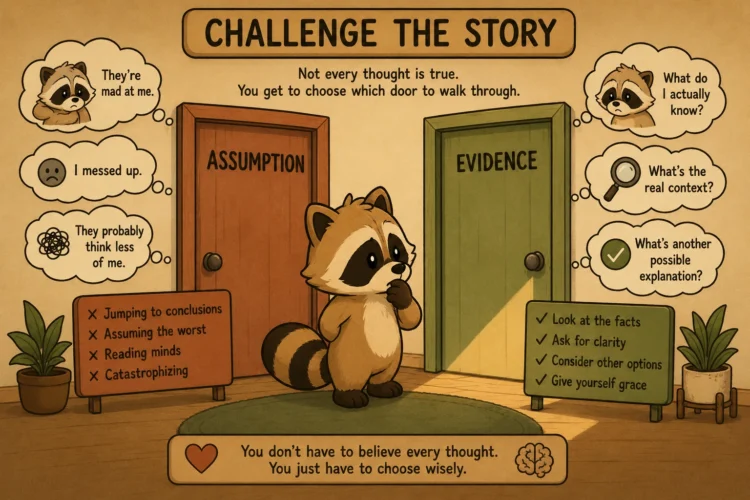
This has probably helped me more than anything else.
Because here’s what I’ve learned…
My emotions usually aren’t lying.
But my explanations sometimes are.
There’s a difference.
If someone doesn’t text me back…
The feeling of anxiety is real.
The story my brain immediately creates?
“They’re mad at me.”
That part deserves a second look.
One question has become incredibly helpful:
“What evidence do I actually have?”
Not…
“What do I feel?”
Not…
“What do I think?”
Evidence.
Sometimes there is evidence.
A lot of times…
There isn’t.
Give Yourself Time Before Reacting
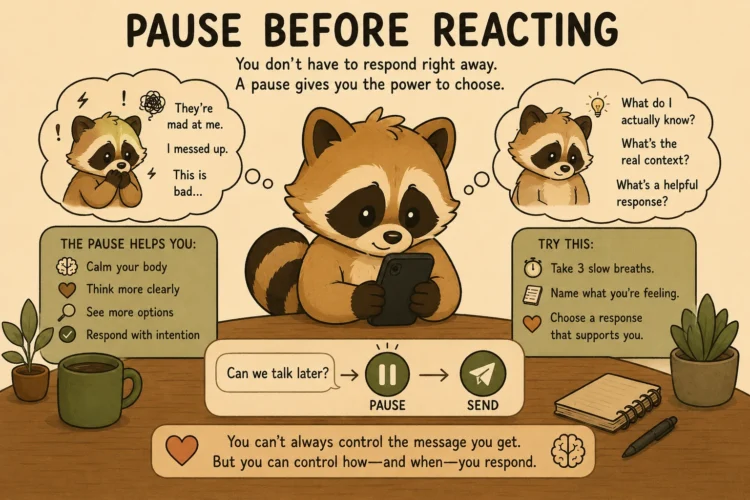
One of the hardest parts about RSD is that it demands immediate action.
Reply now.
Apologize now.
Explain yourself now.
Fix everything now.
But urgency doesn’t always mean emergency.
I’ve learned that some of my biggest regrets happened because I reacted to the story in my head instead of the situation in front of me.
Sometimes waiting thirty minutes changes everything.
Sometimes sleeping on it changes even more.
The situation may not be different.
Your perspective often is.
Talk to Someone You Trust
One thing I’ve noticed is that RSD loves isolation.
When you’re sitting alone with your thoughts, your brain can become an excellent lawyer.
It builds an incredibly convincing case.
Then you tell someone you trust what happened.
They listen for thirty seconds and say,
”…you know they probably just got busy, right?”
Sometimes that’s all it takes.
Not because they magically fixed your emotions.
Because they gave your brain another explanation to consider.
Practice Separating Feelings From Facts
This one takes time.
A lot of time.
Instead of saying,
“They hate me.”
Try saying,
“I feel like they might be upset with me.”
That one small change creates space.
It reminds your brain that feelings and facts aren’t always the same thing.
It sounds simple.
It isn’t.
But it gets easier with practice.
When Should You Seek Professional Help?
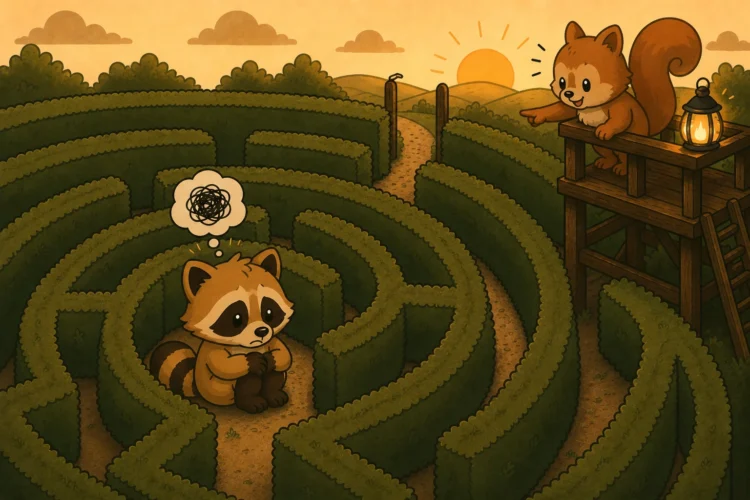
Everyone worries about rejection sometimes.
Everyone has moments where criticism stings.
RSD becomes more concerning when those reactions begin affecting your daily life.
Consider talking with a qualified healthcare professional if rejection sensitivity is:
- Damaging your relationships.
- Causing you to avoid opportunities.
- Making work or school significantly more difficult.
- Leading to constant anxiety about what other people think.
- Causing emotional reactions that feel impossible to control.
- Accompanied by persistent anxiety, depression, hopelessness, or thoughts of self-harm.
A mental health professional can help determine whether ADHD, anxiety, trauma, depression, or something else may be contributing to what you’re experiencing.
It’s important not to assume RSD is the only explanation.
If you’re experiencing thoughts of harming yourself or suicide, or you feel like you’re in immediate danger, call or text 988 in the United States or contact your local emergency services if you’re elsewhere.
You don’t have to carry that alone.
Frequently Asked Questions
Is Rejection Sensitive Dysphoria an official diagnosis?
No.
RSD is not an official diagnosis, and it isn’t included in the DSM-5-TR diagnostic criteria for ADHD.
However, it’s widely discussed within the ADHD community because many clinicians and adults with ADHD recognize similar experiences.
Does everyone with ADHD have RSD?
No.
Many people with ADHD report experiences that resemble RSD, but not everyone does.
ADHD affects everyone differently.
Can you have RSD without ADHD?
Yes.
Although RSD is most commonly discussed alongside ADHD, intense rejection sensitivity can occur in people without ADHD as well.
That’s one reason it’s important not to self-diagnose based on one symptom.
Is RSD the same as emotional dysregulation?
Not exactly.
Emotional dysregulation refers to difficulty regulating many different emotions.
RSD focuses specifically on intense emotional reactions to real or perceived rejection, criticism, or failure.
Many people experience both.
Can ADHD medication help RSD?
Some people report that treating their ADHD also improves rejection sensitivity.
Others continue experiencing RSD even when their ADHD symptoms improve.
Researchers are still learning about this relationship, so treatment decisions should always be discussed with a qualified healthcare professional.
Does RSD ever get better?
It can.
Many adults find that understanding their triggers, therapy, ADHD coaching, healthier coping strategies, and, when appropriate, ADHD treatment all help reduce the intensity or duration of RSD over time.
The goal isn’t to stop caring about people.
It’s to stop assuming the worst before you have the facts.
Final Thoughts
If there’s one thing I wish someone had told me years ago, it’s this:
Not every uncomfortable silence means someone is angry with you.
Not every short text message means you’ve done something wrong.
Not every piece of criticism is a rejection of who you are.
For a long time, I confused uncertainty with certainty.
If I didn’t know what someone was thinking…
My brain happily filled in the blanks.
Usually with the worst possible explanation.
Learning about RSD didn’t stop those thoughts from showing up.
What it changed was how much I believed them.
Now, instead of immediately accepting the first story my brain writes, I try to get curious.
“Do I actually know that’s true?”
Sometimes the answer is yes.
Most of the time…
It isn’t.
That one question has probably saved me more emotional energy than anything else I’ve learned.
If this article sounded painfully familiar, I hope you leave with one thought:
Your emotions deserve compassion.
Your assumptions deserve curiosity.
Learning the difference can change a lot.
Research & Editorial Standards
Every article on ADHDefined combines lived experience with evidence-informed research. Our goal is to explain ADHD in plain language while accurately reflecting the current scientific understanding.
Personal experiences are included to help readers relate to common ADHD experiences. They are not presented as scientific evidence. When personal experience and current research differ, we prioritize the best available evidence.
While our content is not a substitute for professional medical advice, we develop and review our articles using guidance from trusted organizations, recognized ADHD experts, and peer-reviewed scientific literature whenever appropriate.
Sources Used for This Article
This article was developed using information and educational resources from: