
Quick Answer
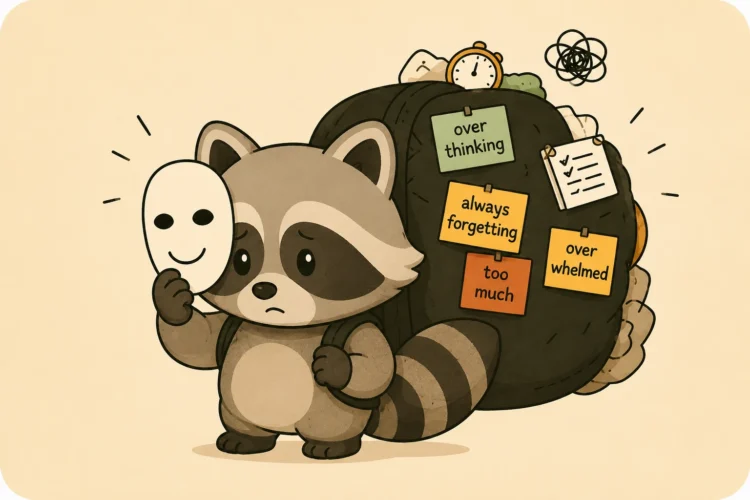
ADHD masking is the conscious or unconscious habit of hiding ADHD traits to appear more organized, attentive, calm, or socially acceptable. Many people learn to mask after years of criticism, rejection, or feeling different. While masking can sometimes help someone navigate school, work, or relationships, doing it constantly can become mentally exhausting and contribute to stress, burnout, anxiety, and a loss of authenticity.
Introduction
Have you ever gotten home after work, closed the front door, and felt like you could finally exhale?
Not because the day was especially hard.
But because you could finally stop pretending.
For years, I thought everyone had to work this hard just to seem “normal.” I thought everyone rehearsed conversations before they happened, reminded themselves not to interrupt, forced themselves to make eye contact, laughed at jokes they didn’t quite process, or spent all day trying to hide how overwhelmed they really felt.
I didn’t realize there was a name for it.
It’s called masking.
Masking doesn’t necessarily mean pretending to be someone you’re not. It’s often much more subtle than that. It can look like double-checking everything so nobody notices your forgetfulness. It can mean staying quiet because you’re afraid of interrupting someone. It can mean acting calm even though your mind feels like fifty browser tabs are open at once.
Many adults with ADHD don’t even realize they’re masking because they’ve been doing it for so long. What started as a way to avoid criticism, embarrassment, or rejection can eventually feel like second nature.
The problem is that constantly hiding parts of yourself takes energy. Sometimes a lot of it.
In this article, we’ll look at what ADHD masking actually is, why so many people do it, what it can look like in everyday life, and why understanding it can be an important step toward understanding yourself.
What Is ADHD Masking?
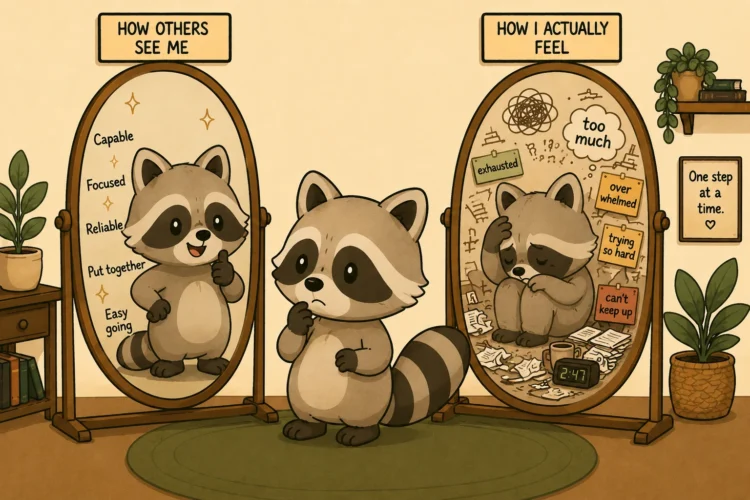
ADHD masking is the conscious or unconscious habit of hiding, minimizing, or compensating for ADHD traits so they aren’t as noticeable to other people.
Sometimes it’s intentional.
You realize you’re about to interrupt someone, so you stop yourself.
You set five alarms because you’re afraid of being late.
You spend an extra hour organizing your notes before a meeting because you don’t want anyone to think you’re disorganized.
Other times, you don’t even realize you’re doing it.
After years of adapting to school, work, relationships, and social expectations, certain behaviors become automatic. You may have learned to hide your ADHD so well that it simply feels like part of your personality.
Current research suggests that many people with ADHD develop masking behaviors over time, although researchers are still learning how common it is and how it affects long-term mental health. While masking has been studied more extensively in autism, growing research and clinical experience suggest it’s also an important part of many people’s ADHD experience.
Masking doesn’t mean you’re being fake.
Most people aren’t trying to deceive anyone. They’re trying to avoid being misunderstood.
For many adults, masking starts long before they know they have ADHD.
Imagine hearing some version of these comments for years:
- “You need to pay attention.”
- “Stop interrupting.”
- “You’re so smart. Why don’t you apply yourself?”
- “Just try harder.”
- “You’re always forgetting something.”
- “You need to be more organized.”
After hearing those messages enough times, it’s natural to start changing your behavior, not because your ADHD disappeared, but because you don’t want to be criticized again.
Over time, masking can become a survival strategy.
ADHD Masking Isn’t the Same as Managing ADHD
One of the biggest misconceptions is that masking means you’re successfully managing your ADHD.
They’re not the same thing.
| Managing ADHD | Masking ADHD |
|---|---|
| Uses strategies that make life easier. | Hides struggles from other people. |
| Focuses on improving daily functioning. | Focuses on appearing “normal.” |
| Reduces stress over time. | Can increase stress and exhaustion over time. |
| Accepts that ADHD exists. | Often tries to make ADHD invisible. |
For example, using a digital calendar because it genuinely helps you remember appointments is a management strategy.
Pretending you remembered the appointment all along because you’re embarrassed you almost forgot is masking.
The behavior might look similar from the outside, but the motivation is very different.
Why Do People Mask ADHD?
Nobody wakes up one morning and decides to start masking.
For most people, it happens little by little.
You forget your homework.
So you become the student who obsessively checks your backpack three times before leaving.
You interrupt someone.
They look annoyed.
Next time, you stay completely quiet, even when you have something important to say.
You miss a deadline.
After that, you spend hours over-preparing because you’re terrified of making another mistake.
Each adjustment makes sense on its own.
Years later, you may realize you’re constantly monitoring yourself.
Many people describe feeling like they’re always asking themselves questions such as:
- Am I talking too much?
- Did I interrupt?
- Am I making enough eye contact?
- Did I miss something everyone else understood?
- Am I forgetting anything?
- Do I look distracted?
- Does anyone notice how overwhelmed I feel?
That kind of self-monitoring is exhausting.
Research suggests there isn’t one single reason people mask. Instead, it’s often influenced by a combination of experiences, including:
- Wanting to fit in socially.
- Avoiding criticism or embarrassment.
- Fear of disappointing others.
- Trying to succeed at work or school.
- Learning to compensate after years of struggling.
- Previous experiences of rejection or misunderstanding.
Some people also notice their masking becomes stronger in certain environments.
For example, someone might feel completely comfortable being themselves at home but spend the entire workday trying not to appear distracted, impulsive, or overwhelmed.
Masking isn’t necessarily a sign that someone lacks confidence.
Sometimes it’s simply what they’ve learned they need to do to get through the day.
Signs You Might Be Masking ADHD
Everyone masks differently, so there isn’t a checklist that fits everyone.
Still, many adults with ADHD recognize themselves in experiences like these:
- Rehearsing conversations before they happen.
- Holding back comments because you’re afraid of interrupting.
- Pretending you understood instructions when you didn’t.
- Laughing along with a conversation while you’re still trying to process what was said.
- Spending far more time preparing than other people realize.
- Hiding forgotten appointments or mistakes out of embarrassment.
- Acting calm even when your thoughts feel overwhelming.
- Waiting until you’re alone before letting yourself mentally or emotionally crash.
- Constantly comparing yourself to people who seem to handle everyday tasks effortlessly.
- Feeling like people only know the version of you that’s working incredibly hard to keep everything together.
None of these experiences automatically mean someone is masking ADHD.
But if several of them feel familiar, and they leave you feeling mentally drained, it may be worth reflecting on whether you’ve spent years hiding parts of yourself without realizing it.
What Does ADHD Masking Feel Like?
One of the hardest things about ADHD masking is that most people never see it.
From the outside, someone might look organized, calm, successful, and completely in control.
On the inside, they’re working twice as hard just to keep everything from falling apart.
That’s why people often say things like:
“Nobody would ever guess I have ADHD.”
It isn’t necessarily because their ADHD is mild.
It’s because they’re putting an enormous amount of effort into making sure nobody notices.
Imagine trying to keep dozens of beach balls underwater at the same time.
As long as you keep pushing, everything looks calm from the surface.
The moment you stop, they all pop back up at once.
For many people, masking feels like that.
It’s not that the ADHD disappears.
It’s that you’re constantly managing how much of it other people can see.
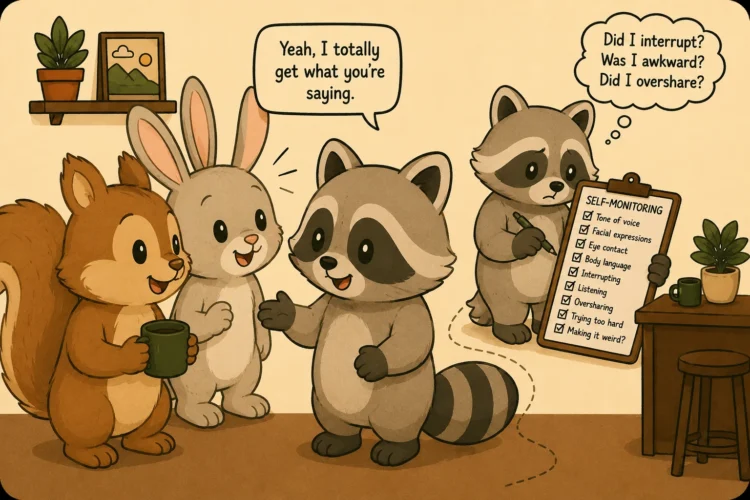
You’re Always Watching Yourself
One thing I’ve noticed is that masking can make you feel like you’re constantly observing yourself instead of simply living your life.
You’re having a conversation…
…but another part of your brain is asking questions like:
- Am I talking too much?
- Am I making enough eye contact?
- Did I interrupt?
- Am I rambling?
- Did that joke land?
- Am I sitting still enough?
- Do I look distracted?
Instead of being fully present, part of your attention is spent monitoring yourself.
That mental effort adds up.
By the end of the day, you might feel completely exhausted without understanding why.
It Can Feel Like You’re Playing a Character
Some people describe masking as feeling like an actor.
Not because they’re pretending to be someone else…
…but because they’re constantly editing themselves.
Maybe you stop yourself from talking about the hobby you’re currently obsessed with because you’re worried people will think you’re “too much.”
Maybe you force yourself to sit perfectly still during meetings even though every part of you wants to move.
Maybe you smile and say,
“Everything’s good.”
Even when your brain feels completely overloaded.
Over time, you can start wondering:
Which parts of me are actually me… and which parts did I learn to hide?
That can be a surprisingly difficult question to answer.
The Mask Usually Comes Off Somewhere
Most people can’t mask forever.
Eventually, something has to give.
For some people, that’s the moment they get home after work.
For others, it’s after a family gathering.
Or after spending the entire day trying to stay focused in meetings.
The moment they’re finally alone…
…they collapse onto the couch.
Not because they did intense physical work.
Because they’ve spent the entire day managing themselves.
That kind of exhaustion is one reason researchers and clinicians have become increasingly interested in ADHD masking. While the research is still developing, many adults describe masking as mentally draining, especially when it becomes a daily habit rather than something they use only in certain situations.
Common Examples of ADHD Masking
Masking doesn’t always look obvious.
In fact, many of the behaviors below are things other people might even compliment.
| What People See | What’s Happening Behind the Scenes |
|---|---|
| “You’re always so organized.” | You created six reminders because you’re terrified of forgetting. |
| “You’re so quiet.” | You’re constantly stopping yourself from interrupting. |
| “You never miss deadlines.” | You started the project at the last possible minute and stayed up until 3 a.m. to finish it. |
| “You’re a great listener.” | You’re working incredibly hard to stay focused because your mind keeps drifting. |
| “You’ve got everything together.” | You’re mentally exhausted from trying to keep everything together. |
That’s one reason masking can be confusing.
Sometimes the very behaviors people praise are the ones costing you the most energy.
How ADHD Masking Can Affect Daily Life
Masking isn’t automatically harmful.
In some situations, it can genuinely help.
For example, you might make a conscious effort not to interrupt someone during an important conversation.
That’s not necessarily a bad thing.
The problem is when masking becomes your default way of existing.
When that happens, it can affect almost every part of your life.
Work
You may spend far more time preparing than your coworkers because you’re afraid of making a mistake.
You might avoid asking questions because you don’t want anyone to think you weren’t paying attention.
You may even stay late, not because you have more work than everyone else, but because it took so much mental energy to appear focused throughout the day.
Relationships
Masking can make relationships surprisingly lonely.
Friends, family members, or partners may only know the version of you that’s constantly trying to seem calm, organized, and unaffected.
Meanwhile, the parts of you that struggle never really get seen.
That can make it difficult to feel fully understood, even by people who care about you.
Mental Health
Researchers are still learning about the long-term effects of ADHD masking, but many adults report that constantly hiding their difficulties contributes to stress, anxiety, emotional exhaustion, and burnout.
It’s important to remember that masking itself doesn’t necessarily cause these experiences.
Life is complicated, and many factors influence mental health.
But if you spend years feeling like you can never fully relax or be yourself, it’s understandable why that might become exhausting over time.
Self-Identity
Perhaps the hardest part isn’t the exhaustion.
It’s wondering who you are underneath the mask.
If you’ve spent years changing how you speak…
how you act…
how you work…
how you socialize…
…you may eventually ask yourself:
“What would I be like if I stopped trying so hard to hide?”
That doesn’t mean throwing away every coping strategy you’ve developed.
It means learning the difference between adapting in healthy ways and constantly feeling like you have to hide who you are.
ADHD Masking vs. Autism Masking
If you’ve spent any time reading about masking, you’ve probably noticed that many articles focus on autism.
That’s because masking has been studied much more extensively in autistic people than it has in people with ADHD.
As researchers have looked more closely at ADHD, they’ve found that many adults describe similar experiences of hiding, suppressing, or compensating for traits they worry other people will judge.
The important thing to remember is that ADHD masking and autism masking are not the same thing, even though they can overlap.
Someone can have ADHD and mask.
Someone can be autistic and mask.
Someone can have both ADHD and autism (sometimes called AuDHD) and experience masking related to both conditions.
The reason for masking—and what someone is trying to hide—may be different.
| ADHD Masking | Autism Masking |
|---|---|
| Hiding distractibility, impulsivity, forgetfulness, or disorganization. | Hiding autistic traits, social differences, repetitive behaviors, or sensory needs. |
| May involve over-preparing, self-monitoring, or suppressing impulsive behaviors. | May involve copying social behaviors, forcing eye contact, scripting conversations, or hiding stimming. |
| Often develops after criticism for ADHD-related behaviors. | Often develops after social pressure to appear neurotypical. |
There’s also plenty of overlap.
For example, someone with either condition might:
- Rehearse conversations.
- Constantly monitor their behavior.
- Feel exhausted after social situations.
- Worry about saying the wrong thing.
- Feel like nobody knows the “real” them.
Because of that overlap, masking alone can’t tell you whether someone has ADHD, autism, both, or neither.
That’s one reason a comprehensive evaluation from a qualified healthcare professional is so important when someone is trying to understand what’s behind their experiences.
Is Masking Always Bad?
When I first learned about ADHD masking, I assumed the goal was to stop doing it completely.
I realized it isn’t that simple.
Sometimes masking can be helpful.
Imagine you’re in an important meeting.
You notice the urge to interrupt, but you pause and let the other person finish speaking.
That’s not necessarily unhealthy.
Or maybe you’re giving a presentation and you consciously organize your thoughts beforehand because you know it helps you communicate more clearly.
Again, that’s not a bad thing.
Those are examples of adapting to a situation.
The concern is when masking stops being an occasional strategy and starts becoming your default way of moving through the world.
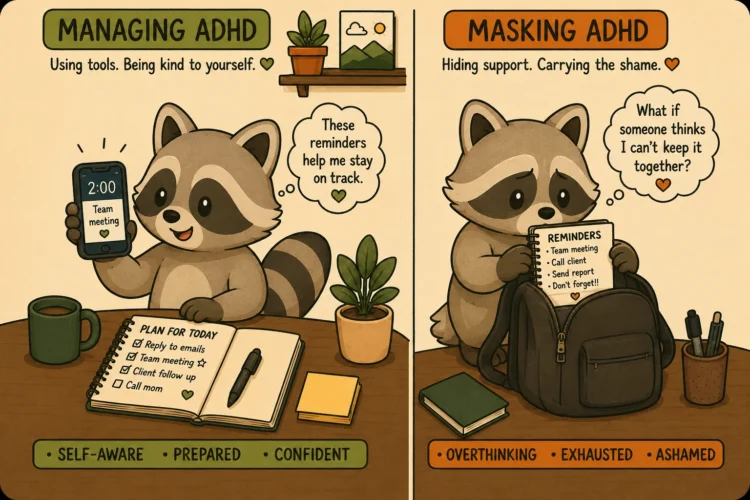
| Managing ADHD | Masking ADHD |
|---|---|
| Uses reminders openly because they help. | Hides reminders because of embarrassment. |
| Accepts that ADHD is part of life. | Tries to make ADHD invisible. |
| Uses tools to reduce stress. | Uses energy to hide struggles. |
| Focuses on functioning better. | Focuses on appearing “normal.” |
| Leads to greater self-acceptance. | Often leads to exhaustion and shame. |
Healthy coping strategies usually make life easier.
Chronic masking often makes life more exhausting.
One question that can be helpful to ask yourself is:
“Am I doing this because it genuinely helps me, or because I’m afraid of what people will think if I don’t?”
There’s no perfect answer.
Sometimes it’s both.
The goal isn’t to judge yourself.
It’s simply to become more aware of why you’re doing what you’re doing.
Can You Stop Masking?
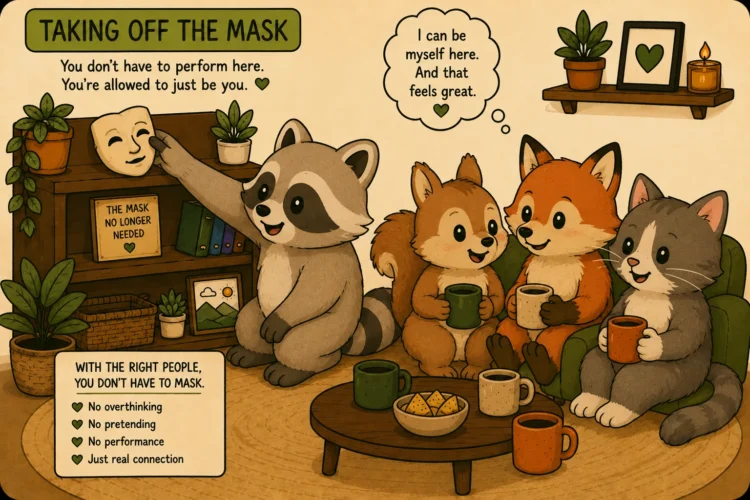
Many people hope there’s a moment where they can simply decide:
“I’m done masking.”
For most people, it doesn’t work that way.
Masking often develops over many years.
It becomes automatic.
You don’t wake up and consciously decide to monitor every conversation or double-check everything you do.
Your brain simply learned that those behaviors reduced the chances of being criticized, embarrassed, or misunderstood.
Because of that, unmasking usually isn’t something that happens overnight.
It’s more like gradually giving yourself permission to need less armor.
That might look like:
- Asking someone to repeat themselves instead of pretending you heard them.
- Using reminders without feeling embarrassed about it.
- Telling a trusted friend that you lose your train of thought sometimes.
- Letting yourself move, fidget, or doodle if it helps you pay attention.
- Saying, “I need a minute to think,” instead of feeling pressured to respond immediately.
For some people, receiving an ADHD diagnosis helps explain behaviors they’ve spent years trying to hide.
For others, medication, therapy, coaching, or learning more about ADHD can make masking feel less necessary because they’re developing strategies that actually support them rather than simply covering up their struggles.
There’s no requirement to completely stop masking.
In fact, everyone adjusts their behavior depending on the situation.
Most people speak differently at work than they do with close friends.
That’s normal.
The goal isn’t to eliminate every form of masking.
The goal is to reach a point where you don’t feel like you have to hide who you are just to deserve acceptance.
You Don’t Have to Earn the Right to Be Yourself
If you’ve spent years masking your ADHD, there’s a chance you’ve become so good at it that other people have no idea how much effort it takes.
They may only see someone who looks organized, capable, and calm.
They don’t see the reminders.
The mental checklists.
The rehearsed conversations.
The constant self-monitoring.
Or the exhaustion that sometimes comes after trying to hold it all together.
Learning about masking doesn’t mean you suddenly stop doing it.
But it can help explain why life sometimes feels so much harder than it appears from the outside.
And sometimes, simply having a name for that experience is the beginning of treating yourself with a little more understanding.
Practical Strategies for Reducing ADHD Masking
If you’ve realized you’ve been masking for years, you might feel tempted to stop all at once.
You don’t have to.
In fact, trying to suddenly change every habit you’ve built over decades can be overwhelming.
A better approach is to become more intentional.
Instead of asking,
“How do I stop masking?”
Try asking,
“Where am I masking, and is it actually helping me?”
Sometimes the answer will be yes.
Sometimes it won’t.
The goal isn’t to become a completely different person.
It’s to spend less energy hiding and more energy living.
1. Notice When You’re Self-Monitoring
The first step is simply paying attention.
Throughout the day, notice moments when you’re constantly monitoring yourself.
For example:
- Replaying a conversation immediately after it ends.
- Worrying that you talked too much.
- Pretending you remembered something you actually forgot.
- Hiding that you’re overwhelmed.
- Saying “I’m fine” when you’re clearly struggling.
You don’t have to change those moments right away.
Just notice them.
Awareness usually comes before change.
2. Separate Helpful Strategies From Fear-Based Habits
Not every coping strategy is masking.
Using a planner…
setting reminders…
keeping a to-do list…
or asking someone to repeat themselves…
are all examples of accommodations that can genuinely make life easier.
Ask yourself:
“If nobody judged me for having ADHD, would I still do this?”
If the answer is yes, it’s probably a strategy that’s helping you.
If the answer is no, it may be worth exploring whether fear of being judged is driving that behavior.
3. Practice Being Honest in Safe Places
You don’t have to tell everyone about your ADHD.
But you may not need to hide it from everyone either.
Sometimes being honest sounds like:
- “Can you text me that? I’ll remember it better.”
- “I completely lost my train of thought.”
- “Would you mind repeating that?”
- “I’m writing this down because I’ll forget.”
Most people have probably said something similar at some point.
You may be surprised by how little anyone reacts.
4. Stop Measuring Yourself Against Your Mask
This one can be difficult.
If you’ve spent years presenting the version of yourself that always has everything together, that version can quietly become the standard you expect yourself to meet.
The problem is…
that person isn’t real.
They’re the result of constant effort.
Instead of asking,
“Why can’t I keep everything together all the time?”
Try asking,
“Am I expecting myself to maintain something that’s impossible to sustain?”
That’s a much kinder question.
5. Build a Life That Requires Less Masking
Sometimes the goal isn’t changing yourself.
It’s changing your environment.
That might mean:
- Using tools that support your memory.
- Working in a quieter space.
- Taking movement breaks.
- Setting realistic expectations.
- Spending more time with people who don’t make you feel like you have to pretend.
When your environment supports your brain, you often need less masking in the first place.
When Should You Seek Professional Help?
Masking itself isn’t a diagnosis, and not everyone who masks needs professional support.
However, it may be worth talking with a qualified healthcare professional if masking leaves you feeling emotionally exhausted, affects your relationships, interferes with work or school, or makes it difficult to feel like yourself.
A mental health professional with experience in ADHD can help you better understand what’s contributing to your experiences and work with you to develop strategies that fit your individual needs.
If you think you may have ADHD but have never been evaluated, seeking an assessment can also be a helpful step toward understanding what you’re experiencing.
You don’t have to figure everything out on your own.
Frequently Asked Questions
Is ADHD masking a real thing?
Yes. Although ADHD masking is not part of the official diagnostic criteria for ADHD, researchers and clinicians increasingly recognize that many people consciously or unconsciously hide or compensate for ADHD traits. Research into ADHD masking is still developing, but many adults describe it as a significant part of their lived experience.
Is ADHD masking the same as autism masking?
No.
The two share similarities, but they are not identical.
People with ADHD may hide distractibility, impulsivity, or disorganization, while autistic masking often involves hiding autistic traits or consciously adapting social behaviors. Some people have both ADHD and autism and may experience aspects of both.
Can masking lead to burnout?
It may contribute.
Current research is still evolving, but many adults report that constantly monitoring themselves and hiding ADHD-related difficulties becomes mentally exhausting over time. For some people, that ongoing effort may contribute to stress or burnout alongside other factors.
Why do I feel exhausted after social situations?
There are many possible reasons.
For some people with ADHD, social situations involve constant self-monitoring, trying not to interrupt, remembering names, following conversations, staying focused, and worrying about how they’re being perceived. That mental effort can leave someone feeling drained afterward.
Is it possible to stop masking completely?
Probably not, and that isn’t necessarily the goal.
Everyone adjusts their behavior depending on the situation.
The healthier goal is to recognize when masking is helping you versus when it’s preventing you from being yourself or leaving you emotionally exhausted.
Research & Editorial Standards
Every article on ADHDefined combines lived experience with evidence-informed research. Our goal is to explain ADHD in plain language while accurately reflecting the current scientific understanding.
Personal experiences are included to help readers relate to common ADHD experiences. They are not presented as scientific evidence. When personal experience and current research differ, we prioritize the best available evidence.
While our content is not a substitute for professional medical advice, we develop and review our articles using guidance from trusted organizations, recognized ADHD experts, and peer-reviewed scientific literature whenever appropriate.
Sources Used for This Article
This article was researched and reviewed using guidance from the following organizations and educational resources:
- National Institute of Mental Health (NIMH) – Attention-Deficit/Hyperactivity Disorder (ADHD)
- Children and Adults with Attention-Deficit/Hyperactivity Disorder (CHADD)
- Attention Deficit Disorder Association (ADDA)
These organizations provide evidence-informed information about ADHD, including symptoms, diagnosis, treatment, and the lived experiences of adults with ADHD. Research on ADHD masking is still emerging, so this article also reflects current expert consensus where appropriate while distinguishing established evidence from evolving areas of study.