

Quick Answer
ADHD can affect nearly every part of a relationship, including communication, emotional regulation, memory, time management, and follow-through. These challenges don’t mean someone loves their partner any less. Understanding how ADHD influences everyday behavior can help couples replace blame with better communication and practical strategies that actually work.
Key Takeaways
- ADHD often affects relationships in ways that are easy to misunderstand.
- Many conflicts come from differences in how ADHD impacts communication, memory, and emotional regulation, not from a lack of love.
- Understanding ADHD doesn’t remove responsibility, but it can change how couples approach problems.
- Practical systems usually work better than relying on memory or good intentions.
- Healthy relationships are absolutely possible with ADHD, but they often require different tools.
Introduction
If you’ve ever been in a relationship, you’ve probably had an argument that started over something small.
A forgotten errand.
A text message that never got answered.
Showing up late.
Leaving the kitchen a mess.
For most couples, those things are annoying.
For couples where ADHD is part of the picture, they can slowly turn into something much bigger.
Over time, the conversation stops being about the dishes.
Or the laundry.
Or the forgotten phone call.
Instead, it becomes…
“You don’t listen to me.”
“You never follow through.”
“You always forget.”
“I feel like I’m doing everything.”
If you have ADHD, hearing those things can be painful because you may already be telling yourself the exact same things.
You know you forgot.
You know you got distracted.
You know you said you’d do it.
You probably didn’t wake up that morning planning to disappoint the person you love.
That’s one of the hardest parts about ADHD and relationships.
The outside world often sees the outcome.
The missed appointment.
The unfinished chore.
The interrupted conversation.
What they don’t see is everything that happened inside your brain before those moments.
This article isn’t about blaming ADHD for every relationship problem.
Healthy relationships still require accountability, communication, and effort from both people.
But understanding how ADHD affects everyday life can help explain why the same arguments happen over and over, and why solving them often requires more than simply “trying harder.”
Whether you’re the one with ADHD, you’re in a relationship with someone who has ADHD, or you’re both trying to understand each other better, my hope is that this article helps you stop seeing each other as the problem.
Because more often than not…
ADHD is what the two of you are fighting.
Not each other.
How ADHD Can Affect Relationships
No two relationships are exactly alike.
Some couples argue about money.
Others argue about parenting.
Some rarely argue at all.
When ADHD is part of the relationship, though, certain patterns tend to show up again and again.
That’s because ADHD doesn’t just affect attention.
It can influence communication, memory, emotional regulation, organization, time management, and follow-through, all things that relationships rely on every day.
One of the biggest misconceptions is that these behaviors reflect how much someone cares.
In reality, the same ADHD symptom can be interpreted in two completely different ways.
| Your Partner Sees | What May Actually Be Happening |
|---|---|
| “You never listen.” | Your attention drifted without you realizing it. |
| “You don’t care enough to remember.” | Working memory made the information difficult to retain. |
| “You always interrupt me.” | Your brain became excited and blurted out the thought before it disappeared. |
| “You said you’d do it.” | Executive dysfunction made getting started much harder than it looked. |
| “You’re overreacting.” | Emotional dysregulation or rejection sensitivity intensified the emotional response. |
That doesn’t automatically excuse these behaviors.
If your partner feels hurt because you forgot something important, that hurt is still real.
Understanding ADHD isn’t about removing accountability.
It’s about making sure you’re solving the right problem.
If you believe someone forgot because they don’t love you, the solution is completely different than if they forgot because their brain struggles with working memory.
One assumption leads to resentment.
The other opens the door to understanding.
“You Never Listen to Me”
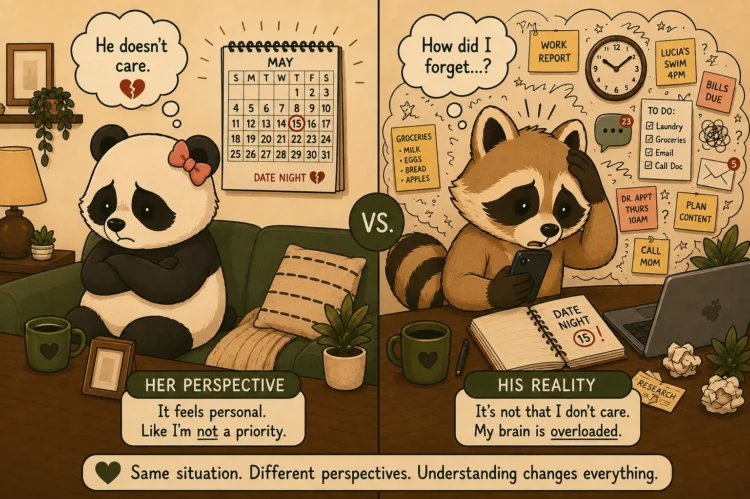
This is probably one of the most common frustrations partners describe.
From the outside, it can look like someone simply isn’t paying attention.
You’re halfway through telling a story…
…and suddenly they’re looking at the dog.
Or checking their phone.
Or asking you to repeat the last sentence.
It can feel incredibly personal.
But ADHD attention doesn’t work like an on-and-off switch.
Many people with ADHD desperately want to pay attention.
Their brain just doesn’t always cooperate.
Sometimes you’ll hear every word.
Other times your attention slips away before you even realize it happened.
I know this one hits close to home for me.
My fiancée has told me more than once that I don’t listen.
From her perspective, I completely understand why it feels that way.
If someone has to repeat themselves over and over, it would be easy to assume they aren’t important to the other person.
But from my side, it never felt like I was choosing not to listen.
In fact, I usually wanted to hear what she was saying.
My brain just wandered somewhere else without asking for permission.
Learning that ADHD affects attention didn’t magically solve the problem.
But it changed how I understood it.
Instead of thinking,
“Why can’t I just pay attention?”
I started asking,
“What can I do to help myself stay present?”
That shift matters.
Because once you stop treating it like a character flaw, you can start looking for practical solutions instead.
For example:
- Putting your phone down during important conversations.
- Asking your partner to get your attention before sharing something important.
- Repeating back what you heard to make sure you understood.
- Letting your partner know if your attention drifted instead of pretending you caught everything.
None of those strategies are perfect.
But they work a lot better than simply promising,
“I’ll try harder next time.”
“You Said You’d Do It”
If I had to guess, I’d say this is one of the biggest sources of frustration in relationships where one partner has ADHD.
It usually starts with good intentions.
“I’ll take the trash out.”
“I’ll call tomorrow.”
“I’ll make the appointment.”
“I’ll pick that up after work.”
In that moment, there’s every intention of following through.
Then life happens.
A notification pops up.
Something else feels more urgent.
The phone rings.
You walk into another room.
Three hours later, you’ve completely forgotten the promise you made.
To your partner, it can look like this:
“If it mattered to you, you would’ve done it.”
But many people with ADHD experience something very different.
The problem isn’t caring.
It’s bridging the gap between intending to do something and actually starting it.
That’s one of the reasons executive dysfunction can be so frustrating.
If you’ve read our article on Executive Dysfunction, you already know this isn’t about laziness or motivation.
Sometimes your brain knows exactly what needs to happen…
…but getting started feels like trying to push a car with the parking brake on.
Your partner doesn’t see that invisible resistance.
They just see another promise that wasn’t kept.
That disconnect can slowly chip away at trust.
Not because either person is trying to hurt the other…
…but because they’re experiencing the exact same situation from completely different perspectives.
That doesn’t mean you simply say,
“Sorry, it’s my ADHD.”
Healthy relationships still require accountability.
If you forget something important, your partner is allowed to be disappointed.
The difference is that instead of relying on memory next time, you build a system.
Maybe that means:
- Putting it in your calendar immediately.
- Setting a reminder before you leave work.
- Writing it on a whiteboard you’ll actually see.
- Doing it immediately instead of trusting you’ll remember later.
Those systems aren’t “cheating.”
They’re accommodations.
Glasses don’t cure poor eyesight.
They help someone see.
ADHD tools work the same way.
Now, I know what some of you are thinking…
“That’s great in theory, but remembering to set the reminder is hard too.”
And you’re right.
Sometimes even using the tools is part of the struggle.
That’s why managing ADHD isn’t about finding one perfect system that you’ll follow forever.
It’s about experimenting until you find systems that fit your life well enough that you’ll actually use them most of the time.
You won’t remember every reminder.
You won’t update your calendar perfectly.
I know I don’t.
The goal isn’t perfection.
It’s making life a little easier than it was yesterday.
“Why Are You So Defensive?”
This one surprised me after learning more about ADHD.
Sometimes a conversation that starts with a simple observation can suddenly feel much bigger.
Your partner says,
“Hey, you forgot to lock the door.”
Objectively, that’s a small comment.
But inside your head it might immediately become:
“I’m so careless.”
“I never get anything right.”
“They’re tired of me.”
“I’m failing again.”
Your partner probably wasn’t trying to say any of those things.
But your brain filled in the blanks before they had a chance to.
For some people, this can be related to Rejection Sensitive Dysphoria (RSD) or emotional dysregulation, both of which are commonly discussed in connection with ADHD.
Not everyone with ADHD experiences RSD, and RSD itself isn’t an official diagnosis in the DSM.
But many adults describe feeling intense emotional pain in response to criticism, disappointment, or the possibility of letting someone down.
That doesn’t mean every disagreement is caused by ADHD.
Sometimes criticism is fair.
Sometimes you’ve genuinely made a mistake.
The challenge is recognizing when your emotional response has become much bigger than the situation itself.
I’ve noticed this in my own life.
There have been times when someone gave me feedback, and before they even finished talking, my brain had already decided they thought I was a terrible person.
Looking back, that usually wasn’t what they were saying at all.
It was the story my brain wrote before I had all the information.
Learning to pause before reacting hasn’t been easy.
But it’s helped me ask myself a simple question:
“Am I reacting to what they actually said… or to what I’m afraid they meant?”
That one question has probably prevented more arguments than I realize.
Why Small Things Become Big Arguments
Have you ever noticed how an argument starts over something tiny…
…and twenty minutes later you’re somehow talking about things that happened six months ago?
I’ve seen that happen more times than I’d like to admit.
One person is upset because the trash didn’t get taken out.
The other person feels attacked.
Now you’re talking about forgotten birthdays…
unfinished projects…
being late…
or feeling unappreciated.
At some point you both stop arguing about the trash.
You’re arguing about what the trash represents.
For one partner, it might represent feeling unsupported.
For the other, it represents another reminder that they can’t seem to get things right.
Neither person woke up wanting to have that fight.
But ADHD can make those moments snowball quickly.
Working memory means you might genuinely forget something your partner considers important.
Emotional dysregulation can make a small disagreement feel much bigger than it actually is.
Rejection sensitivity can make feedback feel like personal rejection instead of a request.
Executive dysfunction can make promises difficult to follow through on.
Individually, each of those things can create friction.
Together, they can make couples feel like they’re stuck on the same merry-go-round.
That’s why so many couples say,
“We keep having the same argument.”
Sometimes they are.
The topic changes.
The pattern doesn’t.
Recognizing the pattern is often the first step toward changing it.
ADHD Doesn’t Only Affect the Person Who Has It
One thing I’ve learned is that ADHD doesn’t stay contained to one person.
It affects the relationship itself.
If you’re the partner with ADHD, you may constantly feel like you’re letting someone down.
If you’re the partner without ADHD, you may feel like you’re carrying more of the mental load.
Both experiences can be true at the same time.
That’s what makes these conversations so difficult.
I’ve found that couples often get stuck because each person is defending their own experience.
One partner says,
“You never listen.”
The other responds,
“I’m trying!”
Neither person feels heard.
Neither person feels understood.
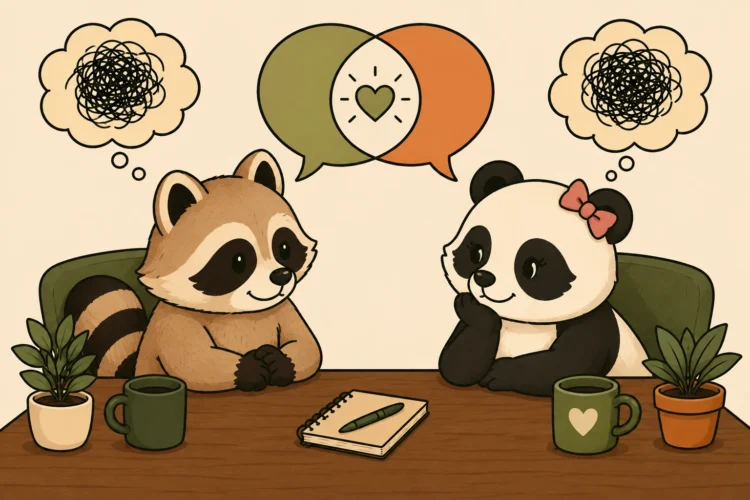
They’re answering different questions.
One is talking about the impact.
The other is talking about the intention.
What If Both Partners Have ADHD?
One question I don’t see talked about very often is…
What happens when both people in the relationship have ADHD?
At first, it might sound like the perfect match.
After all, if you’ve both lived with ADHD, you probably understand each other in ways that other people don’t.
You know what it’s like to lose your train of thought halfway through a sentence.
You understand that forgetting something doesn’t automatically mean someone doesn’t care.
You know how exhausting it can be to constantly feel like you’re trying to keep up with everyone else.
That kind of shared understanding can be incredibly comforting.
Sometimes you don’t even have to explain why you’re overwhelmed.
The other person just gets it.
But sharing ADHD doesn’t automatically make relationships easier.
In some ways, it creates a completely different set of challenges.
I was recently talking with a coworker who also has ADHD and is married to someone with ADHD.
One thing she told me really stuck with me.
Some days, they understand each other better than anyone else could.
Other days, it’s like two ADHD brains are trying to solve the same problem at the same time.
That conversation reminded me that sharing ADHD doesn’t automatically make a relationship easier.
Imagine two people who both struggle with procrastination.
Two people who both lose track of time.
Two people who both forget appointments.
Two people who both hate making phone calls.
Someone still has to remember the dentist appointment.
Someone still has to pay the electric bill.
Someone still has to decide what’s for dinner.
Sometimes one partner naturally has strengths where the other struggles.
Other times, you both struggle with the exact same things.
I’ve laughed thinking about situations where one person walks into the kitchen and says,
“What did I come in here for?”
…and the other person replies,
“I don’t know… I came in here trying to remember what I forgot.”
If you’ve lived that moment…
…you know exactly what I’m talking about.
The goal isn’t for one person to become the “organized one” or the “responsible one.”
It’s for both of you to understand where each of you struggles and build systems that support both brains.
Maybe one of you is better at remembering appointments.
Maybe the other enjoys handling finances.
Maybe one likes cooking while the other doesn’t mind cleaning up afterward.
Healthy relationships aren’t built because two people think exactly alike.
They’re built because two people learn how to work with each other’s differences instead of constantly fighting against them.
Whether one partner has ADHD or both of you do, the goal is still the same:
Understand each other.
Communicate honestly.
And build a life that works for your relationship, not for someone else’s idea of what a relationship is supposed to look like.
The Same Situation Can Feel Completely Different
| The ADHD Partner Often Feels… | The Non-ADHD Partner Often Feels… |
|---|---|
| “I’m trying, but I keep messing up.” | “I feel like I’m carrying everything.” |
| “I forgot, not because I don’t care.” | “If it mattered, why wasn’t it remembered?” |
| “I’m overwhelmed.” | “Why won’t you just tell me that?” |
| “I feel like I’m always disappointing you.” | “I don’t feel heard or prioritized.” |
| “I’m afraid of letting you down again.” | “I’m tired of making the same requests.” |
Your intentions matter.
Your partner’s experience matters too.
One doesn’t cancel out the other.
One of the biggest shifts for me was realizing that explaining why something happened isn’t the same thing as dismissing how it affected someone else.
For example, saying,
“I forgot because of my ADHD.”
isn’t the same as saying,
“So you shouldn’t be upset.”
Those are two completely different statements.
Understanding the reason behind a behavior can help you solve it.
It doesn’t erase the impact it had on the other person.
I think that’s an important distinction because ADHD should help create understanding, not become a way to avoid responsibility.
What Actually Helps?
If you’re hoping there’s one communication trick that fixes everything…
I wish there were.
Relationships are more complicated than that.
But there are a few things that I’ve found make a real difference.
Try Body Doubling
One strategy that doesn’t get talked about enough is something called body doubling.
The name sounds strange, but the idea is surprisingly simple.
Body doubling means having another person nearby while you work on a task.
They’re not there to supervise you.
They’re not there to remind you every five minutes.
In many cases, they don’t even have to help.
Sometimes just having another person in the room makes it easier to get started and stay focused.
Researchers are still learning exactly why body doubling seems to work for many people with ADHD, and it doesn’t help everyone. But it’s a strategy that’s commonly discussed within the ADHD community, and many adults describe it as one of the most effective ways to get through tasks they’ve been putting off.
In a relationship, body doubling can look like this:
Instead of your partner asking,
“Did you ever start cleaning the garage?”
they might simply come out and organize a shelf while you begin cleaning.
Maybe you’re folding laundry while they’re paying bills at the kitchen table.
Maybe you’re answering emails while they’re reading a book on the couch.
You’re not necessarily doing the same thing.
You’re just sharing the space.
That small change can sometimes make starting a task feel much less overwhelming.
I’ve always found it interesting because, from the outside, it doesn’t seem like it should make much of a difference.
After all, the other person isn’t actually doing the task for you.
But for many people with ADHD, simply knowing someone else is there can make it easier to stay engaged and keep moving.
If your partner has ADHD, one of the most supportive questions you can ask isn’t,
“Why haven’t you started yet?”
It’s…
“Would it help if I stayed in here with you for a little while?”
Sometimes the answer will be no.
But sometimes…
that’s exactly what’s needed to turn an overwhelming task into one that finally gets done.
Stop Relying on Memory
If something matters, don’t trust yourself to remember it later.
Write it down.
Put it in your calendar.
Set a reminder.
Ask Alexa.
Tell Siri.
Use whatever system works.
Your partner doesn’t care whether the reminder came from your memory or your phone.
They care that it happened.
Be Honest About Your ADHD
For years, I thought admitting I forgot something would make me look lazy or irresponsible.
Ironically, pretending I remembered usually made things worse.
Sometimes saying,
“I’m sorry, I honestly forgot. Let me write it down right now.”
builds more trust than pretending everything is under control.
Work as a Team
One of the biggest mindset shifts is moving from…
“You versus me.”
to
“Us versus ADHD.”
That doesn’t mean blaming ADHD for every disagreement.
It means recognizing that the two of you are usually trying to solve the same problem.
When couples stop treating each other like the enemy, it’s often much easier to find solutions together.
Celebrate What Goes Right
This is something I think we forget.
When you’re constantly putting out fires, it’s easy to only notice mistakes.
Take time to notice the things your partner did remember.
The conversations that went well.
The effort they made.
The progress they’ve made.
Nobody changes because they’re reminded they’re failing every day.
People usually grow when they feel safe enough to keep trying.
When Should You Seek Professional Help?
Every relationship goes through difficult seasons.
Having ADHD doesn’t automatically mean your relationship is unhealthy, and having relationship problems doesn’t necessarily mean ADHD is the only reason they’re happening.
However, it may be worth seeking professional support if:
- The same arguments keep happening without resolution.
- One or both partners feel constantly misunderstood.
- Resentment is starting to replace connection.
- Emotional reactions feel overwhelming or difficult to manage.
- ADHD symptoms are affecting trust, communication, or daily life in significant ways.
A therapist who understands ADHD can help couples identify patterns, improve communication, and develop strategies that work for both partners.
If you suspect you have ADHD but have never been evaluated, speaking with a qualified healthcare professional can also be an important first step toward understanding what you’re experiencing.
Asking for help isn’t a sign that your relationship has failed.
Sometimes it’s the decision that gives it the best chance to grow.
You and Your Partner Aren’t on Opposite Teams
One of the biggest lessons ADHD has taught me is that love and effort aren’t always the same thing.
You can love someone deeply…
…and still forget something important.
You can genuinely want to listen…
…and still find your mind wandering halfway through a conversation.
You can promise yourself you’ll do better…
…and still find yourself repeating the same mistake.
None of that means your partner’s feelings aren’t valid.
If they’re hurt, frustrated, or exhausted, those feelings deserve to be acknowledged too.
But understanding how ADHD affects relationships can change the conversation.
Instead of asking,
“Who is the problem?”
you can start asking,
“What problem are we trying to solve together?”
For me, learning about ADHD didn’t magically fix my relationship.
It didn’t stop disagreements from happening.
What it did do was give me a language for experiences I never knew how to explain before.
It helped me stop seeing myself as lazy or careless.
It helped me understand why certain patterns kept showing up.
And maybe most importantly…
It reminded me that relationships aren’t about being perfect.
They’re about continuing to learn each other.
If ADHD is part of your relationship, I hope this article helps you leave with one thought:
You don’t have to fight each other.
You can learn to fight the challenges ADHD brings—together.
Frequently Asked Questions
Can people with ADHD have healthy relationships?
Absolutely.
Many people with ADHD have happy, healthy, long-lasting relationships. ADHD can create unique challenges, but understanding those challenges and building practical systems often helps couples communicate more effectively and reduce unnecessary conflict.
Why do people with ADHD forget important things?
ADHD can affect working memory, which helps us temporarily hold and use information. Forgetting something important doesn’t necessarily mean someone doesn’t care—it may reflect how ADHD affects memory and attention.
Does ADHD make people bad at communication?
Not at all.
Many people with ADHD are excellent communicators. However, symptoms such as distractibility, impulsivity, interrupting, or emotional dysregulation can sometimes make conversations more difficult, especially during stressful situations.
Can ADHD cause relationship problems?
It can contribute to them, but it’s rarely the only factor.
Every relationship is different. ADHD may affect communication, organization, emotional regulation, and follow-through, but healthy relationships are still possible with understanding, accountability, and strategies that work for both partners.
Should both partners learn about ADHD?
In many cases, yes.
When both people understand how ADHD affects everyday life, it’s often easier to replace assumptions with empathy and work together on practical solutions.
Research & Editorial Standards
Every article on ADHDefined combines lived experience with evidence-informed research. Our goal is to explain ADHD in plain language while accurately reflecting the current scientific understanding.
Personal experiences are included to help readers relate to common ADHD experiences. They are not presented as scientific evidence. When personal experience and current research differ, we prioritize the best available evidence.
While our content is not a substitute for professional medical advice, we develop and review our articles using guidance from trusted organizations, recognized ADHD experts, and peer-reviewed scientific literature whenever appropriate.
Sources
This article was informed by current clinical guidance, peer-reviewed research, and reputable ADHD organizations, including:
- Children and Adults with Attention-Deficit/Hyperactivity Disorder (CHADD)
- Attention Deficit Disorder Association (ADDA)
- Cleveland Clinic – ADHD Resources
- American Psychological Association (APA)
Additional perspectives
Some examples and practical insights in this article were also informed by the author’s lived experience with ADHD and conversations with adults living in ADHD relationships. These personal experiences are included to help illustrate common challenges and should not be interpreted as scientific evidence.