
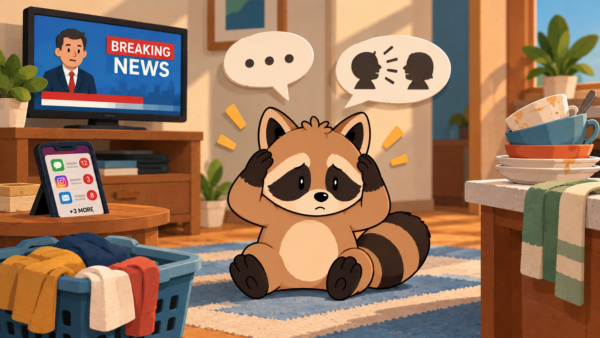
ADHD overstimulation happens when noise, interruptions, uncomfortable sensations, or too many things demanding your attention become overwhelming.
You might suddenly feel irritated, struggle to concentrate, become sensitive to sounds or clothing, or desperately want everyone to stop talking.
What helps? Start by reducing whatever is overwhelming you. Turn off background noise, step somewhere quiet, change uncomfortable clothing, or ask for a few minutes without interruptions.
Overstimulation isn’t an official ADHD diagnostic symptom, but research shows that sensory processing differences are more common among people with ADHD.
And sometimes, the hardest part isn’t the noise itself.
It’s that nobody realizes you’re overwhelmed until you react.
What Does ADHD Overstimulation Feel Like?
The TV is on.
Someone is asking you a question.
Your phone keeps buzzing.
And for some reason, the tag on the back of your shirt has become the most irritating object ever created.
Seriously, we’re in the 21st century. WHAT T-shirt company hasn’t figured out that they can just print the damn thing inside the shirt by now?
Then someone asks you one more question.
And you snap.
“CAN EVERYONE JUST STOP FOR A SECOND?”
Five minutes ago, you seemed fine.
But inside your head, things had been building for a while.
I know that feeling.
When I’m becoming overstimulated, I start getting agitated and irritated. Conversations become harder to follow. And if I’m concentrating on something and someone interrupts me, sometimes that’s enough to push me over the edge.
It’s not necessarily that the person did anything wrong.
It’s that I was already struggling to handle everything else.
And it’s not always about loud noises.
Sometimes it’s uncomfortable clothing. Sometimes it’s multiple people talking. Sometimes it’s someone interrupting you when you’re finally concentrating.
Something you handled perfectly fine yesterday might feel unbearable today.
ADHD Overstimulation Symptoms: What Are the Signs?
ADHD overstimulation can affect how you feel, think, and react to what’s happening around you.
Common signs include:
- Feeling unusually irritated: Small things suddenly become incredibly annoying.
- Difficulty concentrating: You can’t focus because too much is happening around you.
- Trouble following conversations: You hear people talking but struggle to process what they’re saying.
- Sensitivity to noise or touch: Sounds feel unbearable, or clothing becomes uncomfortable.
- Wanting to escape: You desperately want quiet or time alone.
- Feeling mentally exhausted: Even simple questions or decisions feel overwhelming.
- Becoming short with people: You might respond sarcastically, withdraw, or snap when you’ve reached your limit.
Not everyone experiences all these signs, and experiencing them doesn’t automatically mean you have ADHD.
For me, the biggest warning signs are irritation and difficulty following conversations.
I can usually tell things are becoming unbearable before I react.
The challenge is recognizing those signs early enough to do something about them.
Is Overstimulation a Sign of ADHD?
Yes, overstimulation can be associated with ADHD, but it isn’t enough to diagnose someone with ADHD.
Research suggests that people with ADHD experience sensory processing differences more frequently than people without ADHD.
For example, a 2025 review of 30 studies involving 5,374 participants found greater sensory sensitivities and other sensory processing differences among people with ADHD.
That includes being more sensitive to everyday sensations or actively avoiding certain types of sensory input.
You can read the findings in this 2025 systematic review of ADHD and sensory processing.
But overstimulation can also happen because of stress, anxiety, poor sleep, autism, or other factors.
And plenty of people experience sensory overload without having ADHD.
If you’re wondering whether ADHD might explain what you’re experiencing, it’s worth looking at the bigger picture.
Do you also struggle with attention, impulsivity, forgetfulness, or managing everyday responsibilities?
I explain those experiences in more detail in ADHD Symptoms: What ADHD Actually Looks Like in Real Life.
Overstimulation can be part of your ADHD experience without being proof that you have ADHD.
How to Calm Down From ADHD Overstimulation
When you’re already overwhelmed, the last thing you need is a complicated routine with twelve different steps.
Especially if step one involves downloading another app.
For me, what helps depends on what’s bothering me.
1. Reduce Whatever Is Overwhelming You
If noise is the problem, turn something off.
If your clothes are irritating you, change them.
If multiple people are talking, step away for a few minutes if you can.
Sometimes I use headphones.
Other times, even music is too much.
I don’t want relaxing music.
I don’t want a podcast.
I just want silence.
Before starting ADHD medication, there were times when complete silence felt like the only way I could recover.
The point is that what helps one day might not help the next.
Pay attention to what you’re actually struggling with.
2. Give Your Brain Fewer Things to Handle
Imagine you’re trying to finish something important.
Someone asks you a question.
Your phone goes off.
Then you remember something else you need to do.
Now you’re trying to hold on to your original thought while dealing with everything else.
If that sounds familiar, try reducing the number of things competing for your attention.
Silence notifications. Finish one task before switching to another. Ask someone to give you a moment.
And if interruptions make it particularly difficult to return to what you were doing, you might recognize some of the experiences I describe in ADHD Task Switching: Why Is It So Hard to Stop One Thing and Start Another?.
You don’t have to handle everything simultaneously.
3. Notice Your Warning Signs
For me, overstimulation usually builds.
I start feeling irritated.
Following conversations gets harder.
Interruptions become increasingly frustrating.
Those are signs that I’m approaching my limit.
Your warning signs might be different.
Maybe sounds become more annoying. Maybe you can’t concentrate. Maybe you suddenly feel like you need to get away from everyone.
The earlier you notice those feelings, the more opportunities you have to make an adjustment before things get worse.
4. Tell Someone You’re Getting Overwhelmed
This is something I’ve had to learn.
People can’t necessarily tell when I’m becoming overstimulated.
Especially when I’ve spent so much time hiding it.
Sometimes a simple explanation can help:
“I’m getting overwhelmed. Can you give me a few minutes?”
Or:
“I’m trying to concentrate. Let me finish this, and then I’ll listen.”
You don’t have to explain every detail of ADHD.
Just let someone know what’s happening.
And if you do snap at someone, overstimulation doesn’t make that person’s feelings less important.
You can explain what happened and still apologize.
5. Try Something Calming, but Don’t Force It
I’ve tried meditation occasionally.
Sometimes it helped.
But meditation can only do so much.
If I’m overwhelmed because of constant interruptions or uncomfortable clothing, sitting there trying to meditate doesn’t necessarily fix the problem.
Sometimes I need to remove whatever is bothering me.
Sometimes I need a break.
And sometimes I just need quiet.
Why Does ADHD Make You Feel Overstimulated?
With ADHD, it can be harder to manage what you’re paying attention to.
So when you’re trying to concentrate and someone starts talking, switching between the two can be difficult.
Add a television, a buzzing phone, and another conversation, and suddenly everything feels like too much.
Research suggests sensory sensitivity may also play a role.
A 2024 study published in BMC Psychiatry compared 27 adults with ADHD and 24 adults without ADHD.
The researchers found that participants with ADHD reported greater sensitivity to touch and showed differences in how they processed physical sensations.
That doesn’t mean every person with ADHD will be bothered by clothing or touch.
But it helps explain why sensory discomfort is worth taking seriously.
You can read the 2024 study on touch sensitivity in adults with ADHD.
Sensory Overload vs. Mental Overload
These two experiences can feel similar, but they’re slightly different.
Sensory overload happens when things you’re hearing, seeing, touching, or otherwise sensing become overwhelming.
Think of a crowded restaurant with loud music, bright lights, and several conversations happening at once.
Mental overload happens when you have too much information or too many things demanding your attention.
Think of trying to finish a task while answering questions, remembering appointments, and responding to messages.
You can experience both at the same time.
And when you do?
It can feel like your brain has 37 browser tabs open, and one of them is playing music.
Except you can’t figure out which one.
What Can Trigger ADHD Overstimulation?
Different people have different triggers.
Here are some everyday examples:
| Trigger | What it might feel like |
|---|---|
| Loud environments | Every sound competes for your attention |
| Multiple conversations | You struggle to follow what anyone is saying |
| Clothing or touch | Tags, seams, or fabrics become irritating |
| Bright lights | Lighting feels uncomfortable or distracting |
| Constant interruptions | You keep losing your train of thought |
| Phone notifications | Every buzz feels like another demand |
| Too many decisions | Even simple questions become frustrating |
| Crowded places | There’s too much happening around you |
And your tolerance can change.
A busy grocery store might be manageable when you’re rested.
But after a stressful day?
That same store might feel unbearable.
Sometimes it’s not one specific trigger.
It’s everything adding up.
When Nobody Realizes You’re Overwhelmed
This is one of the most frustrating parts for me.
I can feel myself becoming overwhelmed, but nobody around me necessarily knows it.
I’ve gotten so used to hiding how I’m feeling that people often think I’m fine.
That’s sometimes called ADHD masking.
Inside my head, I’m struggling.
I’m trying to concentrate.
Conversations are becoming harder to follow.
And I’m getting increasingly irritated.
Meanwhile, I’m thinking:
“Dude, don’t you see how overwhelmed I am?”
But why would they?
I’ve been hiding it.
Then someone interrupts me.
And sometimes I snap.
I might raise my voice, respond sarcastically, or become unnecessarily short with someone.
Then they say:
“I’m just asking a question.”
And I immediately realize they had no idea what was happening.
They weren’t trying to overwhelm me.
They were just asking something.
Then Comes the Guilt
For me, the regret happens almost immediately.
I feel guilty.
Embarrassed.
And I usually withdraw for a while.
Eventually, I recognize that I need to apologize.
And I do.
The difficult part is knowing the other person didn’t necessarily do anything wrong.
Being overstimulated can explain why I reacted that way, but it doesn’t mean the other person deserved it.
And not every angry reaction is caused by overstimulation.
That’s an important distinction.
If strong emotional reactions are something you struggle with, I talk about that in ADHD Emotional Dysregulation: Why Small Things Feel So Big.
ADHD Overstimulation vs. Understimulation
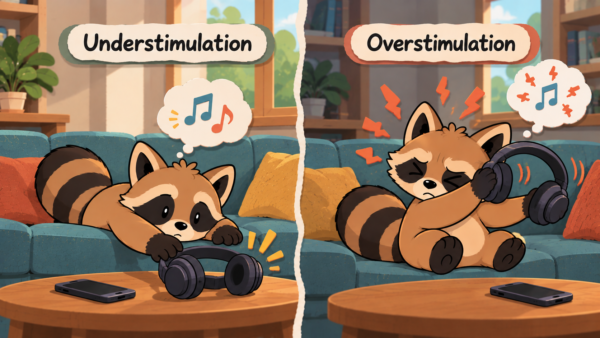
Here’s something that might seem confusing.
Sometimes people with ADHD want more stimulation.
Other times, they can’t stand any of it.
Understimulation means you’re not getting enough mental or sensory input to feel engaged.
You might feel bored, restless, or desperate to find something interesting.
So you turn on music.
Pick up your phone.
Start another activity.
But when you’re overstimulated, those same things can become annoying.
Take music.
Sometimes headphones help me.
Other times, I don’t even want music playing.
I want complete silence.
The difference is how much stimulation I can comfortably handle at that moment.
And that can change throughout the day.
Does ADHD Medication Help With Overstimulation?
For me, yes. Quite a bit, actually.
Before starting ADHD medication, I experienced what I describe as meltdowns almost every two weeks.
Sometimes I needed complete silence before I could recover.
Interruptions and multiple conversations could become incredibly frustrating.
Since starting medication, I’ve noticed a difference.
I can handle multiple conversations more easily.
Interruptions don’t bother me as intensely.
I recover faster when I become overwhelmed.
And those nearly biweekly meltdowns aren’t happening the way they used to.
But medication hasn’t made overstimulation disappear.
There are still times when I’ve taken my medication and become overwhelmed.
I can still get irritated.
I can still reach my limit.
It just happens less often.
That’s my experience. It doesn’t mean medication will have the same effect on everyone.
ADHD medication primarily treats symptoms such as difficulties with attention and impulse control. Its effects on sensory sensitivity aren’t as well understood.
If you’re taking medication and still struggling with overstimulation, that’s worth discussing with your prescriber.
If you’re curious about what starting treatment felt like for me, I wrote about it in What My First Day on ADHD Medication Actually Felt Like.
Is ADHD Overstimulation the Same as Sensory Processing Disorder?
No.
ADHD overstimulation describes an experience, not a separate diagnosis.
Sensory processing difficulties can happen with ADHD, autism, and other conditions. They can also happen without any of those diagnoses.
Some people experience significant sensory sensitivities that interfere with daily life.
If that’s happening to you, a healthcare professional can help explore what’s contributing to it.
You don’t need to figure out the exact label before asking for help.
The Bottom Line
ADHD overstimulation isn’t always about loud noises or crowded places.
Sometimes it’s an itchy shirt.
Sometimes it’s too many conversations.
Sometimes it’s trying to concentrate while someone keeps interrupting you.
And sometimes it’s a combination of things that normally wouldn’t bother you.
For me, the biggest challenge has been recognizing when I’m getting overwhelmed before I reach my limit.
Medication has helped.
Headphones sometimes help.
Meditation occasionally helps.
And sometimes I just need complete silence.
But I’ve also learned something about the people around me.
Just because I can feel myself becoming overwhelmed doesn’t mean they can see it.
So I’m trying to get better at recognizing those warning signs and communicating what I need.
Because I’d rather tell someone I need a few minutes than snap at them and spend the next hour feeling guilty about it.
Frequently Asked Questions
Is overstimulation a symptom of ADHD?
Overstimulation isn’t an official ADHD diagnostic symptom, but sensory processing differences are more common among people with ADHD. Not everyone with ADHD experiences sensory overload.
What does ADHD overstimulation feel like?
It can feel like increasing irritation, difficulty concentrating, sensitivity to sounds or touch, or an overwhelming need to get away from what’s happening around you.
Why do people with ADHD get overstimulated?
ADHD can make it harder to manage competing demands on your attention. Research also suggests that sensory sensitivities are more common among people with ADHD.
Can ADHD make clothing feel uncomfortable?
Some people with ADHD are particularly sensitive to clothing tags, seams, textures, or fabrics. However, clothing sensitivity isn’t unique to ADHD.
Can overstimulation cause anger or meltdowns?
Overstimulation can contribute to irritability, frustration, or intense reactions. Some people describe reaching a point where they feel unable to cope with additional demands.
However, not every angry reaction or meltdown is caused by overstimulation.
Does ADHD medication help with overstimulation?
Some people notice improvements in their ability to handle interruptions or overwhelming situations while taking ADHD medication. However, medication doesn’t necessarily eliminate sensory sensitivities, and individual experiences vary.
How do you calm ADHD overstimulation?
Try reducing whatever is overwhelming you. Turn off unnecessary noise, take a break, change uncomfortable clothing, or ask for time without interruptions.
What helps depends on the situation.
Sources
Jurek L, Duchier A, Gauld C, et al. (2025). Sensory Processing in Individuals With Attention-Deficit/Hyperactivity Disorder Compared With Control Populations: A Systematic Review and Meta-Analysis. Journal of the American Academy of Child & Adolescent Psychiatry.
Frost-Karlsson M, Johansson Capusan A, Olausson H, Boehme R. (2024). Altered somatosensory processing in adult attention deficit hyperactivity disorder. BMC Psychiatry.
National Institute of Mental Health. Attention-Deficit/Hyperactivity Disorder: What You Need to Know.
Read the NIMH ADHD overview