
There are few things more frustrating than knowing exactly what you need to do…and still not doing it.
The laundry is sitting there.
The email would probably take five minutes.
You bought the groceries to cook dinner.
You actually want to go to the gym.
And yet your brain seems to respond with:
Nah. Maybe later.
Then something else catches your attention and suddenly you’re researching it for three hours, you’ve opened 17 tabs, and somehow that wasn’t difficult to start at all.
If you have ADHD, this can make your motivation feel completely unpredictable.
It can also make you wonder whether you’re lazy, undisciplined, or simply not trying hard enough.
But ADHD motivation is more complicated than that.

Quick Answer: How Does ADHD Affect Motivation?
ADHD can make it harder to start and sustain effort, especially when a task is boring, repetitive, unclear, or offers rewards that feel far away.
Research suggests ADHD involves differences not only in attention and executive functioning, but also in how the brain responds to rewards and delays. People with ADHD, on average, show a stronger preference for smaller immediate rewards over larger delayed rewards.
That doesn’t mean people with ADHD are incapable of motivation.
It means motivation can depend heavily on the conditions surrounding the task.
That’s why you can desperately want a clean house and still struggle to start cleaning it.
Wanting something and being able to reliably initiate the actions required to get it aren’t always the same thing.
Key Takeaways
- ADHD motivation problems aren’t simply laziness or a lack of caring.
- Executive-function difficulties can make starting, organizing, and sustaining effort harder.
- Immediate rewards may have a stronger pull than rewards that are far in the future.
- Urgency and external structure can sometimes make previously impossible tasks easier to start.
- Even enjoyable activities can be difficult to initiate.
- Changing the environment around a task can sometimes work better than trying to force yourself to “want it more.”
- There is no single motivation trick that works for every person with ADHD.
Why ADHD Motivation Can Feel So Inconsistent
One of the strangest parts of ADHD is that your abilities don’t always feel consistent.
You might stare at an email for four hours without answering it.
But if someone says:
“I need that response in ten minutes.”
Suddenly you’re typing.
You might avoid cleaning the house all weekend.
Then someone texts:
“We’re coming over.”
Apparently you are now capable of cleaning at Olympic speed.
Where was that ability three hours ago?
This inconsistency is one reason ADHD gets mistaken for a lack of effort.
From the outside, people see that you can do something.
So naturally they wonder:
“If you can do it now, why couldn’t you just do it earlier?”
The problem is that ADHD isn’t simply a question of whether you possess the ability to complete a task.
The conditions under which you’re trying to use that ability matter too.
Research on ADHD has found differences in several cognitive areas, including executive functioning, attention, inhibition, working memory, and reward delay.
Researchers have also found that people with ADHD tend, on average, to place more value on immediate rewards relative to delayed ones.
In normal-human language:
“This will benefit me three months from now” may not pull your brain toward action as strongly as “this needs to happen in ten minutes.”
That doesn’t explain every motivation problem in ADHD.
But it helps explain why motivation can sometimes feel so dependent on what is happening right now.
“But I Can Do It When I Really Have To”
This one messed with my head for a long time.
Because sometimes I really can do the thing.
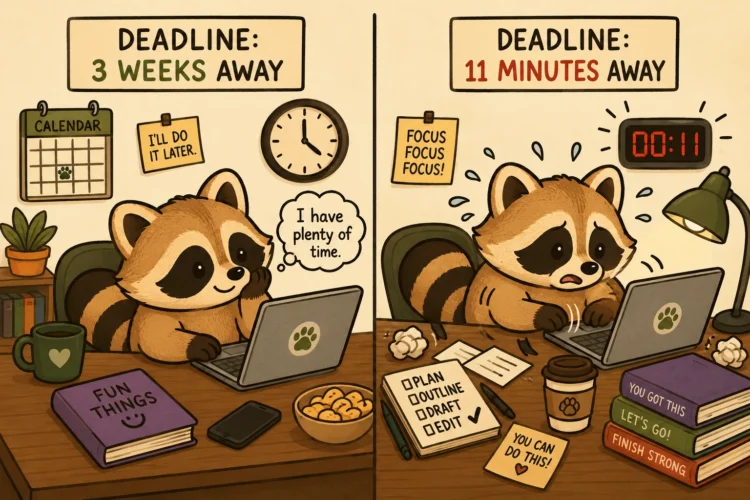
I’ve procrastinated on something forever and then somehow managed to get an absurd amount of work done once the deadline became real.
That creates a pretty convincing argument against yourself.
See? You could have done it the whole time.
Except that’s not necessarily what happened.
The task changed.
Not physically.
The email is still the email.
The report is still the report.
But now there’s urgency.
There’s a clear deadline.
There’s an immediate consequence.
There’s less room to keep negotiating with yourself about when you’ll start.
Those changes can alter how easy it feels to engage with the task.
This is also why procrastination can accidentally become a coping mechanism.
If waiting until the last minute is one of the few things that reliably creates enough urgency to get you moving, your brain learns:
Pressure works.
Unfortunately, living like every Tuesday is the season finale of a television show gets exhausting.
And eventually that pattern can contribute to stress, missed deadlines, ADHD burnout, and what I call the ADHD tax…the money, time, opportunities, and energy we lose because ADHD keeps making ordinary life more expensive.
What Actually Gets an ADHD Brain Moving?
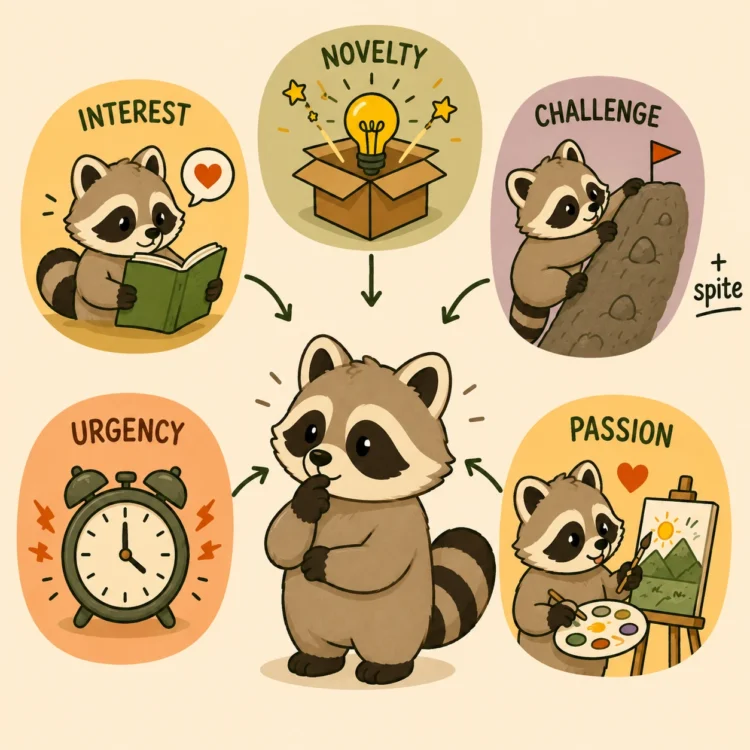
If motivation with ADHD can be inconsistent, what actually makes something easier to start?
There isn’t one universal formula. But there are a few things that seem to come up again and again when people with ADHD talk about what gets their brain to finally go:
Interest
This is probably the easiest one to recognize.
If something genuinely interests me, getting started can feel completely different.
I don’t necessarily need a reminder. I don’t need to convince myself. Sometimes I don’t even notice how long I’ve been doing it.
The problem is that life doesn’t conveniently arrange itself around what I find interesting.
Bills unfortunately refuse to become fascinating.
Novelty
Ooh, new thing.
A new hobby. A new project. A new app. A new way of organizing something.
Novelty can make something that normally feels boring suddenly feel much more engaging.
This might also help explain why a new productivity system can feel life-changing for two weeks…and then mysteriously become part of the furniture.
Challenge
Sometimes making something slightly harder actually makes it easier to do.
That sounds backwards, but a challenge can turn a boring task into something you want to beat.
Can I finish this before the timer goes off?
Can I beat what I did last time?
Can I figure this out without looking it up?
And yes, occasionally:
Oh, you don’t think I can do it?
Spite probably deserves an honorable mention here.
Urgency
This one needs almost no introduction.
A task I’ve avoided for three weeks can suddenly become extremely important when the deadline is tomorrow.
Or in an hour.
Or, ideally for maximum panic:
11 minutes.
Urgency makes the consequence immediate. There’s no longer some vague future version of me who can deal with it.
Unfortunately, relying on panic to activate yourself works right up until it doesn’t, and it’s an exhausting way to live.
Passion
Interest and passion sound similar, but I think there’s a useful distinction.
Interest is:
“This is fascinating.”
Passion is:
“This matters to me.”
Something can be difficult, frustrating, repetitive, and occasionally boring, but I can keep coming back to it because I genuinely care about what I’m trying to accomplish.
Passion doesn’t magically erase executive dysfunction. Caring deeply about something doesn’t guarantee you’ll always be able to start it.
But having a strong personal reason for doing something can give the work meaning that a random task doesn’t have.
The Important Part Is Knowing Your Own Patterns
None of these are magic buttons.
And not every person with ADHD is motivated by the same things.
You might respond strongly to competition while someone else hates it. Deadlines might activate you while they completely overwhelm someone else.
The useful part is paying attention to the conditions where starting becomes easier.
Maybe you need curiosity.
Maybe you need another person involved.
Maybe you need a timer.
Maybe you need to turn it into a challenge.
Maybe you need to remember why the thing matters to you.
And sometimes, apparently, you need someone to tell you that you can’t do it.
Whatever works.
The point isn’t to wait around until the perfect kind of motivation appears.
It’s to start recognizing what tends to wake your brain up—and, when possible, bring some of those ingredients into tasks that don’t naturally have them.
Motivation and Executive Dysfunction Aren’t the Same Thing
This distinction matters.
Sometimes:
I don’t want to do it.
Other times:
I desperately want to do it, but I’m still sitting here.
Those are different experiences.
Executive functions are mental processes involved in things like planning, organizing, remembering information, regulating attention, inhibiting impulses, and carrying actions through.
When those processes aren’t cooperating, a task can become difficult even when motivation is technically present.
Imagine standing in front of a car saying:
“I REALLY want to drive to Target.”
That’s wonderful.
But wanting to arrive at Target doesn’t start the engine.
You still need the systems responsible for turning intention into action.
That’s one reason executive dysfunction can feel so confusing.
You know.
You care.
You intend to do it.
And somehow there’s still a wall between intention and action.
That’s also why ADHD paralysis can feel different from ordinary procrastination.
Sometimes you aren’t casually deciding to do something later.
You’re sitting there thinking about the task, feeling increasingly stressed about the task…and somehow still not starting the task.
Why Even Things You Want to Do Can Be Hard
This is the part that really destroys the “you’re just not motivated” explanation.
I’ve procrastinated on things I actually wanted to do.
Not taxes.
Not paperwork.
Things I liked.
You can buy a video game you’ve been waiting months to play and then never start it.
You can want to text someone back and avoid opening the conversation.
You can buy everything for a hobby you’re genuinely excited about and leave it untouched.
You can spend all day thinking:
I want to watch that movie tonight.
Then somehow it’s 11:47 p.m. and you’ve watched 46 completely unrelated videos instead.
If motivation were simply about how much you wanted something, this wouldn’t make much sense.
But tasks contain more than their eventual reward.
They have a starting cost.
You have to stop whatever you’re currently doing.
Shift attention.
Decide where to begin.
Gather what you need.
Possibly tolerate uncertainty.
Then maintain enough attention to keep going.
Sometimes the problem isn’t:
“I don’t want the thing.”
It’s:
“My brain isn’t crossing the gap between here and the thing.”
The Problem With Waiting Until You “Feel Motivated”
I’ve done this plenty of times.
I’ll do it when I feel ready.
I’ll exercise when I have more energy.
I’ll clean when I get motivated.
I’ll start the project when I can really focus.
Sounds reasonable.
Except motivation isn’t particularly good at respecting appointments.
You can wait all afternoon for it.
Sometimes it shows up at 10:43 p.m. when you should be going to bed. (Literally me right now.. I had all day
to type this up and I chose to play Call of Duty instead.)
This is why one of the most useful changes I’ve made is trying to make starting require less motivation instead of constantly trying to create more motivation.
Those sound similar.
They’re not.
One asks:
“How do I make myself want to do this?”
The other asks:
“How can I make this easier to begin even if I don’t want to?”
That second question has been much more useful for me.
What Actually Helps With ADHD Motivation?
There isn’t a universal ADHD motivation hack.
Anyone promising one probably also has a morning routine involving a 4:30 a.m. ice bath.
No thanks.
But there are ways to change the conditions surrounding a task so your brain has less work to do before it can engage.
Make the First Step Embarrassingly Small
“Clean the kitchen” isn’t a small task.
It’s a category containing a bunch of tasks.
Try:
Put one plate in the dishwasher.
That’s physical.
It’s obvious.
And you can do it immediately.
Same thing with work.
Instead of:
Work on article.
Try:
Open the document and write one heading.
Sometimes you’ll stop after the tiny step.
That’s fine.
But sometimes starting creates enough momentum to continue.
The goal isn’t to trick yourself into secretly doing two hours of work.
The goal is to make the entrance to the task easier to walk through.
Reduce Friction Before You Need Motivation

Think about how many tiny obstacles exist between you and the thing you’re supposed to do.
You want to exercise.
But first you need clothes.
Then shoes.
Then headphones.
Your headphones aren’t charged.
Your water bottle is upstairs.
You can’t find your keys.
Congratulations.
You’ve completed a side quest before the actual quest even started.
Reducing friction means removing some of those decisions ahead of time.
Put your shoes where you’ll see them.
Leave the document open.
Keep supplies where you actually use them.
Automate repetitive steps when possible.
Prepare tomorrow’s first task tonight.
This also works for mornings.
Getting up and getting ready in the morning is already a pain and a half in the ass for me, so I try to make as many decisions as possible the night before.
I’ll get my clothes ready. I’ll put the socks I’m going to wear inside my shoes. I’ll make sure my work backpack has everything I need for the day.
Because the last thing I need when I’m already running late is to suddenly realize I can’t find my shoes.
I’ve actually been in such a rush before that I threw my shoes on, left for work, and didn’t realize until I was already on the highway that I was wearing one black shoe and one brown shoe.
I drove back home to make sure I had the right pair on. Ain’t no way I’m going to work looking like a clown with two different shoes.
So now I try to get my shoes ready the night before, with the socks I’m going to wear already inside them.
So yeah. Preparing the night before helps.
Do I always do it?
Absolutely not.
There are still nights when I tell myself, I’ll wake up with plenty of time tomorrow. I’ll just get everything ready in the morning.
This is a lie.
A lie I apparently remain willing to believe despite an overwhelming amount of evidence to the contrary.
It has backfired on me approximately 82% of the time.
And somehow, I never learn.
But that’s really the point of reducing friction. I’m not preparing everything the night before because I’m trying to become the world’s most organized person. I’m doing it because I know Morning Me is going to have a harder time dealing with those extra steps.
If I can remove a few of them ahead of time, getting out the door becomes just a little easier.
This sounds almost too simple.
But when task initiation is already difficult, every unnecessary step becomes another place where the process can break.
Make Progress Visible
ADHD brains don’t always get much satisfaction from invisible progress.
A project might technically be 60% finished and still feel like:
NOT DONE.
So externalize the progress.
Check boxes.
Move sticky notes.
Cross things off.
Use a timer.
Create a visible “done” pile.
Break a project into stages you can actually finish.
You aren’t changing the importance of the task.
You’re giving your brain more immediate evidence that something is happening.
Bring the Reward Closer
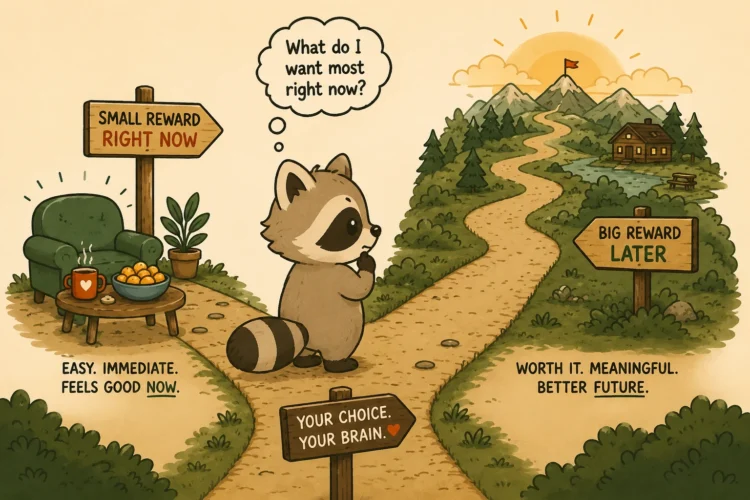
A lot of adult responsibilities have terrible reward design.
Exercise consistently and maybe months from now you’ll notice results.
Save money and maybe years from now you’ll benefit.
Complete paperwork and your reward is…
…having completed paperwork.
Fantastic.
Research on delay discounting suggests people with ADHD tend to prefer smaller immediate rewards more strongly than people without ADHD.
So when possible, don’t make every reward live six months in the future.
Pair boring tasks with something pleasant.
Give yourself a visible completion marker.
Work in short blocks.
Create intermediate milestones.
The point isn’t that adults with ADHD need to be bribed like children.
The point is that immediate feedback can matter.
I’m actually trying to figure out how to do this with this website, ADHDefined.
The real rewards from building this website are pretty far away. I want people to find it. I want it to become a genuinely useful ADHD resource.
But publishing an article tonight doesn’t immediately give me any of those things.
I could spend hours researching, writing, editing, making illustrations, and publishing an article…and my immediate reward is basically:
Cool. Now do another one.
That’s not exactly exciting.
So I’m trying to make the progress itself more visible. Instead of only thinking about some distant goal like traffic or income, I can see that I’ve published 20 articles. Then 25. Then 30.
And maybe I need to start attaching actual little rewards to those milestones too.
Because if my brain cares more about rewards it can see right now, it probably doesn’t make much sense to ask it to stay motivated by something that might happen six months from now.
Borrow Structure From the Outside World
Sometimes internal motivation isn’t enough.
External structure can help.
That might mean:
- working beside another person
- making an appointment
- setting a real deadline
- using a timer
- telling someone when you’ll finish something
- scheduling the task instead of keeping it on a vague to-do list
Adults with ADHD also report using external aids and supportive relationships as ways of managing everyday difficulties.
You’ve probably already experienced this.
Cleaning alone:
Impossible.
Cleaning while someone else is cleaning:
Apparently we’re doing this now.
That’s one reason body doubling has become popular in ADHD communities.
The other person doesn’t necessarily need to help.
Their presence can simply provide structure that wasn’t there before.
Why New Systems Work Brilliantly…Until They Don’t
New planner.
New app.
New workout routine.
New organization system.
Day one:
My life has changed forever.
Day fourteen:
You don’t remember the password to the app.
I’ve fallen into this trap more times than I’d like to admit.
Novelty can make something easier to engage with at first.
The danger is assuming that because the new system feels exciting now, you’ve permanently solved the underlying problem.
Then when the excitement disappears, you blame yourself.
Again.
A better system survives the boring phase.
It should still be usable when you aren’t excited about it.
That’s why I increasingly prefer boring systems with very few moving parts.
If maintaining your productivity system becomes its own productivity project, the system may be too complicated.
Hyperfixation Makes ADHD Motivation Even More Confusing
Then there’s the opposite experience.
Sometimes you don’t need motivation at all.
You need someone to physically remove you from the task.
A subject catches your attention and suddenly you’ve spent hours researching it.
You forget to eat.
You lose track of time.
Everything else disappears.
That’s often described as ADHD hyperfixation.
And it makes the motivation problem even more confusing.
How can someone who couldn’t answer one email somehow spend an entire evening learning everything ever documented about espresso machines?
Because ADHD isn’t simply an inability to focus or an absence of motivation.
Attention and engagement can be highly dependent on context.
The problem is often regulating where that attention goes and when, not possessing attention in the first place.
Why “Just Try Harder” Usually Doesn’t Help
Most adults with ADHD have tried harder.
A lot.
We’ve made lists.
Bought planners.
Set alarms.
Downloaded apps.
Created routines.
Abandoned routines.
Created new routines to fix the old routines.
Then created a spreadsheet to track the new routines.
The problem with “try harder” is that it gives you no information.
If a task repeatedly isn’t happening, something about the system isn’t working.
Maybe the task is too vague.
Maybe there are too many steps.
Maybe you’re overwhelmed.
Maybe the reward is too distant.
Maybe you don’t know where to start.
Maybe you’re exhausted.
Maybe you’re afraid of doing it badly.
Maybe you’re distracted by something that provides much more immediate stimulation.
Those problems require different solutions.
Calling all of them “laziness” tells you absolutely nothing about what to change.
A Better Question to Ask
Instead of:
“Why can’t I just make myself do this?”
I’ve found a better question:
“What is making this hard to start right now?”
That question gives you somewhere to go.
Is the task unclear?
Define the first physical action.
Too big?
Shrink it.
Too boring?
Add stimulation or shorten the work period.
Too many steps?
Remove one.
No deadline?
Create external structure.
Overwhelmed?
Choose one thing instead of trying to mentally carry everything.
Waiting for motivation?
Start for five minutes without requiring yourself to finish.
This isn’t about accommodating every uncomfortable feeling.
Some things are going to be boring.
Some responsibilities just suck.
ADHD doesn’t change that.
The goal is to stop treating every failure to start as evidence that you don’t care enough.
What About ADHD Medication and Motivation?
Medication deserves a careful distinction here.
ADHD medication isn’t a motivation pill.
It doesn’t decide what matters to you.
It doesn’t create goals.
And it doesn’t automatically turn unpleasant responsibilities into enjoyable ones.
But medication can reduce core ADHD symptoms for many adults, which may make it easier to direct attention, regulate behavior, and function day to day.
Clinical guidelines recommend medication as one treatment option for adults whose ADHD symptoms continue to cause significant impairment, alongside environmental modifications and, when appropriate, non-medication treatments.
Response varies from person to person.
Some adults describe a dramatic difference.
Others experience more subtle improvements.
Some don’t tolerate a particular medication or don’t find it helpful.
Medication decisions should be made with a healthcare professional trained in ADHD treatment.
The important point for this conversation is:
Struggling with motivation doesn’t automatically mean you need more willpower, and medication doesn’t replace strategies, environment, or personal goals either.
You Probably Don’t Need More Shame
Maybe you’ve spent years hearing:
Apply yourself.
Stop procrastinating.
You have so much potential.
If you really cared, you’d do it.
Eventually those messages become your own voice.
So when you’re staring at something you haven’t started, you don’t think:
Interesting. Something about this task isn’t working for me.
You think:
What the hell is wrong with me?
I know that voice.
I’m still learning how not to automatically believe it.
Understanding ADHD hasn’t magically made me productive every day.
I still procrastinate.
I still avoid things.
I still occasionally discover that something I’ve been dreading for four days took approximately seven minutes.
Very cool, brain.
But understanding what’s happening gives me more options than simply calling myself lazy.
Sometimes I need urgency.
Sometimes I need a smaller first step.
Sometimes I need another person nearby.
Sometimes I need to remove distractions.
And sometimes I genuinely don’t want to do something and have to do it anyway.
That’s adulthood.
The difference is that now I’m trying to solve the actual problem instead of turning every unfinished task into a character judgment.
Final Thoughts
If you’ve spent years thinking:
“I know what I need to do. Why can’t I just do it?”
you’re asking a reasonable question.
But maybe there’s a more useful one:
“What would make this easier for my brain to start?”
You might need a smaller step.
A closer reward.
More structure.
Less friction.
A clearer deadline.
Treatment.
Or simply a different approach than the one you’ve been forcing yourself to use for years.
ADHD motivation isn’t about finding the magical trick that makes you excited to pay bills and fold laundry.
I’m pretty sure that trick doesn’t exist.
It’s about understanding what helps your brain turn intention into action.
And once you understand that, you can stop waiting for motivation to rescue you and start building conditions that make action easier.
Frequently Asked Questions
Does ADHD cause a lack of motivation?
ADHD can contribute to difficulties that look like low motivation, including problems with task initiation, executive functioning, sustaining attention, and responding to delayed rewards.
That doesn’t mean every motivation problem is caused by ADHD, or that people with ADHD don’t care about responsibilities.
Often the more useful question is what is preventing someone from turning an intention into action.
Why do people with ADHD suddenly get motivated at the last minute?
Urgency changes the conditions surrounding a task.
A distant deadline can feel abstract. As the deadline approaches, the consequences become immediate and the task becomes harder to ignore.
That can make starting easier for some people with ADHD.
The downside is that repeatedly relying on emergencies for motivation can create significant stress.
Why can’t I start something even when I want to do it?
Wanting an outcome and initiating the actions required to reach it involve different processes.
ADHD-related executive-function difficulties can interfere with planning, task initiation, attention regulation, working memory, and sustained effort.
That’s why genuinely caring about something doesn’t always guarantee you’ll immediately start it.
Is ADHD motivation just a dopamine problem?
No.
Dopamine is involved in reward processing, motivation, attention, and learning, and ADHD research has identified differences involving dopamine-related systems.
But reducing ADHD to “your brain doesn’t have enough dopamine” is an oversimplification.
ADHD involves complex interactions among multiple brain networks, neurotransmitter systems, genetics, development, environment, and individual differences.
Does ADHD medication help with motivation?
Medication can improve core ADHD symptoms for many adults, which may indirectly make it easier to start and complete tasks.
But medication isn’t designed to manufacture desire or make someone care about something.
Treatment response varies, and medication decisions should be discussed with a qualified healthcare professional.
Continue Exploring ADHDefined
If this article felt familiar, continue with:
- Executive Dysfunction: Why Everything Feels So Hard
- ADHD Paralysis: The Invisible Wall Between Wanting to Do Something and Actually Starting
- ADHD Time Blindness: Why Time Feels Different
- ADHD Hyperfixation
- ADHD Tax: What It Is and How to Reduce It
Research & Editorial Standards
Every article on ADHDefined combines lived experience with evidence-informed research. Our goal is to explain ADHD in plain language while accurately reflecting the current scientific understanding.
Personal experiences are included to help readers relate to common ADHD experiences. They are not presented as scientific evidence. When personal experience and current research differ, we prioritize the best available evidence.
While our content is not a substitute for professional medical advice, we develop and review our articles using guidance from trusted organizations, recognized ADHD experts, and peer-reviewed scientific literature whenever appropriate.
Sources & Further Reading
This article combines personal experience with information from ADHD research and educational resources. If you’d like to dig deeper, these are some of the sources used while researching this article:
- National Institutes of Health (NIH) — Research on ADHD, executive functioning, motivation, reward processing, and related neuroscience.
- ADHD Evidence Project (ADHDEvidence.org) — Evidence-based information and scientific consensus on ADHD.
- Attention Deficit Disorder Association (ADDA / ADD.org) — ADHD education and practical resources for adults.