
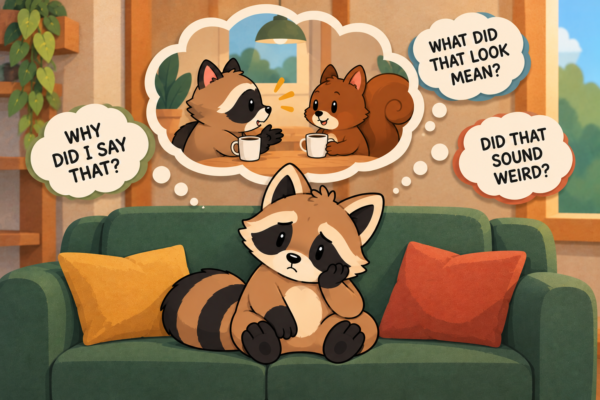
ADHD rumination is when your brain gets stuck replaying the same thought, conversation, mistake, or upsetting experience, even when you want to move on.
Maybe you said something awkward at work. Maybe you had an argument. Or maybe someone sent you a text that sounded a little different than usual.
Now you can’t stop thinking about it.
You replay what happened, question what you said, and imagine what you should’ve done differently.
These repetitive thoughts are sometimes called thought loops. You keep going over the same situation, hoping you’ll eventually figure something out, but often end up right where you started.
Rumination can be a familiar experience for people with ADHD, and difficulties managing attention and emotions may make these thought loops harder to interrupt.
The frustrating part is that you might know you’re overthinking something and still struggle to stop.
It’s like having a song stuck in your head.
Except the song is an embarrassing conversation from Tuesday.
And apparently, it’s playing on repeat.
What Does ADHD Rumination Feel Like?
Imagine saying something slightly awkward at work.
Nobody reacts.
The conversation moves on.
Everyone else probably forgets about it five minutes later.
Your brain, however, has apparently acquired the streaming rights.
Now you’re replaying it in the car.
In the shower.
While you’re supposed to be watching TV.
And, naturally, at 1:43 a.m.
Why did I say it like that?
Did they think that was weird?
I should’ve said something else.
Then you replay their facial expression.
Then your tone.
Then their response.
Before you know it, you’ve constructed three alternative versions of a conversation that ended 14 hours ago.
And here’s what makes rumination so frustrating:
You’re not necessarily figuring anything out. You’re just thinking about the same thing again.
Rumination vs. Normal Reflection
Thinking about something that happened isn’t always a bad thing.
Sometimes reflecting on a mistake helps you learn from it.
You recognize what went wrong, decide what you’d do differently, and move on.
Rumination is different.
Instead of reaching a conclusion, your thoughts keep returning to the same place.
| Reflection | Rumination |
|---|---|
| Helps you understand what happened | Replays what happened repeatedly |
| Can lead to a decision | Often creates more questions |
| Moves toward a solution | Circles the same problem |
| Usually has a stopping point | Can feel difficult to stop |
Here’s a question that can help you recognize the difference:
Am I learning something new, or am I just replaying what I already know?
If you’ve reviewed the same conversation 15 times without discovering anything useful, you’re probably ruminating.
Why Does Rumination Happen With ADHD?
ADHD can make it difficult to control where your attention goes.
And that doesn’t always mean struggling to focus.
Sometimes it means struggling to stop focusing on something.
Think about how easily you can get absorbed in something interesting.
A video game.
A new hobby.
A random subject you suddenly need to know everything about.
But your attention can also get caught on something unpleasant.
An argument.
A mistake.
Something embarrassing.
An unanswered message.
You want to move on, but your brain keeps returning to the same subject.
Emotions Can Make Thoughts Harder to Let Go
Think about two conversations.
In the first, someone asks what you ate for lunch.
In the second, your boss says:
“Can I talk to you tomorrow?”
Which conversation are you more likely to think about later?
Probably not the sandwich.
When something makes you anxious, embarrassed, angry, or uncertain, it can become harder to stop thinking about.
For some people with ADHD, difficulties managing attention and emotions may contribute to these repetitive thought patterns. Research involving adults with ADHD has found connections among rumination, excessive mind-wandering, anxiety, and depression.
In everyday language?
When something bothers you, your brain may have a harder time letting it go.
And sometimes, the more you try to figure it out, the more stuck you become.
That can overlap with ADHD emotional dysregulation, when feelings are hard to manage even after you recognize what’s happening.
Why Rejection Can Trigger Rumination
Sometimes the thought loop starts because you’re worried about how someone sees you.
You send a message.
They don’t respond.
Maybe they’re busy.
Maybe they forgot.
Maybe they haven’t looked at their phone.
But your brain starts investigating.
Are they upset with me?
Did I say something wrong?
Why did they respond differently yesterday?
Before long, your brain has assembled a prosecution case from three emojis, a delayed text, and somebody saying “okay” instead of “okay!”
For people who are particularly sensitive to criticism or rejection, situations like these can be difficult to let go of. If that sounds familiar, our article about rejection sensitive dysphoria (RSD) explains why rejection or perceived criticism can feel so intense.
And the problem is that you’re trying to find certainty where you don’t have enough information.
Replaying the situation doesn’t necessarily provide any.
The same thing can happen after an argument.
You imagine what you should’ve said.
Then you come up with the perfect response.
Then another one.
Suddenly, you’re having an entirely new argument with someone who isn’t even in the room.
And somehow, you’re getting angry all over again.
How Do You Stop ADHD Rumination?
You can’t always prevent an unwanted thought from appearing.
But you can practice responding to it differently.
And no, the solution isn’t simply to “stop thinking about it.”
If that worked, you probably wouldn’t be reading this article.
Here are four strategies worth trying.
1. Recognize When You’re Stuck in a Thought Loop
The first step is noticing what’s happening.
Instead of automatically following the thought, try telling yourself:
“I’m replaying this again.”
That’s it.
You don’t have to criticize yourself.
You don’t have to force the thought away.
You’re simply recognizing that your brain has returned to the same subject.
For example, you might notice yourself thinking about an awkward conversation for the fifth time.
Instead of reviewing everything again, acknowledge what’s happening:
There’s that conversation again.
Then gently return your attention to whatever you’re doing.
You might have to do this repeatedly.
That’s okay.
The goal isn’t to prevent every unwanted thought.
It’s to practice not automatically following each one.
2. Ask Yourself Whether There’s Anything You Can Actually Do
This might be the most useful question:
“Is there something I can do about this right now?”
Let’s say you’re replaying an argument.
Maybe you realize you owe someone an apology.
That’s something you can do.
Or perhaps you forgot to complete something important.
You can make a plan to fix it.
But what if you’re replaying an embarrassing comment from last week?
You can’t travel back in time and deliver the perfect response.
You can’t read someone’s mind to find out exactly what they thought.
And you probably won’t discover anything new by replaying their facial expression another 36 times.
Sometimes the answer is simply:
“I don’t know.”
And that’s uncomfortable.
Your brain wants an explanation, so it keeps analyzing.
But thinking about something longer doesn’t automatically give you more information.
If there’s something useful you can do, do it.
If there isn’t, recognize that continuing to analyze the situation may not help.
3. Write Down What’s Bothering You
Sometimes getting a thought out of your head and onto paper can help you organize it.
Keep it simple.
You don’t need an eight-page investigation.
Try answering four questions:
What happened?
I interrupted someone during a meeting.
What am I worried about?
They think I’m rude.
What do I actually know?
They continued talking to me normally afterward.
Is there anything I need to do?
Be more mindful about interrupting next time.
That’s enough.
The goal isn’t to solve every possible interpretation.
It’s to separate what happened from what you’re imagining might have happened.
This is similar to a CBT thought-record exercise, which helps you examine what you know instead of treating every worry as a fact.
And if there’s something you need to handle later, write down the next step.
That way, you don’t have to keep mentally reminding yourself.
4. Give Your Attention Something Else to Do
Sometimes trying to argue with your thoughts keeps you stuck in them.
Instead, change what you’re doing.
Take a walk.
Listen to music.
Watch something familiar.
Cook.
Clean something small.
Go outside.
Do something with your hands.
You’re not pretending the problem doesn’t exist.
You’ve already considered whether there’s anything you need to do.
Now you’re giving your attention somewhere else to go.
And if the thought comes back?
Recognize it and redirect your attention again.
The goal isn’t to erase the thought. It’s to stop giving it your full attention every time it returns.
Why Is Rumination Worse at Night?

Ever notice how your brain suddenly remembers everything embarrassing you’ve ever done the moment you get into bed?
During the day, there are distractions.
Work.
Messages.
People.
Appointments.
Laundry.
Dinner.
A thousand things competing for your attention.
Then you finally lie down.
The lights go off.
Everything gets quiet.
And your brain goes:
Excellent. I’ve been meaning to talk to you about something you said in 2019.
Without as much external stimulation, repetitive thoughts can become more noticeable.
Stress, anxiety, and poor sleep may also make it harder to disengage from upsetting thoughts.
And sometimes a frustrating cycle develops:
Rumination → Difficulty sleeping → Feeling exhausted → More difficulty managing stress → More rumination
What Can Help With Rumination at Bedtime?
If your thoughts keep returning to the same issue, consider writing down what’s bothering you before bed.
If there’s something you need to handle tomorrow, write down the next step.
A calming bedtime routine may also help.
Some people find gentle background audio useful. Others prefer silence.
The important thing is finding something that helps you settle without creating another distraction.
And if you’re regularly lying awake for long periods, it’s worth addressing the sleep problem itself rather than assuming it’s simply part of ADHD.
Rumination vs. Racing Thoughts vs. Overthinking
These experiences can overlap, but they’re not exactly the same.
Rumination means repeatedly returning to the same thought or subject.
Racing thoughts involve thoughts moving quickly, sometimes jumping between different subjects.
Overthinking is a broad everyday term for spending too much time thinking about something.
Here’s what that might look like.
Rumination
Why did I say that?
What did they think when I said that?
I really shouldn’t have said that.
Why did I say that?
Your brain keeps returning to the same subject.
Racing Thoughts
I need to finish that email.
Did I pay the electric bill?
I wonder what we’re eating tomorrow.
Wait, where’s my phone?
I should really clean the garage.
Your thoughts move quickly from one subject to another.
Overthinking
You spend 45 minutes deciding whether to send a two-sentence text.
You consider every possible interpretation.
Then you rewrite it.
Then you delete it.
Then you start over.
Overthinking can include rumination, but it isn’t always the same thing.
And worry is another related experience.
Worry often focuses on what might happen in the future.
Rumination frequently focuses on something that already happened or what it means about you.
For example:
Worry: What if tomorrow’s meeting goes badly?
Rumination: Why did I embarrass myself during yesterday’s meeting?
You can experience more than one of these patterns.
You might start by replaying yesterday’s conversation and end up worrying about tomorrow’s meeting.
Congratulations.
Your brain has turned one uncomfortable thought into a cinematic universe.
When Should You Get Help for Rumination?
Occasionally replaying an embarrassing moment or argument is common.
But rumination deserves more attention when it starts affecting your everyday life.
For example, if you’re regularly losing sleep, spending hours caught in repetitive thoughts, struggling to concentrate at work, or experiencing significant anxiety or depression, consider speaking with a mental health professional.
Cognitive behavioral therapy (CBT) can help people recognize unhelpful thinking patterns, question assumptions, and practice responding differently when repetitive thoughts appear. Other therapeutic approaches may also help, depending on what’s contributing to the rumination.
Rumination can occur alongside anxiety, depression, and other mental health conditions.
Understanding what’s contributing to it can help you find more effective ways to manage it.
The Bottom Line
Sometimes ADHD feels like you can’t hold onto a thought.
Rumination can feel like the exact opposite.
You can’t put one down.
The conversation ended.
The argument is over.
The text was sent.
Everybody else went home.
And somehow, your brain is still standing at the scene with a clipboard conducting interviews.
But recognizing when you’re stuck, figuring out whether there’s something you can actually do, and practicing ways to redirect your attention can help.
Thinking longer isn’t always thinking better.
Sometimes there’s something you need to learn, fix, or talk about.
Other times, you’ve already learned everything the situation has to teach you.
And the rest?
That’s just the replay.
Frequently Asked Questions
Is Rumination Common With ADHD?
Yes. Some people with ADHD experience repetitive thinking, particularly when something triggers strong emotions, embarrassment, or uncertainty. ADHD-related difficulties with attention and emotional regulation may make it harder to move on from those thoughts.
Why Do People With ADHD Replay Conversations?
ADHD can make it harder to disengage attention from emotionally significant thoughts. Embarrassment, uncertainty, criticism, or perceived rejection may make conversations especially difficult to stop thinking about.
How Do I Stop Replaying Conversations in My Head?
Start by recognizing that you’re ruminating. Ask whether there’s anything useful you can do about the situation. If there isn’t, try redirecting your attention rather than continuing to analyze the conversation.
What’s the Difference Between ADHD Rumination and OCD?
Both can involve thoughts that are difficult to stop.
With rumination, you might repeatedly replay an argument, mistake, or embarrassing moment.
OCD can involve unwanted intrusive thoughts and compulsions, including mental rituals such as repeatedly checking, reviewing, or seeking reassurance to reduce anxiety. The NHS explains how obsessions and compulsions work.
The experiences can overlap, so the content of a thought alone doesn’t tell you which condition is involved.
If repetitive thoughts are causing significant distress or interfering with your life, a mental health professional can help you understand what’s happening.
Can ADHD Cause Obsessive Thoughts?
People with ADHD can experience persistent or repetitive thinking. However, intrusive or obsessive thoughts can also occur with anxiety, OCD, and other conditions. If they’re causing significant distress, a professional can help identify what’s happening.
Does Rumination Make ADHD Worse?
Rumination can interfere with sleep, concentration, and emotional well-being. Those difficulties can make everyday ADHD challenges harder to manage.
Can ADHD Medication Help With Rumination?
Possibly. ADHD medication can improve attention regulation for many people, which may help some people disengage from repetitive thoughts.
However, medication doesn’t automatically eliminate rumination. If anxiety, depression, or another difficulty is contributing to it, addressing that may also be important.
If rumination continues to interfere with your life, it’s worth discussing with your prescriber.
Can You Experience Rumination Without ADHD?
Absolutely. Rumination can happen to anyone. It’s also common among people experiencing anxiety, depression, or prolonged stress.
Research and Further Reading
- Kandeğer et al. (2024), Clinical Psychology & Psychotherapy — Examines rumination, excessive mind-wandering, mindfulness, anxiety, and depression in adults with ADHD.
- Mind wandering during attention performance (2017) — Examines ADHD-inattention symptoms, mood, rumination, and mind-wandering.
- NHS: Self-help CBT techniques — Practical approaches to unhelpful thinking patterns.